Even While Walking on Water?
 “Let this mind be in you which was also in Christ Jesus, who, being in the form of God, did not consider it robbery to be equal with God, but made Himself of no reputation, taking the form of a bondservant, and coming in the likeness of men.” -Philippians 2:5-7
“And the Word became flesh and dwelt among us, and we beheld His glory, the glory as of the only begotten of the Father, full of grace and truth.” —John 1:14
“Jesus says even greater works than these you will do. And the way you are going to do that is the same way that Jesus was able to do everything which was by the power the Spirit – as Jesus lived in relationship with the Father, by faith through the enabling of the Holy Spirit.” – Pastor Todd Wagner, Watermark Community Church, Dallas Texas
“His mission was to be in our place, to walk in our steps. That means the miracles He did were by the Holy Spirit and not in His power as God.” Chuck Missler from The Trinity: The Mystery of the Godhead.
≈≈≈≈
I know full well this is a topic which has been studied and debated over the centuries by people much smarter and with more formal education than myself. Conclusions run the spectrum of Jesus being fully God to Jesus being fully man to Jesus being fully God and fully man, and everything in between.
Still, I will humbly tell you up front what my personal studied opinion is: Jesus, even as the eternal Son of God, while he walked this earth from birth, right up until when he breathed his last breath on the cross, chose to live his life fully as a man!
There, I said it! (Hopefully, we have moved beyond the days of the Puritan’s use of stocks, whips, severed ears, tongue piercing, and the gallows for people with differing religious opinions!)
I understand that many people who get upset at this idea, become upset because they think I’m saying that Jesus was just a good man or that he was only a prophet—that he was only a son of God like all humans are sons of God. Let me be as clear as I can—even as a man, Jesus never stopped being a part of the Triune Godhead, the eternal Son of God.
Perhaps a poor but helpful example of this is found in the hit TV show, Undercover Boss. In the show, the high-level executive, often the CEO, decides to hide his identity by putting on a disguise and taking on the appearance of a low-level employee. He does this to experience what goes on at the very foundational level of his organization and to understand the challenges his employee’s face, all in order to gain insight as to how he can make his organization better. Yet, even though he has put on a disguise and put aside all the power and privilege of his position, he is still the CEO.
A similar example might be Mark Twain’s classic, The Prince and the Pauper. In this story, the prince finds a commoner who was his doppelganger (a counterpart who looked just like him). He decides that he wants to see what life is like outside of the safe confines of the palace, so he switches clothes with his double and leaves all his princely privilege and power behind. Yet, by lineage and blood he is still the prince and is eventually restored to his rightful place.
Like Undercover Boss and the Prince and the Pauper, even though Jesus put on the disguise of a servant and emptied himself of his Godly power and privilege, he still continued to be the Son of God! Below is my rationale for this opinion:
Christ in Heaven, from the beginning was God, equally God with the Father and the Holy Spirit. The Son of God came down to earth and chose to be fully man. He died, was raised from the dead, and ascended back to Heaven to once again be fully God.
The following are my key scripture proofs for my opinion that Jesus chose not to exercise His Godly power and privilege, but to live fully as a man when he walked the earth:
- Philippians 2:5-8 tells me that Jesus was the Son of God who came down and emptied himself of his godliness to become fully man and faithfully carried out the mission set before him. Paul writes in Philippians 2:5-6, “Let this mind be in you, which was also in Christ Jesus, who, being in the form of God, did not consider it robbery to be equal with God, but made himself of no reputation, . . .”
The Greek word for “no reputation” or “nothing” is kenoo. It means “emptied” or “to make empty” as if taking a full glass and turning it upside down leaving nothing left in the glass. Christ emptied himself of his reputation as God—all the vast power and omniscience over all things—to become just like one of his creation, a man.
In Philippians 2:7-8 Paul continues, “taking the form of a bondservant, and coming in the likeness of men. And being found in appearance as a man, He humbled Himself and became obedient to the point of death, even the death of the cross.”
After Jesus emptied himself of all his God stuff, he took on the likeness of a man. But what form of man did he decide to take on? A king? A prince? No, he took on the form of a servant. In Mark 3:6, Jesus is described using the Greek word tekton. giving some indication that he may have grown up to work as a builder or artificer who could work in wood, fabric, and masonry—most often translated as a common carpenter.
Now, if Jesus actually maintained his godliness and was just hiding it all his life, I imagine that it would probably be easy for other men to see his godliness oozing out. But the scripture goes on to say that during his life, Jesus was “found in appearance of a man.” The word “found” in the Greek is heurisko. It means to find by enquiry, thought, examination, scrutiny, observation, to find out by practice and experience. The word appears about one hundred times in the gospels, and in almost every occasion, it is used in the context of searching to find something. (Luke 15: The Lost Sheep, The Lost Coin, The Lost Son. Matthew 7:7: “Seek, and you will find.”)
The Greek word for “fashion” or “appearance” is schema: comprising everything in a person, which strikes the senses – the figure, bearing, discourse, actions, and manner of life. In other words, men and women searched Jesus out for every aspect of who he was but could only see him as a common man. His own cousin John the Baptist had trouble seeing past Jesus’s common humanness. The scriptures indicate that even Jesus’s siblings could not see beyond his common humanity.
In addition, scripture also indicates the following to confirm Jesus’ manhood:
- The testimony of other biblical figures. Found in Matthew 12:15-18, John 1:30-31, Romans 5:17-19, Ephesians 4:13, 1 Timothy 2:5, Hebrews 2:9 and Acts 2:22-24: “a Man attested by God.“ The word for “man” in every case is the Greek word anthropos, referring to a human being. The Apostle John writes in John 1:14, “And the Word became flesh . . .” The “Word” is understood to be Jesus and the Greek for flesh is sarx meaning the body of a man. Jesus, Son of God, became a man.
- Jesus was filled by the Holy Spirit. Why would Jesus, if he were God, need to be filled with the Holy Spirit?
- Jesus was tempted, while God cannot be tempted – James 1:13-14 says that God cannot be tempted by evil. Then how was it that Jesus was tempted in the gospels and that in Hebrews it says Jesus was tempted in every way like any other man?
- At times, Jesus does not appear to be “all-knowing.” God is certainly omnipotent so there is nothing that can confuse or surprise God. So why is it that Jesus is described on occasions as surprised, disappointed, Astonished and marveling? He also asks factual questions on occasion that as God, He would know. I might also argue that He was mistaken about something. At the wedding of Cana Mary tries to solicit Jesus to perform a miracle. Jesus declares, “My hour has not yet come.” But then he complies, indicating that his hour had come. In Mark 13:32 Jesus declares, “But of that day and hour no one knows, not even the angels in heaven, nor the Son, but only the Father.”
- Jesus needed to pray. If Jesus was operating on the earth as God then why did he pray to the Father?
- Don’t Jesus’s miracles prove that he was exercising his God attributes? On most miraculous occasions, Jesus does not take credit for the miracle but gives all the credit to God the Father. In fact, Jesus admits that he could do nothing (even walking on water) but what He sees the Father do as recorded in John 9:4, in John 5:30, and in John 5:19-20. There are occasions where Jesus does not explicitly give the Father credit for the miraculous work Jesus had performed. But, in Acts 2:22, we read the words of Peter, “Men of Israel, hear these words: Jesus of Nazareth, a Man attested by God to you by miracles, wonders, and signs which God did through Him.” confirming that all of Jesus’ miracles were actually done by God the Father through him.
- Disciples continue to do the miracles Jesus did. In the book of Acts, Jesus’s original disciples carried out miraculous works that could be described as even greater things (Acts 5:12,16). Also, we see other non-original disciples (Paul and Stephen) who performed miracles as Jesus proclaimed in John 14:12-14. If Jesus did the miracles as God then it would seem that men or disciples would not have been able to continue doing them.
- Jesus, Son of God chose as a man, to walk by faith. Hebrews 3:1-2 says, “Therefore, holy brethren, partakers of the heavenly calling, consider the Apostle and High Priest of our confession, Christ Jesus, who was faithful to Him who appointed Him, as Moses also was faithful in all His house.” The writer of Hebrews lists the great Biblical heroes of faith in chapter 11, concluding with Moses. Yet, in chapter 3 the author refers to Jesus in carnal terms as the Apostle and High Priest and likens Jesus’s faithfulness to that of the man, Moses. Some Christians argue that the translations of Galatians 2:16 And Romans 3:21-22 should be referring not to the faith in Jesus but the faith of Jesus Christ. Some Christians are concerned that this may destroy our protestant doctrine of “justification by faith only,” but to me it does not, because there are still a myriad of passages in which Paul talks about our union with Christ, using the phrase “in Christ” (literally, en Xristo). I, personally, have no problem with this as it only confirms my conviction that salvation is based upon a person’s faith in the person of Jesus Christ including his faith walk to the completion of God’s plan for salvation.
- Jesus, Son of God, chose to walk the earth as a man with his own will. Jesus consistently chose the Father’s will over his own to the point he could declare in John 10:30, “I and My Father are one.” In Gethsemane, Jesus says, “‘My Father, if it is possible, may this cup be taken from me. Yet not as I will, but as you will.’
Jesus was the glorified Son of God who came down and emptied himself of his godliness. He became fully man and faithfully carried out the mission the Father set before him. In Hebrews 5:7 the author writes of Jesus’ days on earth as “in the days of His flesh.” He then died, was resurrected and glorified once again as God the Son.
Just before Jesus enters into the Passion he prays to the Father as recorded in John 17:4-5 saying, “I have glorified You on the earth. I have finished the work, which You have given Me to do. And now, O Father, glorify Me together with Yourself, with the glory which I had with You before the world was.”
Earlier, when Jesus was at the Last Supper, we read in John 13:3, “Jesus, knowing that the Father had given all things into His hands, and that He had come from God and was going to God.” To me it further confirms that Jesus was God who came down to earth, choosing to complete his mission as a man but was then restored to his rightful place in heaven.
Henry Gariepy said it well in his 100 Portraits of Christ, “Christ is called ‘the Man’ in Scripture to emphasize the fact of His humanity. He who was divine, became human. He who was God, became man. He who was infinite, became finite. He who was Spirit, became flesh. He who was with all the attributes of divinity, took upon Himself the limitations of our humanity. The incarnation, God becoming man, is in the words of C.S. Lewis ‘the grand miracle.’
“In our veneration of Christ, let us not lose sight that he was a Man, human as we are. Let us not wrap him in the mist of the years or veil him in the mysticism of our creeds. For Christ was a man. And what a man!
G. K. Chesterton famously said that Jesus was “more human than humanity”
* * *
Why do I believe that the Son of God, Jesus’s completion of his mission as he walked the earth (and even while on water) as a man is important? The Bible tells us in Philippians 4:13 that, “I can do all things through Christ who strengthens me” and Paul tells us in 1 Corinthians 11:1, “Imitate me, just as I also imitate Christ.” In essence Paul says, “Do what I do, as I do what Jesus did.” If Jesus tells us we can not only do what he did, but can do even greater things, then I’ve got to think that Jesus did not have some distinct “God” advantage, setting me up for failure. How disingenuous would it be for Jesus to say, “You can do all that I have done and even greater things, but actually, I was here on earth using my God power and you can’t, so good luck with that!”
So, if Jesus chose to live fully as a man just like us, we cannot say, “Well, I can’t imitate Christ in certain things because Jesus was God and that’s how he did such great things. I’m just a man and therefore I can’t do that so why bother striving to be like Christ?”
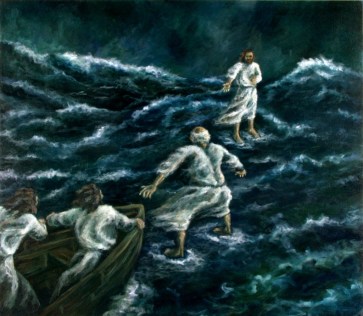
This is an issue that is not just about doing signs and wonders and miracles but about living the life of Christ. I have heard Christ-followers on many occasions reject the notion that they can overcome the issues in their lives and live the life of Christ, because Jesus was God and they are not. They say, “Come on, man! Jesus walked on water!” But, so did Peter (if only for a few steps). Jesus also took a boat on every other occasion he was on the water.
My conclusion is that Jesus, fully the Son of God, chose to walk fully as a man while on this earth. Now, I still see Jesus’s great advantage: he was pure, without sin and therefore had no obstacles in his relationship and communication with God. He was a perfectly clean vessel to display the Father’s power.
His dedication to the will of his Father was also complete and pure. While we are forgiven, I believe our sin and the distractions in our lives create limits to our relationship and communication with God. Jesus, even as a man, was absolutely one with God’s Spirit who guided him and directed him and empowered him. Though he had his own will, he always chose God the Father’s will and faithfully completed the mission for God’s glory and our salvation.
The only difference we have is that while Jesus was sinless, we are sinners – forgiven, but still sinners. We still have God’s Spirit to guide, direct, and empower us to do what Jesus did and to, collectively as his body and possibly even as individuals, do as Jesus declared, even greater things!
I will honestly concede that I do not know any of this with complete certainty. There are many Christians much more studied than I am who believe that the Gospels show Jesus while on earth as fully God and fully man. They believe Jesus chose on occasion to exercise His divine abilities while choosing on other occasions to exercise self-imposed limits as a Human Being. Who am I to say that they are wrong?
My faith, belief, and trust in the saving work of Jesus Christ does not waver based upon whether I know the true mix of God and man that Jesus was when he walked the earth. My continued walk in following Christ is predicated on the truth, reality, and knowledge of his Word and who he has proven to be in my life. I fully expect that my knowledge of who he is will only continue to grow as long as I continue to seek after the Son of God who came down to say as a man, “Follow me.”
I welcome any honest comments and discussion on this topic that we may collectively grow in our knowledge and understanding of our Savior.
 Tucked In and Lamps Burning