 With all that Mud, what do we really KNOW? Part II
“When He had said these things, He spat on the ground and made clay (mud) with the saliva; and He anointed the eyes of the blind man with the clay (mud).” – John 9: 6-7
Continued from the Blog Post of 9/26/2018. In this post we further explore the question – “What do each one of us really know about God? What is it I really know of Jesus?”
Lets look at the episode in John Chapter 9 – The Mud Healing from the standpoint of what is KNOWN or UNKOWN
John chapter 9 opens with Jesus passing by a man who was blind from birth. His disciples asked Jesus, “Rabbi, who sinned, this man or his parents, that he was born blind?” The Disciples understood the common knowledge that someone in the family must have sinned resulting in this man being born blind. In this culture the family’s name was MUD, being stigmatized by guilt and shame for some unknown failure.
Jesus answered, “Neither this man nor his parents sinned, but that the works of God should be revealed in him.” Jesus is responding to the disciple’s question and correcting the record. He is the Rabbi making things known by teaching.
The story continued, “After he answered, Jesus spat on the ground and made clay (mud) with the saliva and He anointed the eyes of the blind man with the clay (mud).
(note: One of the unique elements about this recorded healing episode is that of the 25 or so recorded healings, this is the only one where Jesus is not solicited or that Jesus does not make his intentions KNOWN)
Jesus hocks a loogie (spits):
In the Gospels, Jesus chose to heal in many different ways. On one occasion Jesus spit right into a blind man’s face. On another occasion Jesus gave a deaf man what I believe to be the first recorded “wet-willy” (A prank whereby a saliva-moistened finger is inserted into an unsuspecting person’s ear). The same man was also mute and Jesus spit on his own finger and touched the man’s tongue. (Can you imagine trying that one today?) However, on this particular occasion, Jesus decided to spit on the ground, make mud and wipe an application of mud over the unsuspecting blind man’s eyes.
What is with Jesus and spitting?
In some cultures at the time, spitting on oneself was done to ward off evil. However, generally, to be spat upon by another was a show of great offense and contempt. The Sanhedrin spat in Jesus’ face as a sign of complete disgust.
However, the people of that day also had a high view of saliva’s healing properties. So, many conclude that Jesus’ saliva as Son of God had unique healing properties. Others conclude that Jesus used spit to communicate His intention to heal. Or, Jesus recognized this spiritual need for increased faith and offered a physical action as a means of raising people’s expectations and focusing their faith. No one really knows for sure why Jesus chose to spit as a source of healing.
Jesus not only spits but made mud. Why?
The Greek word used here for clay is Pelos which is also recognized as the thick clay potters use and referred to as mud (wet clay).
Some believe that, symbolically, Jesus’ use of mud in John 9 was meant to parallel God’s original creation of man. He used the “dust of the ground” to give the man born blind new sight. Once again, we don’t really know what the mud was for.
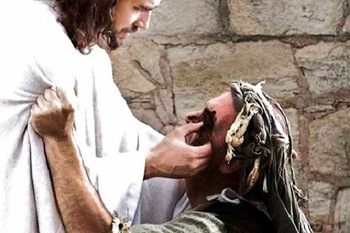 Another interesting word used is “anointed”. It is from the Greek word is Epichrio which means to spread on, to anoint anything upon anything. The word typically meant that the anointing material was generously applied. The Yiddish equivalent is the word SCHMEAR – to spread thickly. When you go to a Jewish deli and ask for a schmear of cream cheese on your bagel, it’s typically a very thick application. (To the point I often will scrape most of it off) As an example we find in John 12:3 that Mary took a pound of very costly oil to anoint the feet of Jesus. This was a very generous application.
So, my take on this scene is that Jesus didn’t just lightly brush wet dirt on the blind man’s eyes but “schmeared” a thick, wet clay across his eyes.
Why are you making my life even more difficult, Jesus?
The episode continues with Jesus instructing the blind man, “Go, wash in the pool of Siloam.” From the blind man’s perspective, I can only imagine what He is thinking. He is sitting there minding his own business when a group comes up and starts talking about him and his family’s sin. Then, without telling him what he is doing, Jesus makes mud, smears it on his face and tells him to struggle his way to the pool and wash it off. The blind man must be thinking, Oh, thank you very much! As if my life isn’t difficult enough? Why are these people torturing me?
But, the man then dutifully washes and comes back – seeing!
So, what was the purpose of the process Jesus used? Jesus, with just a word or a wave of his hand, or a touch could have healed the man. Why go through all this?
My belief is that Jesus’ purpose was less symbolic and less about making a healing concoction and a little more ordinary in its purpose – it was to facilitate uncertainty even division by making something less KNOWN.
I have my own theory as to why and I’ll conclude this study in a future post.
One last comment: With regards to Jesus making the blind man’s life more difficult before being healed – How often do we complain of difficulty in our lives when we don’t know what God is up to? We cry out, Why me? Yet, He promises in Romans 8:28, “And we know that all things work together for good to those who love God, to those who are the called according to His purpose.” Do we trust that even when mud is slung in our face or even as our name and reputation is being dragged through the mud – while the spit and dirt is still dripping down our cheeks, God has a powerful healing in store?
Do we, as James encourages, Count it all joy? Let’s try that one today.
 Tucked In and Lamps Burning