“Caatooo, This Is Not The Time!” . . . “Now Is The Time!”

“If we live by the Spirit, let us also keep in step with the Spirit.” – Galatians 5:25

There is Nothing Quite Like a Good Laugh!
Dmaom6lU4AA_pgIOnly on two occasions in my life can I remember experiencing what I would call a gut-wrenching, roll-on-the-floor, can’t-stop, belly laugh. It’s actually painful and exhausting but so good.

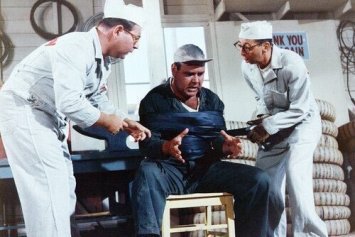
The first one was from watching Jonathan Winters’ Gas Station destruction scene in ITS A MAD MAD MAD MAD WORLD. Wow! (You can guess that I grew up on a steady diet of 3 Stooges)

The other one is from the Pink Panther movies, when Inspector Clouseau would be attacked by his Chinese manservant, Cato (totally un-PC). In order to keep the Inspector’s fighting skills honed, at the most unsuspecting and inopportune times, Cato would spring from a hidden space screaming, “Saaaaaaaaaah” to attack Clouseau. The ensuing fights were long and vicious, as well as destructive to the furniture, and always interrupted by the telephone ringing, at which point they would become civil again. I think on one viewing I may have split the proverbial gut.
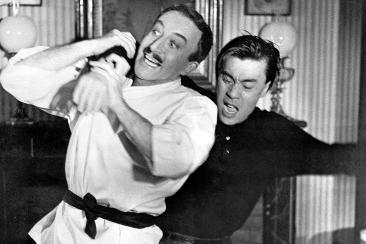
-methode-times-prod-web-bin-aef8f44a-21ba-11e6-840f-4c4661f34181One of the infamous lines amid the ensuing martial arts battle would be Clouseau screaming, “Caatooo, This Is Not the Time!” followed by, “Now Is the Time!”
Of course, Clouseau’s screaming, “Caatooo, This Is Not the Time!” was his way of breaking Cato’s advantage. When Cato would stop, Clouseau would immediately scream, “Now is the time!” to gain the fighting advantage.
This is a line that is very recognizable to my family and often repeated amid some family hijinks.

Wait. Is There a Spiritual Application?
The quote makes me think of Ecclesiastes 3:1 – “There is a time for everything, and a season for every activity under the heavens:” Ecc 3 includes in Verse 4 – “a time to weep and a time to laugh,” as well as Verse 8 – “a time to love and a time to hate, a time for war and a time for peace.” Of course, the writer is indicating that there is not just any time for these things but certain or appropriate or appointed times for each of these things.

Keeping in Step with the Spirit – Now is Not the Time!
In Galatians 5:25 Paul writes, “If we live by the Spirit, let us also keep in step with the Spirit.”
What is Paul saying when he wrote to keep in step with the Spirit? He is saying 1. Don’t get ahead of the Spirit’s pace (Now is not the time) and 2. Don’t lag behind (Now is the time) – be right in step.

According to the Bible God is perfect in all ways. In Matthew 5:48 Jesus declares – “. . . your heavenly Father is perfect.” And the Psalmist concurs writing in Psalm 18:30 “This God—his way is perfect;” If God is perfect and His way is perfect then His timing is perfect. Are we “living by the Spirit” by actively listening for His voice and being quick to act accordingly?

The Spiritual Discipline of SILENCE
There was an episode at a church meeting where I was advocating for something and another leader shut me down. I felt attacked and belittled with my character and good intentions besmirched. (How dare anyone question my inherent goodness?) In my flesh, I felt I had every right to respond and defend myself. In fact, many people would say that I must. But, at the time I heard God say (Though not in a goofy French accent) “Now is not the time.”

So, I obeyed and exercised the Spiritual Discipline of SILENCE. This Spiritual Discipline includes restricting your speech by not acting on the impulse to righteously defend yourself but to pray and trusting that God will step in. Exodus 14:14 says, “The Lord will fight for you; you need only to be still/silent.” We don’t always see the results of exercising Spiritual Disciplines but in this case, God clearly stepped in and spoke in unison to several leaders. What I was advocating for was implemented in a different way but with wonderful Kingdom results without me ever saying another word. (Soooo good when God does it!)
When I am feeling angry or frustrated, are these not legitimate feelings? Yes, but when I’m tempted to act out on them in an “It’s all about me” way I can often hear a voice saying, “Daaaviiiid, This Is Not the Time!”
This has happened many times in my life when I want to debate a point, confront a situation, or write an email or text response to something that has riled me. It’s often a knee-jerk response to defend myself or inject righteous judgment. God steps in to say, Take the time to meditate on what I would have you say or do.
When keeping in step with the Spirit we need only go back several verses in Galatians 5:22-23 – The Fruit of the Spirit as our guide for how we act and talk. Which for me is not always my initial inclination.
When I can remove any self-righteousness, and speak and act in God’s righteousness reflecting the full Fruit of the Spirit, I can hear God say, “Now is the time.”

There is No Time for That!
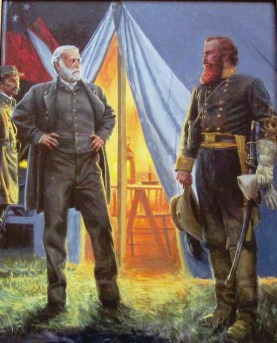
tempImage9Lkb04This brings to mind another powerful line in a similar vein from the movie, Gettysburg. There is a scene where General Robert E Lee confronts Maj. Gen. J.E.B. Stuart. Stuart has been gallivanting over the Pennsylvania countryside with his cavalry making headlines but not reporting back to Lee with critical intelligence on the Union troops. When Lee expresses his and others’ disappointment in him, Stuart wants to defend his honor and then offers to resign. The usually soft-spoken Lee yells, “There is no time for that!”
The application is that when facing the battle there is no time or energy to waste focusing on ourselves – soothing our egos or being sidetracked by being personally offended.
There have been occasions when I’ve been offended and inclined to retreat. But, on those occasions when I’ve taken those feelings to God I’ve heard him say, “Is my love and appreciation for you not enough? I’ve got so much for you to do. There is no time for self-pity and self-loathing. Let’s get back to doing what I’ve designed for you to do. Now is the time.”

Keeping in Step with the Spirit – Now is the Time!
I believe that God is speaking and more often than calling out “Now is not the time!” God is prompting us with, “Now is the time!” Are we listening? When we hear God speaking or giving instructions, do we act?
Pastor Jeremy of my home church recently spoke on responding to God’s prompting and being willing to get out of the boat and take risks. Hebrews 11:6 says, “But without faith it is impossible to please Him”. The writer is saying that God loves those who by His prompting are willing to step into the unknown. Why? Because they trust God that much.
Are we willing to put aside our agenda for the day or for a time to act on a prompting from God – to pay a visit, write a note, or meet a need? Now is the time. Often, I’ll tell myself I will act on it later but I miss the moment.
James writes, Show me your faith without your works, and I will show you my faith by my works. The works James is referring to are not just working harder at a job but the acts we perform in response to God’s prompting. They are tangible evidence of our faith.

Inspector Jesus Clouseau
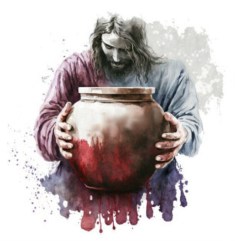
il_1588xN.4459334921_qineEven Jesus had somewhat of an Inspector Clouseau experience in the second chapter of John’s Gospel. Mary solicits Jesus to perform a miracle by providing a wedding party with more wine. Jesus declared, “Woman, my hour has not yet come.” Or, in other words, “Now is not the time!” I can reasonably conclude that Jesus (who declared in John 5:19 that He only does what He sees/discerns the Father reveals for Him to do), asked His Heavenly Father, “Is now the time?” His Father then confirmed, “Now is the time!” Based on that confirmation, Jesus complied with Mary’s request to perform His first public miracle. It was not in Mary’s time, not even in Jesus’ time but in the Father’s time.

Let’s remind ourselves that Now is not the time to focus on ourselves but Now is the time to listen and act on God’s prompting for the interests of others. Philippians 2:4 – “Let each of you look out not only for his own interests, but also for the interests of others.”


“Now is the time!” for Gloria
A little over a year ago Don Treash went to be with our King in glory. I couldn’t think then of many who exhibit the full Fruit of the Spirit as Don did so well. Certainly, one would be the perfect partner in their Ekbasis (Good Finish), Gloria. Last Saturday she joined Don to be with their King in Glory.
A few days before she passed she was, as far as I know, healthy and actively loving like Jesus to those around her. Our Group was on a Zoom call with her being in good health the night before she fell ill. But in the Father’s perfection, the next day He said, “Now is the Time.”
So, today I want to take this time to remember and honor our beloved leaders of our Community Group – teachers, friends, mentors, and their wonderful Ekbasis – how Gloria, like her partner Don led their lives right up through to a good finish. We will always love and cherish you for your loving kindness and for leading us into a deeper knowledge of God.
Our Community Group which they led for so many years rejoices in their reunion in Heaven and their union with our loving King.
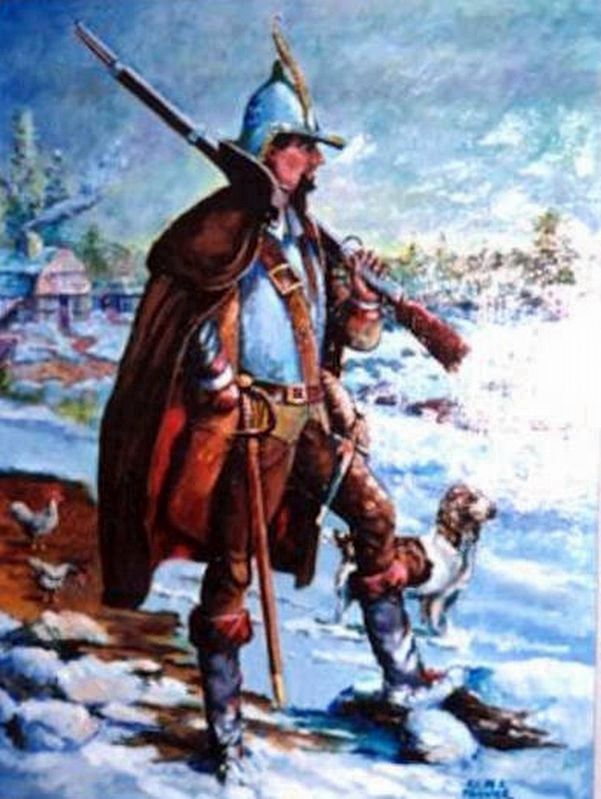
Captain John Underhill – American Centurion of Faith (or Genocidal Mercenary?)

Photo566047“The God of my strength, in whom I will trust; my shield and the horn of my salvation, my stronghold and my refuge; my Savior, You save me from violence. I will call upon the LORD, who is worthy to be praised; so shall I be saved from my enemies.” – 2 Samuel 22:3-4

JUST RELEASED: BLOCK ISLAND BECKONS

I have just released my newest novel – Part IV in the Block Island Settlement Series: BLOCK ISLAND BECKONS. One of the key figures in the series is Captain John Underhill (1608-1672). For decades Underhill had been revered as a devoted Christian and a great protector of the European migrants to America. In more recent years his actions have come under scrutiny and his legacy has become controversial. Based upon my study of the man, I like to believe the historical record shows I have portrayed him in a fair and accurate fashion.

Below is Appendix C from the book providing my perspective on Captain John Underhill.


Perspective on Captain John Underhill

Over the years, Captain John Underhill has been either revered as a heroic early American protector of European settlers or reviled as a cruel, barbaric, genocidal mercenary who heartlessly murdered thousands of Native Americans. 

What’s the Truth?

After reviewing all I could find on Underhill’s life I have concluded that the latter is far from the truth. John Underhill was a God-fearing man with strong faith and moral convictions who acknowledged his own moral failings. He had been a follower of Anne Hutchinson who defended the rights of the Natives, believed in a Gospel of Grace, and was a champion of religious freedom.

Underhill was hired and brought to America to provide security for a Puritan people whose charter was to “lovingly win the American Natives to Faith in Jesus Christ”. The civilians he commanded were not soldiers but “artisans, farmers, and city-dwellers”[1] who were required to serve in the local militia for the protection of the colony. They had no desire to take land through war and bloodshed. If the Natives claimed land ownership, the Puritans were legally required to negotiate the purchase. (a law certainly not always adhered to)

Many misrepresent the wars with the Indians as simply land grabs. The fact is that Underhill and his men were not instigators but those who responded as protectors of their people. Most historians agree that of all the causes of the Pequot War, English land encroachment seems unlikely. Instead, the primary causes of the Pequot War were aggressive conduct by both the Pequot and English, and control of regional trade.

Certainly, the English and Dutch leaders were not blameless. Far from it. Their foolish and reckless decisions, dirty dealings, and lack of honor and respect towards the Natives often drove the Natives to react with violence. Underhill and the militia were the ones left with the task of providing protection for what their leaders had instigated.

“It was tragedy that the blunders of an incompetent administrator gave rise to a situation that had goaded the usually peaceful Algonquins beyond endurance. One’s sympathy is un-questionably with the red men (written in 1964) as we look across the years. But to the innocent victims of the inadequacy of Company government – the Dutch and English settlers within reach of the embittered tribesman – the immediate danger was very real. The terrible scourge of Indian warfare was sweeping the land and the successes of the allied tribes up to that point could well have meant the extinction of all settlements in New Netherland. If that happened, the fury of arrow and tomahawk might well have descended once more on New England.”[2]

War is ugly and though we may try to put some humane parameters around the bloodshed, it often devolves into increasingly ugly exchanges. Once an atrocity is committed to a comrade or to a family, the kid gloves are off and the atrocities escalate. So, it is in Ukraine as of this writing and so it was in the early American Indian wars. The Pequot War was an extremely violent war with horrific atrocities committed on both sides. Where did it start? Where would the vengeance end?

Numerous historical records indicate that the Pequot nation was the regional bully at that time. They would impose their will on the neighboring Native tribes by violent force, often brutalizing and enslaving their enemies. Other tribes actually welcomed peaceful Europeans into their lands to act as a buffer against the Pequot’s terrorism.

“The Pequot tribe were the most feared of all the savage nations in New England, a “fierce and powerful” people, a terror to other Indians as well as to the white settlers.”[3]

The Connecticut Court in Hartford met in May of 1637 to consider their circumstances. The Condition was described as “. . . very Sad, for those Pequots were a great people, being strongly fortified, cruel, warlike, munitioned, and the English but a handful in comparison: But their outrageous violence against the English, having murdered about thirty of them, their great pride and insolency, constant pursuit in their malicious Courses, with their engaging other Indians in their quarrel against the English.”[4]

Underhill describes the Pequots compared to his soldiers as, “that insolent and barbarous Nation, called the Pequeats, whom by the sword of the Lord, and a few feeble instruments, souldiers not accustomed to warre,” were drove out of their Countrey

Underhill goes on to describe the Pequots at the time, “so insolent were these wicked imps growne, that like the divell their commander, they runne up and downe as roaring Lyons, compassing all corners of the Countrey for a prey, seeking whom they might devoure: It being death to them for to rest without some wicked imployment or other, they still plotted how they might wickedly attempt some bloody enterprise upon our poore native Countreymen.”

Even Roger Williams, certainly a man of peace who had spent his life advocating for and even living amongst Natives, wrote to John Mason detailing his attempt to negotiate peace with the Pequots. He wrote, “Three days and nights my business forced me to lodge and mix with the bloody Pequot Ambassadors, whose hands and arms reeked with the blood of my countrymen, murdered and massacred by them on Connecticut river, and from whom I could not but nightly look for their bloody knives at my throat also.”[5]

Before the Mystic Massacre, there were numerous efforts to negotiate peace. Governor of Massachusetts, Harry Vane wrote to the Governor of Connecticut, John Winthrop Jr. to be included in a negotiated peace. “Demanding a solemn meeting for conference with them in a friendly manner about matters of importance.” Promising, “We shall not refuse to harken to any reasonable proposition from them for confirmation of the peace betwixt us.”[6]

Underhill describes his desire for leniency and negotiated peace but the Pequots would have none of it. Underhill writes, “This insolent Nation, seeing wee had used much Lenitie towards them, and themselves not able to make good use of our patience, set upon a course of greater insolencie then before, and slew all they found in their way.”[7]

John Endicott had raided the Pequots a year before the Mystic massacre and stirred up the Natives to provoke an Indian war leaving the English settlers to deal with the Pequot’s violent retribution. Underhill understood that the Puritans did not have the means to police and provide security to those countrymen in the area. If the Pequot’s would not entertain a peaceful solution then it was determined that they had to be fully subdued. It is a sad commentary on the human condition. Nothing new. Wars over possessions, politics, religion, and even for the purpose of establishing peace going on since the fall of creation.

Still, Underhill expressed his sadness with the result of the Massacre. “Great and dole-full was the bloudy sight to the view of young souldiers that never had beene in Warre, to see so many soules lie gasping on the ground so thicke in some places, that you could hardly passe along. It may bee demanded, Why should you be so furious (as some have said) should not Christians have more mercy and compassion?”

The documented atrocities of the English visited upon the Pequots were not traditionally the way of the English Puritans as recorded by Underhill but were an ugly response to the evils perpetrated on their people, “but yet you shall see it is not the nature of English men to deale like Heathens, to requite evill for evill,”[8] There are several accounts where Englishmen were perpetrating torture on Natives but Underhill intervened to reprimand and put an end to the cruelty.

Underhill became known as “The Indian Fighter”. I doubt that was a moniker he embraced. In his NEWS FROM AMERICA, he simply refers to himself as John Underhill, Captain of Militia, Massachusetts Bay Colony. He was hired by the English and later by the Dutch as a military leader to provide protection to the Settlers.

In later years, he was viewed with great respect across the Tribal Nations. Once settled on Long Island, he defended the Matinecock Tribe against those who had illegally taken their land. “the contention that the Hempstead settlers had invaded the rights of the Matinecocks by depriving them of their land without compensation. Probably because of his authoritative position in local affairs and the undoubted respect they bore of the man himself (Underhill), the Indians turned to him as their legal spokesman. The Captain pleaded their rights, was their champion in the Court of Assizes, the high court of Yorkshire, and won a clear-cut victory on their behalf.”[9]

In fact, during the Dutch Indian War the Natives went to Underhill to broker peace. “a group of chiefs from present Westchester and Dutchess counties went to Stamford “asking Capt Onderhil to apply to the Governor of New Netherland for peace.”[10]

The Pequot War by Alfred A. Cave provides compelling arguments that the Native Americans were purely victims of European bigotry and aggression. It is one of a number of more recent studies that try to set the record straight from the Native American perspective.

While the case is irrefutable that the Natives already occupied the land, and had first rights, they often had no problem trading for land believing that available land was vast and endless with more than enough to share. As we all know, the Natives were eventually either subjugated or relegated to something less than 2nd class citizens. The cultural differences and abuses were too great, leaving many with the only option for survival but to move West.

Unfortunately, in my opinion, these attempts to set the record straight often end up sanctifying one side of the story, while completely demonizing the other side. As with most arguments, the truth lies somewhere in the middle.

Charles Orr highlights a quote from John Fisk as if anticipating future revisionist history. “John Fisk in his Beginnings of New England, says, writing of the overthrow of the Pequots and its importance in the planting of New England: “As a matter of practical policy the annihilation of the Pequots can be condemned only by those who read history so incorrectly as to suppose that savages, whose business is to torture and slay, can always be dealt with according to the methods to be used between civilized peoples.””[11]

The corrupt means of man that we find within every society and people group can often be turned into something good. Somehow the abuses to Native and African tribal people in America has eventually led to a nation offering greater freedom and opportunity to more people of all persuasions than any other nation on this planet. It does not justify the evil but does mean there can be some justice in this world.

Have we really morally “evolved” to be better people today? Are we able to pass judgment on those in the past who sincerely tried to do their duty to protect their people under the most tenuous circumstances? Jesus declared, “Judge not lest you be judged.” One thing I know for certain is that anyone today who would judge someone like John Underhill but entertains the threat or use of violence to attain what they deem to be a “righteous” cause is no better person.

We say, Let history be the judge! But often the historical record and the people of history are too complicated for us to pass judgment upon. Ours is an imperfect society with deep flaws and historically shameful acts of injustice but with core values that cause us to continue to face and address those injustices. We are best to honor most ancestors for their good and learn from them for their bad. In our society today, we have much to be grateful for and much to learn from the life of Captain John Underhill.


Screenshot 2023-01-22 at 7.02.25 PMIf you are interested in learning more about early American Christian history or just looking for an entertaining read with action, adventure, and intrigue, give this series a try.

Check out the first three books in the Block Island Settlement Series:
1. The Battle of Mohegan Bluffs
2. The Fate of Captain John Oldham
3. Puritan Retribution and Manisses Destiny

You can find this book in Paperback or Ebook available on Amazon at:
https://www.amazon.com/gp/product/B0BSSLWJT3/ref=ox_sc_act_image_1?smid=A1Y53T3O3Q25L8&psc=1


[1]Captain John Underhill, Gentleman * Soldier of Fortune, L. E. & Anne DeForest, DeForest Publishing Co. NY, NY 1934, Page 7

[2] Captain John Underhill and Long Island by Myron H Luke, The Nassau County Historical Society Journal, 1964, Page 3

[3]Captain John Underhill, Gentleman * Soldier of Fortune, L. E. & Anne DeForest, DeForest Publishing Co. NY, NY 1934, Page 14

[4] History of the Pequot War, Charles Orr, page 25

[5] History of the Pequot War, Charles Orr, Published by Pantianos Classics, 1897, Pages 19-20

[6] History of the Pequot War, Pages 75-76

[7] Newes from America, John Underhill, Captain of Militia, Massachusetts Bay Colony, 1638, Pages 1-2, 13-14

[8] Newes from America, John Underhill, Captain of Militia, Massachusetts Bay Colony, 1638, Pages 35, 37-38

[9] Captain John Underhill and Long Island by Myron H Luke, The Nassau County Historical Society Journal, 1964, Page 9

[10] Captain John Underhill, Gentleman * Soldier of Fortune, L. E. & Anne DeForest, DeForest Publishing Co. NY, NY 1934, Page 58

[11] History of the Pequot War by Charles Orr, Published by Pantianos Classics, 1897, Page xii