“There is neither Jew nor Greek, there is neither slave nor free, there is neither male nor female; for you are all one in Christ Jesus.” – Galatians 3:28
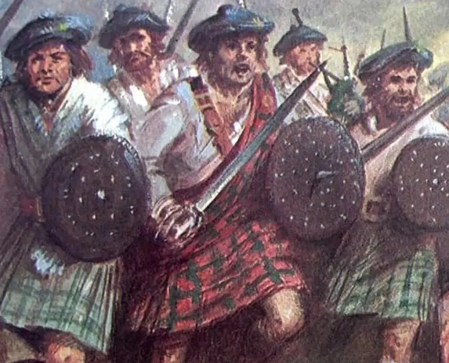 The English Civil War of the 1650s once again pitted 2 Christian groups against one another. Cromwell’s New Model Army under the Anglican Church of England invaded Presbyterian Scotland. While the battle was not really about religious differences, it is another example of Christ-followers ignoring the Biblical call to oneness established by the Unity of the Spirit found in Ephesians 4:3 – “endeavoring to keep the unity of the Spirit in the bond of peace.”
However, for the people of Block Island, it was a fateful encounter. These Scottish Highlanders fought, were captured, marched a death march to Durham Castle, survived the starvation and squaller, to be put on the ship named “John and Sarah” for the hellish 2-3 months at sea sailing to the American Colonies. There they worked off their 7-8 years of servitude in the ironworks of Massachusetts. A number of these men played a key role in the settlement of Block Island. Below is my fictional account of their fight, capture, and survival from my latest novel – Block Island Brotherhoods.
Chapter 7 – Scotland – September 1650
Robert Guthrie and Henry Merrow looked out over the rolling hills of the Highlands, illuminated by the bright full moon. They stood as close to the small fire as possible, holding their hands out and allowing the heat to rise under their tartan kilts to warm their bodies. Both twenty-five years of age, they were the older and more experienced of their small unit.
Robert looked over his shoulder at the young soldiers lying on the ground behind them. “Aye, the laddies sleep like babes withoot a care.”
“I guess it’s an advantage not ta know what lies ahead in war. True, such babes. Look at young Will Mackintosh. He’s no more than sixteen, and the others canna be much older.”
“I’d venture William Colquhoun be seventeen, and Alexander Innes, James Danielson, and Duncan MacWilliams no more than eighteen.”
“The better question is, kin they fight? We’ve stayed mainly ahint the strong fortifications in and around Edinburgh for so long. I dinna know if they can even fight.”
“Aye, I’d say that Thormut Rose is at least twenty. He has fight. Yoo know his skill wi’ the Lochaber ax?”
“The lad has forearms like thighs ae a bull, twirling the ax like it be a stick. Aye, I think we have another Donald ‘Black Taylor o’ the Ax’ tearin’ up the clan Mackintosh at Bun Garbhain.”
“Well, we can rest up here on Doon Hill. It’s good high ground looking down upon Dunbar and the Berwick Rood. Our David Leslie has given no place for Cromwell to escape back ta England. We have him trapped. Charles the Second, King o’ Scotland will soon be back on the throne.”
“Aye, but did yoo not hear?”
“Naw, what?”
“We are ta attack. Leslie plans ta bring our forces down from Doon Hill and approach the town, ta secure the road south over the Spott Burn, and prepare ta attack Cromwell’s encampment.”
“Down from this lovely ground? Naw!” Guthrie quickly turned to climb out of the small gulley on the high ground where they camped. He surveyed the terrain and then returned, announcing, “Our men are moving. I dinna know what Cromwell can see, but I see our main body wedged between the deep ditch of the Spott Burn and the slopes o’ the Lammermuirs behind them. If Cromwell realizes his opportunity, our laddies will be trapped.”
“Aye, but our orders are ta hold the right flank. That is all I know.”
“But we are thin here. If Cromwell makes a push against our right while they’re in the ditch, we’ll roll back, and they’ll be done.”
Merrow held up his hand. “Quiet. Can yoo hear some movement down near the Berwick Rood?”
“Aye, Henry. We best get the laddies’ arses up. It is near daybreak, and if they’ve seen our main body moving, then if Cromwell’s officers are as smart as they seem, they’ll be makin’ a charge soon.”
~~~
Thormut Rose looked across the thin line of his Highlander countrymen. The right flank of the Covenanters was ready. The sun was just breaking over the eastern hills when the large body of English soldiers stepped forward into the open. Thormut squeezed the handle of his Lochaber ax as he raised it in front of him. He ran his hand over his precious partner in war.
The ax’s six-foot-long wooden handle was rubbed smooth, except for the notches carved from previous exchanges. The sharp iron spike on the end had proven to be most effective at close combat in a thrusting motion. The long ax head on the side, coupled with the pole, delivered a powerfully deep, gashing blow. The razor-sharp edge of the rounded blade could slice right through a man’s torso, if not for the thick wooden handle preventing its progress. He rubbed the curved hook on the backside. It served well for scaling walls and provided for his favorite pastime, hooking cavalry off their horses. I hate the cavalry, He mused.
Thormut looked past his ax to see that Cromwell had quietly moved a large contingent of his men to the right flank, and their numbers kept growing. The young Highlanders along their flank began raising their long pikes and nervously looked at one another.
The English movement was slow and methodical as they fell into lines. An order was called out, and suddenly the air cracked open with their battle cry, “The Lord of Hosts!” The English began charging up the hill like a swarm of white and red ants.
“Courage, lads!” Robert Guthrie called out. “Close ranks! These are not Highlanders. By the time they climb Doon Hill, they’ll be gaspin’ and beggin’ ta be run through wi’ yer pikes!”
The English reached the Scottish line. The Highlanders’ long pikes poked and stabbed the English, keeping them at bay, as their lines collided and bunched up. The fallen wounded bottled them up further, but a few broke through the Scottish ranks.
Guthrie screamed, “Hold the line, laddies!”
Thormut stood behind his countrymen with their pikes. As Englishmen broke through the line, he jumped forward to quickly dismiss them with a thrust or one swing of his ax. The English white uniforms piled around them. Slowly, the Scottish line on either side was pushed back under the weight of superior English numbers until its lines started to break. The numbers of the English reaching the Scottish line grew to a crushing wave, and the ranks of their countrymen on either side disintegrated.
Guthrie and Merrow continued to yell at the young Highlanders, “Fight and hold your ground!” The Englishmen in front of them began to fall back and sweep around them through the open lines on either side. The small troop found itself on an island. They looked around as the fighting stopped for a moment. But suddenly, the ground began to rumble, and the loud sound of thunder approached from below them.
Thormut jumped up with his kinsmen to the front line to see the wave of stomping horseflesh and riders charging up Doon Hill. He turned the handle of his Lochaber ax around in his hand and hissed through his teeth, “Cavalry.”
Guthrie called out, “Gather up ta a closed formation, laddies!”
The men circled together, with their long pikes protruding from the center. Thormut readied his ax hook. The English cavalry raced around them as the pikes lanced riders and horses. Thormut pulled down rider after rider with his hook and, once down, swiftly sliced them open with his ax.
He looked over and saw Guthrie knocked down by a horse, losing his weapon. While he was getting back up, another rider drew his sword down upon him. Thormut Rose leaped over and swung his ax hook, hooking the rider’s armor and jerking him off his horse to the ground. He then swung the ax around and buried it into the downed rider’s neck. He turned to help Guthrie up and saw him holding his abdomen, with blood dripping through his fingers.
Thormut turned back around and stood in front of Guthrie, swinging his ax, with Englishmen stacking up around them. The Highlanders’ numbers were dwindling, and soon the English army and cavalry surrounded them.
Guthrie called out to his men, “It is finished, lads. Throo dun yer weapons.”
The Highlanders dropped their pikes and swords. Thormut Rose reluctantly dropped his bloodied ax and looked at those who were still alive. Robert Guthrie was on the ground, struggling to sit up. Henry Merrow stood beside him, bleeding from many wounds. The others left were not men but boys, covered in blood—young Will Mackintosh, William Colquhoun, Alexander Innes, Duncan MacWilliams, and James Danielson.
They had stood their ground while the rest of the Scottish right flank had retreated. Thormut looked to the north and over to the center of their lines. The main body of the Scottish army, hopelessly wedged between the Brox Burn and Doon Hill, broke rank, and it too was scattered.
Robert Guthrie sat on the ground, holding his bleeding abdomen. He called to his men, “T’was a good fight. Yoo fought valiantly, laddies. Whatever yoo do now, fight ta stay together. We dinna have another hope ta survive!”
~~~
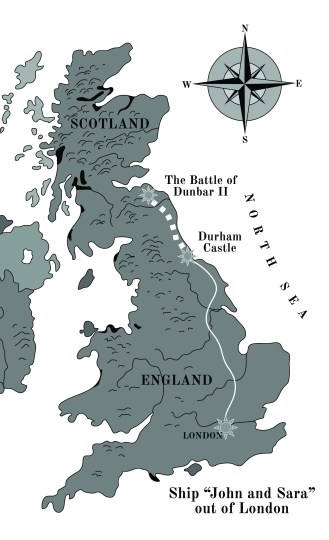 Guthrie’s men huddled together on the cold, dank floor of Durham Cathedral. It had been several weeks since thousands of Scottish soldiers were forced on a death-march south toward England, to prevent any attempt by the Scots to rescue them. No food or water was given. The wounded, ill, and starving who collapsed along the way were beaten, stabbed, and left to die. Robert was grateful—his men carried him and Henry Merrow, caring for them as best they could.
Now, in the dark, dank cathedral, there was little food or water to be had. The prisoners were left to scavenge for themselves or trade anything they could find with the guards for their pottage.
Guthrie’s men had established a spot in a corner of the church as their territory. Robert lay on the cold stone floors. He spoke in a whisper to Merrow as his friend tended to his abdomen wound. “Henry, I heard say that some five thousand were captured at Dunbar. Look at this church—I don’t see more than fifteen hundred still alive. Those left are fighting each other to survive. All the wood is burned, and nothing remains to trade for food. We must hang t’gether if we will make it out alive.”
Merrow asked, “Whit kin we do?”
Guthrie called his young Highlanders together, and they came around him. “Where’s Thormut?”
The others shrugged their shoulders and shook their heads.
“Well, laddies, if the jailors are ta show any compassion and bring another few buckets o’ mush and water, yoo must work t’gether—not fight for yourselves but work t’gether.”
The lads all nodded their heads. “But how?” Merrow asked.
“Well, when they wheel in the buckets, young Will should go straight for a bucket, while the rest o’ yoo lads fight the others off and protect Will ’til he comes back ta our corner.” He nodded his head. “We must survive lads, so that we may make a new life for wherever they send us.”
Will Mackintosh’s lip quivered, and he dropped his head. “Should we never return ta the lovely highlands of Scotland?”
“No, lad. They may let us live, but truth be told, they will ne’er let us see our Highlands agin. They have begun ta take men away, and the word is that they are being put on ships. We must hold on, and keep our strength, and trust in the Lord o’ Hosts ta sustain us.” He looked at the dirty, sullen faces of the boys standing around him. “Aye, cheer up, lads. We have each other, and if we stay t’gether, we can make our way oot o’ this prison and make a life in the colonies.”
Thormut Rose walked over to their corner, looking even grimier and dirtier than the rest of them. Guthrie called to him, “Thormut, where have yoo been? Have yoo found anything for trade?”
With his lips tightly pursed, Thormut shook his head and held out empty hands. The others sighed, and their shoulders drooped.
Guthrie sighed, “Aye, that is disappointing.”
Thormut grunted. The men turned to him. He looked around to make certain no one else was watching. The young ax-man squatted down and spit something out into his hands. He smiled. They all looked more closely as Thormut opened his hands to reveal several bejeweled gold rings and a gold chain.
Guthrie peered into Thormut’s hands and whispered, “Glory ta God.” They all looked at Thormut as Guthrie asked, “Where did yoo find this treasure?”
“Aye. Crawling through the catacombs, there was a hidden tomb still unopened. I pried it open and the resident jist gave it all up withoot a fight.”
“Aye.” Guthrie chuckled. “Thormut, yoo saved ma arse once, and I do believe you’ve done it agin.” He turned to the others and encouraged, “Hold on jist a wee bit longer. We must stay t’gether as a Brotherhood. Yoo kin survive this prison, laddies. And the colonies kin provide us wi’ a new life.”
The Bible promises that wherever we are and whatever state we are in (even as a slave) we can have freedom and a new life by choosing to follow the living God, Jesus.
Romans 10:9-10 – “that if you confess with your mouth the Lord Jesus and believe in your heart that God has raised Him from the dead, you will be saved. For with the heart one believes unto righteousness, and with the mouth confession is made unto salvation.”
Corinthians 5:17 – “Therefore, if anyone is in Christ, he is a new creation; old things have passed away; behold, all things have become new.”
 Tucked In and Lamps Burning