The Resurrection of Andy

Isaiah 40:31 – But those who wait on the Lord Shall renew their strength; They shall mount up with wings like eagles, They shall run and not be weary, They shall walk and not faint.

1980-muhammad-ali-drew-bundini-brown-001069420.jpgThe fighter stumbles to his corner. With what energy he has left, he spins around and flops into his seat. It’s the early rounds of the fight but there appears to be little left in the tank. The corner team descends on him, cooling his body, checking his hydration, massaging his muscles. In only a whisper, his ring man is in his face trying to penetrate the dead stare with a commanding mix of reassurance, encouragement and challenge. Time is short. The bell will soon ring. Will the fighter answer the bell? My money said, no.

But wait! This is not some stuffy, smoke-filled auditorium with a center ring hosting a boxing match. We are in a sun soaked field of tall, golden billowing grasses in the midst of the Green Mountains of Vermont. This is the Vermont 100, an excruciating endurance race – an ultra-marathon stretching for 100 miles.

Continue reading

Miracles by The Lake II

But, as the announcer says in the cheap TV infomercials – But wait! There’s more!

Isaiah 9:3-5 – You have multiplied the nation. And increased its joy; They rejoice before You According to the joy of harvest, As men rejoice when they divide the spoil. For You have broken the yoke of his burden And the staff of his shoulder, The rod of his oppressor, As in the day of Midian. For every warrior’s sandal from the noisy battle, And garments rolled in blood, Will be used for burning and fuel of fire.

(Continued from the Blog Post of 7/9/2018)

driving with arm raisedThe day after our gathering at the lake, I was up early to drive Chuck and his team to JFK airport. The drive to the airport was a great opportunity for me to pick their brains about how they work the ministry they are in and ways that we can encourage churches in our area to move a little bit further out in their expectation of how God can work.

As we were driving Chuck asked me if there was anything they could pray for me about. I gave it some thought and the lightbulb clicked on.

I had been suffering from a damaged right shoulder resulting from a ski accident. I had gone to several doctors but couldn’t get a definitive answer. They just said it was something that I should rehab with a certain set of exercises. But, the exercises were not working. My range of motion was severely restricted. If I tried to extend my arm in any significant way in any direction, there was a great deal of pain. My sleep was suffering for the pain caused whenever I moved about in bed. Our prayer team had prayed for this on a number of occasions but not resulting in much improvement.

Finally, I had concluded from speaking with others that it was a torn rotator cuff injury. The prayer/supernatural approach had not seemed to work,  so perhaps God wanted to used the medical system to do His healing. I had decided it was time to go to the doctor to investigate having surgery.

Now, with the lightbulb burning brightly above my head, I was taken back to the night before when Chris first asked if there was anyone with an “arm” problem. I guess because I didn’t hear “shoulder” it didn’t register. (I checked this out – the shoulder is most definitely part of the arm). I told the guys about my shoulder and right then and there driving down I95 to JFK they laid their hands on my shoulder.

Continue reading

Miracles by The Lake

Why Does Jesus Keep Shouldering My Burden?

Isaiah 9:4 – For You have broken the yoke of his burden And the staff of his shoulder

It was a Sunday evening in JulyYoke.png. I had learned that my cousin Chuck, along with his team, was ministering at a church not far from us. Chuck serves at a West Coast Church known for operating in the miraculous.

At the time I was serving as the Prayer Director at our conservative East Coast Evangelical church. While God was and is doing amazing things at our church, we have not been all that comfortable with operating in the “sign gifts”. I invited my cousin and his ministry team to stay with us at our house by the lake for a couple of days.

It had been decades since I had seen my cousin and both of us had become Christians along the way. Now, spending time with him and his guys was a real treat. While he stayed at our house, I thought I’d invite our Prayer Team and some like-minded friends to come over and let Chuck and his team minister to us. My intent was to let the team stretch us a bit out of our comfort zone.

After some beautiful worship time down by the lake, Chuck gave a teaching. I expected that they would then start praying over people for physical, emotional and spiritual healings, exercising spiritual gifts that his team was blessed with. But, what they did do was simply call out people who had physical infirmities and then organize groups of us around them to then pray for the issue.

Honestly, I was a little disappointed. I had heard of amazing miracles that God has done through Chuck’s ministry and I wanted to see my cousin in action – slaying people in the spirit, casting out demons, some wild healings and maybe even him taking a stroll across the lake.

One of Chuck’s guys named Chris called over to the area where I was standing and asked, “Is there anyone over there who has a problem with an arm?” We all looked at each other until my friend Bill raised his hand and announced, “I do. I tore up a muscle and now it is all twisted and misshapen.” He exposed his arm and it was obvious that his bicep was not in the right place. With that they asked all of us standing around him to start praying for God to heal Bill’s arm.

So, I’m standing next to Bill and I begin praying with the others. But, as I’m praying I can’t help but feel totally inadequate. Our prayer team had been stretching ourselves to be more expectant about praying for God’s healing and we had recently seen some great results. We had begun to see things happening but here I really wanted to see the “professionals” at work.

All I could think of was that I was the wrong person for the job. I just did not have the faith to see this kind of healing. I mean, really, did I expect to see Bills muscle contort and move right back into place? After we all prayed for a while for Bill, we checked in with him.

Continue reading

Doubting Jesus

Wasn’t it Doubting Thomas?

doubtWe certainly have examples in the gospels where the disciples failed to exercise the same power and authority as Jesus, to his apparent frustration. Jesus attributes their failure to their lack of faith – doubt. But, there is one story in the gospels that I find particularly astounding.

Most of the Christian world agrees that Jesus is the Savior of the world—THE Son of God. He always was, is, and will be. Yet, we find in Mark 6:4-6 an interesting phraseology found only here and in one other location. It reads,

“But Jesus said to them, ‘A prophet is not without honor except in his own country, among his own relatives, and in his own house.’ Now He could do no (dunamai—ability, poieo—to do, oudeis—nothing) mighty work there, except that He laid His hands on a few sick people and healed them. And He marveled because of their unbelief.”

It is saying that, Jesus on earth, at that moment as Son of Man/Son of God, had the ability to do nothing or was unable or powerless to do the mighty works he was normally able to do. Why? Because the people in his home town were offended that Jesus was acting in ways that were beyond who they believed he was—at worst an illegitimate child or at best merely a carpenter’s son. They knew his background and understood that he had no real religious pedigree.

  • D. Pentecost writes of Jesus’s family’s unbelief, “The unbelief that characterized Nazareth where Jesus grew up had permeated the home in which Jesus grew up; thus John noted, ‘His own brothers did not believe in him’ (John 7: 5).”

Jesus’s own brothers did not believe in him and lacked faith in him. This seemed to limit Jesus in his exercise of the Father’s powers. Is it possible that this lack of faith in him, for this moment caused a limiting doubt in himself? Ouch! Is that possible?

Continue reading

Was Jesus Fully Man as He Walked the Earth?

Even While Walking on Water?

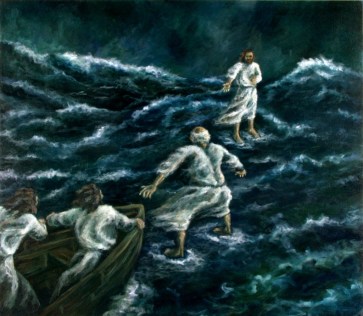
walk_by_faith_peter_walking_on_water-1024x892“Let this mind be in you which was also in Christ Jesus, who, being in the form of God, did not consider it robbery to be equal with God, but made Himself of no reputation, taking the form of a bondservant, and coming in the likeness of men.” -Philippians 2:5-7

“And the Word became flesh and dwelt among us, and we beheld His glory, the glory as of the only begotten of the Father, full of grace and truth.”  —John 1:14

“Jesus says even greater works than these you will do. And the way you are going to do that is the same way that Jesus was able to do everything which was by the power the Spirit – as Jesus lived in relationship with the Father, by faith through the enabling of the Holy Spirit.” – Pastor Todd Wagner, Watermark Community Church, Dallas Texas

“His mission was to be in our place, to walk in our steps. That means the miracles He did were by the Holy Spirit and not in His power as God.” Chuck Missler from The Trinity: The Mystery of the Godhead.

≈≈≈≈

I know full well this is a topic which has been studied and debated over the centuries by people much smarter and with more formal education than myself. Conclusions run the spectrum of Jesus being fully God to Jesus being fully man to Jesus being fully God and fully man, and everything in between.

Still, I will humbly tell you up front what my personal studied opinion is: Jesus, even as the eternal Son of God, while he walked this earth from birth, right up until when he breathed his last breath on the cross, chose to live his life fully as a man!

There, I said it! (Hopefully, we have moved beyond the days of the Puritan’s use of stocks, whips, severed ears, tongue piercing, and the gallows for people with differing religious opinions!)

I understand that many people who get upset at this idea, become upset because they think I’m saying that Jesus was just a good man or that he was only a prophet—that he was only a son of God like all humans are sons of God. Let me be as clear as I can—even as a man, Jesus never stopped being a part of the Triune Godhead, the eternal Son of God.

Perhaps a poor but helpful example of this is found in the hit TV show, Undercover Boss. In the show, the high-level executive, often the CEO, decides to hide his identity by putting on a disguise and taking on the appearance of a low-level employee. He does this to experience what goes on at the very foundational level of his organization and to understand the challenges his employee’s face, all in order to gain insight as to how he can make his organization better. Yet, even though he has put on a disguise and put aside all the power and privilege of his position, he is still the CEO.

A similar example might be Mark Twain’s classic, The Prince and the Pauper. In this story, the prince finds a commoner who was his doppelganger (a counterpart who looked just like him). He decides that he wants to see what life is like outside of the safe confines of the palace, so he switches clothes with his double and leaves all his princely privilege and power behind. Yet, by lineage and blood he is still the prince and is eventually restored to his rightful place.

Like Undercover Boss and the Prince and the Pauper, even though Jesus put on the disguise of a servant and emptied himself of his Godly power and privilege, he still continued to be the Son of God! Below is my rationale for this opinion:

Continue reading

Was Jesus Really an Impertinent Child?

(At the request of one blog follower I’ve posted this follow-up excerpt from WHO IS THIS GUY? and What Have You Done with My Sweet Savior?)

bossy_kid_770

When his parents saw him, they were astonished. His mother said to him, “Son, why have you treated us like this? Your father and I have been anxiously searching for you.” “Why were you searching for me?” he asked. “Didn’t you know I had to be in my Father’s house?” —Luke 2:48‑49

Missing Brother John

The warm summer wind rushes through my hair acting like a blow dryer to my salty wet mop as half my head is out the car window. We turn the corner onto the road home. I can’t wait to get out of my sandy sticky bathing suit. Yuck! A sudden scream snaps my head back into the car. Immediately the mass of bodies of various sizes crammed into this late 1950s station wagon are thrown forward as my mother slams the brakes. None of us are wearing seatbelts.

After the car jerks to a stop, my mother whips her head around to face the back seats—seemingly unconcerned with the welfare of the kids who’ve just been tossed together like a salad. She’s quiet for a moment, eyes darting from child to child calculating the number in her head. Then her eyes bulge and she screams out the question to no one in particular, “Where is JOHNNY?”

We all look around at each other. Nope. There is no Johnny in the car. With no attempt to check for traffic, Mom guns the car forward and swings it around, rubber squealing and burning behind her. The g-force pancakes me and my siblings to one side of the car. The U-turn complete, we all press back into our seats as Mom peals out in the other direction—back to the beach.

What usually takes twenty minutes takes less than ten to get back to the beach. All along the way there is an excited chant from the back seats—a chorus lowly repeating, “Go Speed Racer, go! Go, Speed Racer, go!” We’d never seen Mom push the old station wagon to its max.

Pulling into the beach parking lot, we slow to a crawl as Mom frantically looks for the missing child. Mom has every concern possible running through her head—drowning, eaten by sharks, kidnapping, or worst of all, an acquaintance discovering him and learning what a terrible mother she is. The brothers and sister know better, this is what Johnny does. I have no doubt he’ll be standing there waiting for us to return.

And there he is, calmly standing at the edge of the beach parking lot with a crooked smile on his face. Mom brakes to a complete stop and dramatically jumps out, running over to hug her lost child. She pulls him toward the car and through a forced smile, in hushed tones, she begins to reprimand him. Mom opens the back door, and before we can make room for John, she slaps him on the bottom to catapult him into the car and slams the door shut.

With a smile and a wave to the few disinterested onlookers, she climbs into the driver’s seat and home we go. All the way home, Mom is reading John the riot act for being so irresponsible. Why did he wander off? Didn’t he know how dangerous it was to be at the beach alone? How did he think he would get home? Maybe she should have just left him there, then what would he think? That would teach him a lesson.

As we pull into our long driveway, she concludes with the ultimate threat: “Wait until your father gets home!”

In the silence at the end of Mom’s rant, John finally speaks up in his own defense. “I was playing in the sand and nobody told me we were leaving. Then you were all gone. Why did you leave me there?”

* * *

In the first episode, we find Jesus at age twelve. We start with the fact that we know very little about the childhood of Jesus. After his birth in Bethlehem and the family’s flight to Egypt, we know that around the age of two or three the family returned to Nazareth in the region of Galilee.

During that roughly ten-year period between the return to Nazareth to this episode at age twelve, the Bible is silent except for one bit of information. I’ll get back to this one thing later.

In Luke 2:41-52 when Jesus and his family are in Jerusalem for the Passover. It appears that Jesus decided to stay in Jerusalem while his parents returned home. After a day of travel, Mary and Joseph realized Jesus was not with them. They took two days to make their way back to Jerusalem to search for Jesus. On the third day they finally found him in the Temple courts, engaging with the teachers where he seems uncaring about his parents’ feelings of fear and anxiety.

To me there are two concerns that arise from Jesus’s behavior in this story. (1) He disobediently stayed behind and (2) he is very dismissive of his parents’ feelings.

Continue reading

Let’s Talk ‘Raca’

(Chapter 3 from WHO IS THIS GUY? and What Have You Done with My Sweet Savior?)

“But I say to you that whoever is angry with his brother without a cause shall be in danger of the judgment. And whoever says to his brother, ‘Raca!’ shall be in danger of the council. But whoever says, ‘You fool!’ shall be in danger of hell fire.”—Matthew 5:22

A Fictional Sunday Morning StorySteve martin jerk

It was Sunday morning and I was at church. The service was filled with spirited worship and the pastor brought stirring and passionate words in his message. At the conclusion, I walked to the back of the church and found myself standing near my respected pastor as he greeted members of the congregation while they exited.

Suddenly, a strange man I had never seen before stepped up and pointed a long boney finger in the pastor’s face as he screamed, “You dirty, low-down, poisonous snake! What a hypocrite! You preach like you’re whiter than the driven snow, but you’re a dirty and evil adulterer on the inside!”

The pastor’s jaw dropped and his eyes bulged while I and the others stepped back from the threatening power in the man’s voice.

The man plunged on. “You are a dead man condemned to hell! How dare you, being evil, act like you can speak of good things? You’re no more than a blind fool guiding other fools right off a cliff to their destruction!”

The man’s face was crimson, his voice loud, raspy, and booming. My heart was pounding in my chest as the man pointed his finger right at me and then swung it around to the others hissing, “You are blind fools who listen to these sweet but venomous words. They sound life-giving but they are messages filled with persecution, condemnation, and murder.” He barked at everyone in the foyer, “And you ARE ALL twice as much of a son of hell as your pastor!”

The man then stormed out, leaving me holding my breath, stunned and shaking. I looked at the pastor and his face was beet red, sweat streaming from his brow and washing over his face.

I looked out the church windows to see the man still animated and yelling in the parking lot, and I whispered to myself, “Who is that guy?” I exhaled and shook my head concluding, “What a jerk!”

* * *

First of all, let me be clear. The story above is a fictional one. However, it is based on some similar behavior I have witnessed by people who felt they were justified in publicly calling out a church leader. But, let me ask you. How would you characterize that person? Was he a Christian? In your mind was that person acting Christ-like?

What if I told you that there are Christians who would see that behavior as biblical and even Christ-like? That all the words used to attack that Pastor were, in essence, the same words that Christ himself used to attack the Pharisees of his day?

Continue reading

Loosen Up Already!


Loosen up already! A gentle nudge, A passing thought, a whisper in my ear – “Speak to straining-to-hearthat person, send a message, make a call, do something for Me. Be My messenger.”


God’s voice is famously described in 1Kings as “a still small voice”. When someone whispers it often requires us to twist our neck and lean in to hear them. We want to hear what they are saying, so we make an effort to draw as close as we can. People who are skilled at public speaking use this method of quieting their voice before making a point so the audience will draw closer and then be truly listening when the major point is delivered.

We find in Jeremiah 17:23 Jeremiah declaring, “But they did not obey nor incline their ear, but made their neck stiff, that they might not hear nor receive instruction.” Later on in Jeremiah 19:14&15 Jeremiah “said to all the people, “Thus says the Lord of hosts, the God of Israel: ‘Behold, I will bring on this city and on all her towns all the doom that I have pronounced against it, because they have stiffened their necks that they might not hear My words.’”

The original Hebrew translated into “stiff neck” seems to indicate Jeremiah is talking about “stiff necked persons acting stiff necked” or “obstinate people acting particularly difficult.” What are the people doing? They were not inclining their ear to hear the Lord’s instruction. They are unwilling to twist their neck and lean in to hear God’s voice. How often do I do that? I’m already a difficult person wanting to do what I want to do. Jesus is speaking, but I won’t lean over to come close to hear his whisper.

In Matthew 5:19 it says – Then Jesus answered and said to them, “Most assuredly, I say to you, the Son can do nothing of Himself, but what He sees the Father do; for whatever He does, the Son also does in like manner. And then further in verse 30 He says, “I can of Myself do nothing. As I hear, I judge; and My judgment is righteous, because I do not seek My own will but the will of the Father who sent Me.”

Jesus repeatedly encouraged “those who have ears to hear, listen!” Jesus always deferred His will to the Father’s will. In that way, He could more clearly hear and see the things the Father desired to show and say.

So, I pray, “Thank you Father for loving me even as I willfully ignore your voice and go about seeking my own will. But, on this day, I will limber up my neck and twist it to lean in and hear your voice to guide me and direct me to follow your will. And may I discover what Job describes in Job 26:14 – “Indeed these are the mere edges of His ways, And how small a whisper we hear of Him! But the thunder of His power who can understand?”

Loosen Up Already!

What Did I Just Call Him?

(Chapter 1 from WHO IS THIS GUY? and What Have You Done with My Sweet Savior?)

“The Son of Man has come eating and drinking, and you say, ‘Look, a glutton and a winebibber, a friend of tax collectors and sinners!’” — Luke 7:34

WCFields2

I have to admit that for most of my life, or at least as far back as I can remember, there has been a word, or more often a phrase, almost constant in my vocabulary (spoken or unspoken). It pops into my head when someone cuts me off in traffic, when someone is rude to me or another person, or when someone’s words or actions are oddly out of order from what to me is normal behavior.

It doesn’t necessarily mean the person is a bad person. It refers to a person who is acting badly—selfish, inconsiderate, disrespectful, mean-spirited, vindictive, using coarse language, or even just acting silly—and I think, What a Jerk!

The definition of the word jerk in the New Oxford American Dictionary is “a contemptibly obnoxious person with its root in the idea of a person who is jerking someone around or who deals with others dishonestly or unfairly.”

As a person who regularly probes the Bible as a source of guidance and truth for my life, I enjoy digging into certain topics to see what Scripture has to say about issues pertaining to my life and the world around me. Not surprisingly, when I looked, I could not find the word jerk in any translation of the Bible. What I did find was an interesting word that is one of the few words most of the major Bible translations don’t bother to translate: raca.

While reading through the gospels, on numerous occasions the above-mentioned phrase has popped into my head: What a jerk! Feeling my face flush with embarrassment, I move on. For the thought was not directed toward the words and behavior of the Pharisees who through their hypocrisy sought to trap Jesus, or to the Jewish people who turned away from Jesus, or to the dim disciples who would regularly miss the point of a teaching from Jesus, but for the words and actions of Jesus himself.

Wait a minute! Did I just call Jesus a jerk? Even as I’m thinking it I can feel the wrath of all Christendom bearing down on me.

Continue reading

It’s not in the What but in the Who (Part III)

delivery guy

When we rush to the door, who is it we expect to find?

Continuing with Jesus’ parable of The Faithful Servant and the Evil Servant in Luke 12, we come to verse 41. Here, Peter interjects a question. It seems pretty benign and an easy one to just skim past.

As a writer writing dialogue, I will occasionally use what I call, “Throw away lines”. This is dialogue that doesn’t give much information but just keeps the exchange between characters more interactive or it will que one character to give more information. I’ve been mistaken many times to treat certain lines in the Bible as throw-away lines without a lot of meaning. This is one of them.

Peter asks, “Lord, do You speak this parable only to us, or to all people?” Honestly, it seems kind of a lame question. Like some others the Disciples ask, Jesus seems to almost ignore it and just continues to teach. Right? I mean the simple answer would be for Jesus to respond either “It’s for you” or “It’s not for you but for them.”

But what is Peter asking? He is actually trying to get clarification and to make a point. Saying – If you are talking to us, Jesus, we are right here. We have given all up to serve and to follow you. Where you go, we will go so certainly you are not talking to your Disciples. They are not yet understanding the part about Jesus going away.

So, Jesus actually directly responds to the question. He moves the object of the teaching from a mere servant/slave (Doulos) to a Steward (Oikonomosthe) still a servant but a manager of household affairs. Jesus is recognizing the Disciples as leaders of the church.

Peter refers to Jesus’ teaching as a Parable (Parabole) – where we get the word Parabola – a geometric curve that is identical on either side. The parable is considered “an earthly story with a heavenly meaning” but at its core it refers to a placing of one thing by the side of another. Putting something juxtaposition to another for comparison. An example is 2 ships squaring off for a sea battle. Each ship can look at the other and determine where they stand as a fighting force. A Battleship would feel pretty good about itself if it was facing a Destroyer.

In Mark 4:30 Jesus asks, “And he said, whereunto shall we liken the kingdom of God? or with what comparison (Parabole) shall we compare it?”

When Jesus tells a parable, he is painting a picture and letting the listeners compare themselves to that picture. Or, it’s like looking in a mirror and gauging what’s in the reflection. I don’t know that it is a common phenomenon but now as I am getting older, when I look in the mirror, I believe I often mentally prepare myself and don’t see that I’ve changed all that much. I kind of see what I want to see. However, if I unexpectedly walk past a mirror and happen to notice myself, it can be a shock. Is that old, gray, fat guy really me? Continue reading