Captain John Underhill – American Centurion of Faith (or Genocidal Mercenary?)

Photo566047“The God of my strength, in whom I will trust; my shield and the horn of my salvation, my stronghold and my refuge; my Savior, You save me from violence. I will call upon the LORD, who is worthy to be praised; so shall I be saved from my enemies.” – 2 Samuel 22:3-4

JUST RELEASED: BLOCK ISLAND BECKONS

I have just released my newest novel – Part IV in the Block Island Settlement Series: BLOCK ISLAND BECKONS. One of the key figures in the series is Captain John Underhill (1608-1672). For decades Underhill had been revered as a devoted Christian and a great protector of the European migrants to America. In more recent years his actions have come under scrutiny and his legacy has become controversial. Based upon my study of the man, I like to believe the historical record shows I have portrayed him in a fair and accurate fashion.

Below is Appendix C from the book providing my perspective on Captain John Underhill.


Perspective on Captain John Underhill

Over the years, Captain John Underhill has been either revered as a heroic early American protector of European settlers or reviled as a cruel, barbaric, genocidal mercenary who heartlessly murdered thousands of Native Americans. 

What’s the Truth?

After reviewing all I could find on Underhill’s life I have concluded that the latter is far from the truth. John Underhill was a God-fearing man with strong faith and moral convictions who acknowledged his own moral failings. He had been a follower of Anne Hutchinson who defended the rights of the Natives, believed in a Gospel of Grace, and was a champion of religious freedom.

Underhill was hired and brought to America to provide security for a Puritan people whose charter was to “lovingly win the American Natives to Faith in Jesus Christ”. The civilians he commanded were not soldiers but “artisans, farmers, and city-dwellers”[1] who were required to serve in the local militia for the protection of the colony. They had no desire to take land through war and bloodshed. If the Natives claimed land ownership, the Puritans were legally required to negotiate the purchase. (a law certainly not always adhered to)

Many misrepresent the wars with the Indians as simply land grabs. The fact is that Underhill and his men were not instigators but those who responded as protectors of their people. Most historians agree that of all the causes of the Pequot War, English land encroachment seems unlikely. Instead, the primary causes of the Pequot War were aggressive conduct by both the Pequot and English, and control of regional trade.

Certainly, the English and Dutch leaders were not blameless. Far from it. Their foolish and reckless decisions, dirty dealings, and lack of honor and respect towards the Natives often drove the Natives to react with violence. Underhill and the militia were the ones left with the task of providing protection for what their leaders had instigated.

“It was tragedy that the blunders of an incompetent administrator gave rise to a situation that had goaded the usually peaceful Algonquins beyond endurance. One’s sympathy is un-questionably with the red men (written in 1964) as we look across the years. But to the innocent victims of the inadequacy of Company government – the Dutch and English settlers within reach of the embittered tribesman – the immediate danger was very real. The terrible scourge of Indian warfare was sweeping the land and the successes of the allied tribes up to that point could well have meant the extinction of all settlements in New Netherland. If that happened, the fury of arrow and tomahawk might well have descended once more on New England.”[2]

War is ugly and though we may try to put some humane parameters around the bloodshed, it often devolves into increasingly ugly exchanges. Once an atrocity is committed to a comrade or to a family, the kid gloves are off and the atrocities escalate. So, it is in Ukraine as of this writing and so it was in the early American Indian wars. The Pequot War was an extremely violent war with horrific atrocities committed on both sides. Where did it start? Where would the vengeance end?

Numerous historical records indicate that the Pequot nation was the regional bully at that time. They would impose their will on the neighboring Native tribes by violent force, often brutalizing and enslaving their enemies. Other tribes actually welcomed peaceful Europeans into their lands to act as a buffer against the Pequot’s terrorism.

“The Pequot tribe were the most feared of all the savage nations in New England, a “fierce and powerful” people, a terror to other Indians as well as to the white settlers.”[3]

The Connecticut Court in Hartford met in May of 1637 to consider their circumstances. The Condition was described as “. . . very Sad, for those Pequots were a great people, being strongly fortified, cruel, warlike, munitioned, and the English but a handful in comparison: But their outrageous violence against the English, having murdered about thirty of them, their great pride and insolency, constant pursuit in their malicious Courses, with their engaging other Indians in their quarrel against the English.”[4]

Underhill describes the Pequots compared to his soldiers as, “that insolent and barbarous Nation, called the Pequeats, whom by the sword of the Lord, and a few feeble instruments, souldiers not accustomed to warre,” were drove out of their Countrey

Underhill goes on to describe the Pequots at the time, “so insolent were these wicked imps growne, that like the divell their commander, they runne up and downe as roaring Lyons, compassing all corners of the Countrey for a prey, seeking whom they might devoure: It being death to them for to rest without some wicked imployment or other, they still plotted how they might wickedly attempt some bloody enterprise upon our poore native Countreymen.”

Even Roger Williams, certainly a man of peace who had spent his life advocating for and even living amongst Natives, wrote to John Mason detailing his attempt to negotiate peace with the Pequots. He wrote, “Three days and nights my business forced me to lodge and mix with the bloody Pequot Ambassadors, whose hands and arms reeked with the blood of my countrymen, murdered and massacred by them on Connecticut river, and from whom I could not but nightly look for their bloody knives at my throat also.”[5]

Before the Mystic Massacre, there were numerous efforts to negotiate peace. Governor of Massachusetts, Harry Vane wrote to the Governor of Connecticut, John Winthrop Jr. to be included in a negotiated peace. “Demanding a solemn meeting for conference with them in a friendly manner about matters of importance.” Promising, “We shall not refuse to harken to any reasonable proposition from them for confirmation of the peace betwixt us.”[6]

Underhill describes his desire for leniency and negotiated peace but the Pequots would have none of it. Underhill writes, “This insolent Nation, seeing wee had used much Lenitie towards them, and themselves not able to make good use of our patience, set upon a course of greater insolencie then before, and slew all they found in their way.”[7]

John Endicott had raided the Pequots a year before the Mystic massacre and stirred up the Natives to provoke an Indian war leaving the English settlers to deal with the Pequot’s violent retribution. Underhill understood that the Puritans did not have the means to police and provide security to those countrymen in the area. If the Pequot’s would not entertain a peaceful solution then it was determined that they had to be fully subdued. It is a sad commentary on the human condition. Nothing new. Wars over possessions, politics, religion, and even for the purpose of establishing peace going on since the fall of creation.

Still, Underhill expressed his sadness with the result of the Massacre. “Great and dole-full was the bloudy sight to the view of young souldiers that never had beene in Warre, to see so many soules lie gasping on the ground so thicke in some places, that you could hardly passe along. It may bee demanded, Why should you be so furious (as some have said) should not Christians have more mercy and compassion?”

The documented atrocities of the English visited upon the Pequots were not traditionally the way of the English Puritans as recorded by Underhill but were an ugly response to the evils perpetrated on their people, “but yet you shall see it is not the nature of English men to deale like Heathens, to requite evill for evill,”[8] There are several accounts where Englishmen were perpetrating torture on Natives but Underhill intervened to reprimand and put an end to the cruelty.

Underhill became known as “The Indian Fighter”. I doubt that was a moniker he embraced. In his NEWS FROM AMERICA, he simply refers to himself as John Underhill, Captain of Militia, Massachusetts Bay Colony. He was hired by the English and later by the Dutch as a military leader to provide protection to the Settlers.

In later years, he was viewed with great respect across the Tribal Nations. Once settled on Long Island, he defended the Matinecock Tribe against those who had illegally taken their land. “the contention that the Hempstead settlers had invaded the rights of the Matinecocks by depriving them of their land without compensation. Probably because of his authoritative position in local affairs and the undoubted respect they bore of the man himself (Underhill), the Indians turned to him as their legal spokesman. The Captain pleaded their rights, was their champion in the Court of Assizes, the high court of Yorkshire, and won a clear-cut victory on their behalf.”[9]

In fact, during the Dutch Indian War the Natives went to Underhill to broker peace. “a group of chiefs from present Westchester and Dutchess counties went to Stamford “asking Capt Onderhil to apply to the Governor of New Netherland for peace.”[10]

The Pequot War by Alfred A. Cave provides compelling arguments that the Native Americans were purely victims of European bigotry and aggression. It is one of a number of more recent studies that try to set the record straight from the Native American perspective.

While the case is irrefutable that the Natives already occupied the land, and had first rights, they often had no problem trading for land believing that available land was vast and endless with more than enough to share. As we all know, the Natives were eventually either subjugated or relegated to something less than 2nd class citizens. The cultural differences and abuses were too great, leaving many with the only option for survival but to move West.

Unfortunately, in my opinion, these attempts to set the record straight often end up sanctifying one side of the story, while completely demonizing the other side. As with most arguments, the truth lies somewhere in the middle.

Charles Orr highlights a quote from John Fisk as if anticipating future revisionist history. “John Fisk in his Beginnings of New England, says, writing of the overthrow of the Pequots and its importance in the planting of New England: “As a matter of practical policy the annihilation of the Pequots can be condemned only by those who read history so incorrectly as to suppose that savages, whose business is to torture and slay, can always be dealt with according to the methods to be used between civilized peoples.””[11]

The corrupt means of man that we find within every society and people group can often be turned into something good. Somehow the abuses to Native and African tribal people in America has eventually led to a nation offering greater freedom and opportunity to more people of all persuasions than any other nation on this planet. It does not justify the evil but does mean there can be some justice in this world.

Have we really morally “evolved” to be better people today? Are we able to pass judgment on those in the past who sincerely tried to do their duty to protect their people under the most tenuous circumstances? Jesus declared, “Judge not lest you be judged.” One thing I know for certain is that anyone today who would judge someone like John Underhill but entertains the threat or use of violence to attain what they deem to be a “righteous” cause is no better person.

We say, Let history be the judge! But often the historical record and the people of history are too complicated for us to pass judgment upon. Ours is an imperfect society with deep flaws and historically shameful acts of injustice but with core values that cause us to continue to face and address those injustices. We are best to honor most ancestors for their good and learn from them for their bad. In our society today, we have much to be grateful for and much to learn from the life of Captain John Underhill.


Screenshot 2023-01-22 at 7.02.25 PMIf you are interested in learning more about early American Christian history or just looking for an entertaining read with action, adventure, and intrigue, give this series a try.

Check out the first three books in the Block Island Settlement Series:
1. The Battle of Mohegan Bluffs
2. The Fate of Captain John Oldham
3. Puritan Retribution and Manisses Destiny

You can find this book in Paperback or Ebook available on Amazon at:
https://www.amazon.com/gp/product/B0BSSLWJT3/ref=ox_sc_act_image_1?smid=A1Y53T3O3Q25L8&psc=1


[1]Captain John Underhill, Gentleman * Soldier of Fortune, L. E. & Anne DeForest, DeForest Publishing Co. NY, NY 1934, Page 7

[2] Captain John Underhill and Long Island by Myron H Luke, The Nassau County Historical Society Journal, 1964, Page 3

[3]Captain John Underhill, Gentleman * Soldier of Fortune, L. E. & Anne DeForest, DeForest Publishing Co. NY, NY 1934, Page 14

[4] History of the Pequot War, Charles Orr, page 25

[5] History of the Pequot War, Charles Orr, Published by Pantianos Classics, 1897, Pages 19-20

[6] History of the Pequot War, Pages 75-76

[7] Newes from America, John Underhill, Captain of Militia, Massachusetts Bay Colony, 1638, Pages 1-2, 13-14

[8] Newes from America, John Underhill, Captain of Militia, Massachusetts Bay Colony, 1638, Pages 35, 37-38

[9] Captain John Underhill and Long Island by Myron H Luke, The Nassau County Historical Society Journal, 1964, Page 9

[10] Captain John Underhill, Gentleman * Soldier of Fortune, L. E. & Anne DeForest, DeForest Publishing Co. NY, NY 1934, Page 58

[11] History of the Pequot War by Charles Orr, Published by Pantianos Classics, 1897, Page xii


Merry Christmas! – Wow! You Got the Gift of Meízōn!

“Most assuredly, I say to you, he who believes in Me, the works that I do he will do also; and greater works than these he will do because I go to My Father. And whatever you ask in My name, that I will do, that the Father may be glorified in the Son. If you ask anything in My name, I will do it.” – John 14:12-14

ChristmasGod’s greatest gift of all is undoubtedly the gift of abundant, eternal life through the confessed belief in Jesus Christ. Part and parcel to that gift is what Jesus left behind for us – the Holy Spirit. And, according to Jesus by the power of the Holy Spirit we, corporately or perhaps even as individual followers, we can do what Jesus did and even greater things (Meízōn) than Jesus did while on earth. Whew! Wrap your head around that while you unwrap your gift.
Below is an excerpt from my book, EMPTIED that attempts to unwrap the Gift


Exhibit 7 – Based Upon the Continued Miracles Performed by His Disciples

In the book of Acts, Jesus’ original disciples carried out miraculous works with some being what could be described as “even greater things.” Also, we see other non-original disciples (Paul and Stephen) who carried out miraculous works.

If Jesus did the miracles as God then it would seem that men or disciples would not have been able to continue doing them. Jesus, himself, taught that all the power was from God the Father and that men could and would do even greater things than what the Father did through Jesus.

In John 14:12-14 Jesus responds to Philip saying, “Most assuredly, I say to you, he who believes in Me, the works that I do he will do also; and greater works than these he will do because I go to My Father. And whatever you ask in My name, that I will do, that the Father may be glorified in the Son. If you ask anything in My name, I will do it.”

The Greek word for “works” is also often translated as “things,” which I believe, in context, is commonly understood to be the great and powerful signs and wonders that were performed through Jesus. The same word is used in Matthew 11:4-5: “Jesus answered and said to them, “Go and tell John the things which you hear and see: The blind see and the lame walk; the lepers are cleansed and the deaf hear; the dead are raised up and the poor have the gospel preached to them.” (Italics added)

We see these works or things continued by the Apostles in Acts 5:12,16: “And through the hands of the apostle’s many signs and wonders were done among the people . . . Also, a multitude gathered from the surrounding cities to Jerusalem, bringing sick people and those who were tormented by unclean spirits, and they were all healed.”

The writer of Hebrews testifies that these works or things continue through common men in Hebrews 2:4: “God also bearing witness both with signs and wonders, with various miracles, and gifts of the Holy Spirit, according to His own will.”

Even Greater Things
John 14:12 is an amazing declaration by Jesus. A very common and perhaps the most prevalent interpretation of this passage is that Jesus is speaking to the disciples and He is saying that as the Body of Christ, they will one day do even greater things than He could as one person. When Jesus spoke these words, He had not yet died on the cross for mankind’s salvation, and His followers would be entrusted with the greater task of preaching the Gospel and leading mankind to salvation through belief in Jesus.

However, the Greek to me is open to some interpretation and can indicate something else. I believe Jesus is answering the disciple, Philip, with “Most assuredly, I say to you, he who believes in Me, the works that I do he will do also; and greater works than these he will do, because I go to My Father.”

The Greek word used in this passage is kakemonos, meaning “and he, he also.” A few major English translations translate kakemonos as “they” but the vast majority of English translations use “he.” The indication is that Jesus is not only referring to His church as a whole but to His individual disciples as well.

Speaking Directly to Disciple Philip?
As further indication that Jesus may have been referring to individual disciples in John 14:12, we find this account in Acts chapter 8. The focus is on Philip going to Samaria. What did he do there? If Jesus was responding directly to Philip in John 14:12, saying that he, as an individual follower, could do the same and even greater things, Luke records that Philip did indeed do many of the same works as Jesus. In Samaria, the multitude heeded Philip for what he spoke and the miracles he did brought great joy to the entire city.

imagesIn Samaria, the multitude came to believe in Christ and were baptized due to Philip’s ministry. Later, Philip converted the Ethiopian and when he baptized him it says, “the Spirit of the Lord caught Philip away” and he found himself in Azotus. In Luke 4 Jesus mysteriously passed unnoticed through an angry mob, but there is no record of Jesus ever being whisked away and teleported over 15 miles. Nice trick. Hmmm? A greater thing?

Greater Than Jesus?
The concern here is that we might be saying a Christ-follower could be greater than Jesus himself. Christ-followers are not greater than Jesus—He always was and always will be THE Son of God. We are saved by Jesus’ unique life, death, and resurrection. He is the Christ – the Messiah – our only Savior. And, Jesus was uniquely filled with the Spirit without measure as confirmed in John 3:34, “For he whom God hath sent speaketh the words of God: for God giveth not the Spirit by measure unto him.” (KJV)

As Christians, we are called to be followers and imitators of Christ. We follow Him. If we are doing a good imitation, then Jesus could be interpreted as saying in John 14:12 that we can do the things He did as a man empowered by the Holy Spirit. And, possibly do even greater things or works. What those greater things or works are, is a whole other debate.

A disciple, doing some works that appear greater than what Jesus did (Billy Graham or other evangelists reaching crowds greater in size than Jesus ever spoke to) would not make him/her God or greater than Jesus because it is only by the Spirit of God/Jesus working in them and through them that they can do any of these things. Could it be that Jesus may be challenging the church (Body of Christ) and even his individual disciples to do things beyond what He had done?

Even while writing books about spiritual matters, I’m realizing that Jesus never wrote a book. I am particularly ill-equipped to do it and it’s a daunting task, but if I am following God’s leading, then Jesus is saying, I didn’t do it, but you can! (Through the amazing technology of the internet, my blog has reached people in over 50 countries across the planet. That’s a further reach than Jesus’ ministry while on earth. A greater thing?)

When writing to the Ephesian church, Paul (doing a greater thing?) seemed to want to encourage the Ephesians to measure themselves to the man Jesus, writing in Ephesians 4:13: “Till we all come to the unity of the faith and of the knowledge of the Son of God, to a perfect man, to the measure of the stature of the fullness of Christ.”
(The original Greek uses the phrase, “full measure” or plērōmatos metron which implies being filled up to a limited portion of the fullness of Christ. Some Christian thinkers refer to it as, “Believers having the Spirit by measure.”)

This interpretation of John 14:12 can be a scary proposition for many Christians for what it implies as to the potential power we may have in Christ Jesus and how much may be going unrealized.

Still, I believe it is God encouraging us and coaxing us to the fullness of the life and ministry He intended for us. If nothing else, I see the language leaving an opening for differing opinions and debate.

One opinion holds that certain gifts Jesus and the first Apostles performed are no longer available to us today. While this is not what I see, I humbly acknowledge that many scholarly and very credible Christ-followers believe this. (For more on Cessation of Sign Gifts there is Appendix A in Emptied)

A Study of Jesus’ Miracles
Is Jesus actually saying, You know all the miraculous things I have done? Yes, you can do those and even greater ones?
I have to say that John 14:12 is one scripture, in particular, when reading it I would roll my eyes and just move on. Right! Even greater things than the Son of God? Come on, man!

But, as the idea that Jesus may have carried on throughout his life fully as a man took hold, I decided to take a closer look at His miracles. I did a study of the 37 documented miracles of Jesus as described in the Gospels.
Considering the different miracles Jesus performed, I researched how the miracles performed by other Biblical figures might compare to Jesus’ miracles.

Peter declares in Acts 2:22 “Men of Israel, hear these words: Jesus of Nazareth, a Man attested by God to you by miracles, wonders, and signs which God did through Him in your midst, as you yourselves also know.” (Italics added)
With that in mind, I wondered if any other person in the Bible had done something equivalent to each of the miracles recorded of Jesus?

Based on my research, I have concluded that with every recorded miracle performed by Jesus, there was something similar initiated by another Biblical figure (human) – and in several cases in what could be described as an “even greater” way. Below is a sampling of what I found:
1. All of the same physical healings performed by Jesus were performed by the disciples in the book of Acts – even on two occasions raising someone from the dead.
2. Jesus called Lazarus from the grave but Ezekiel called dry bones to come alive.
3. Jesus turned a few vats of water into fine wine – Moses turned an entire river of water to blood in Exodus 7:17
4. Jesus calmed storms – Moses parted the Red Sea – Exodus 14:13 and Elijah stopped the rain for seven years before bringing the rain again in 1Kings17-18 & James 5:17-18
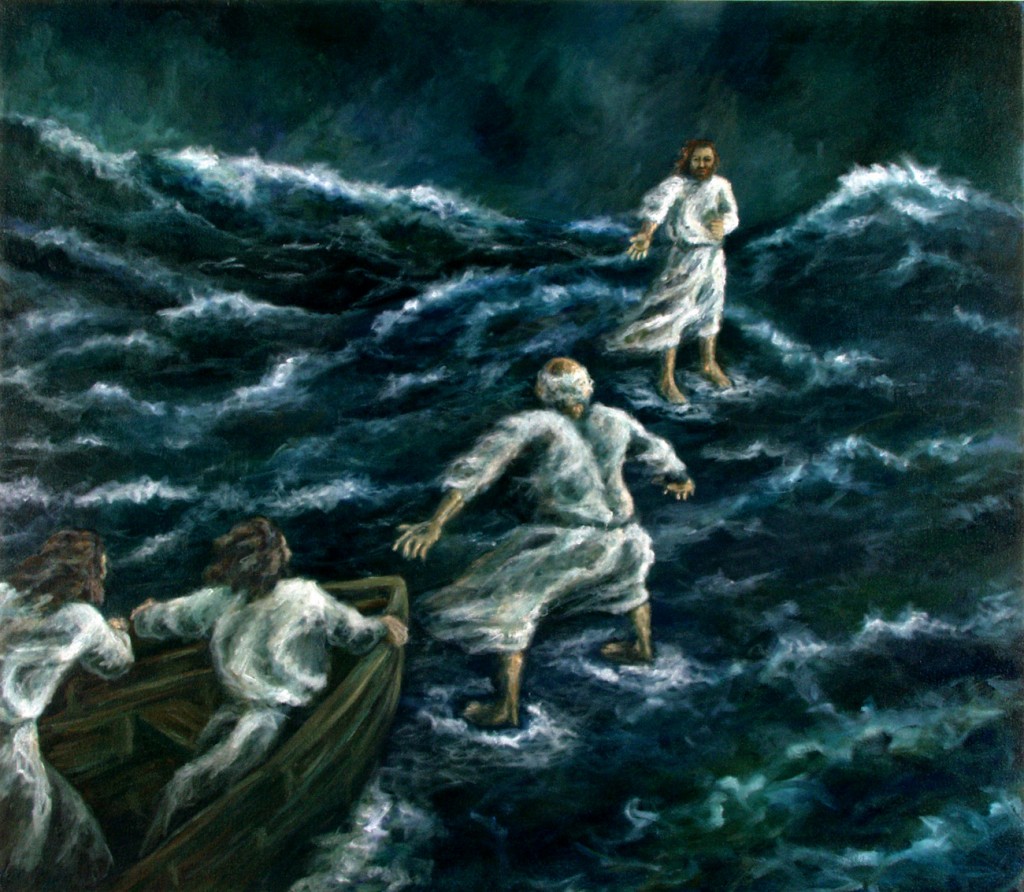
walk_by_faith_peter_walking_on_water-1024x8925. Jesus multiplied loaves and fishes to feed 4000 and 3000 – Moses prayed for food (meat and manna) to feed the entire Hebrew people for years – Exodus 16:11-12


6. Jesus caused a fish to deliver tax money from its mouth – Jonah was delivered from a fish’s mouth onto the shores of Nineva.
7. How about walking on water? Certainly, Jesus was the only one to do that! – Oops, that’s right, Peter walked on water too.

I have looked at every recorded miracle of Jesus and found Biblical figures whom God used to do something similar and in some cases done in arguably greater terms. (A more complete list is found in Appendix B of Emptied)

Please do not take this as an attempt to diminish who Jesus was/is. No one else was or will ever be THE Son of God and THE anointed Messiah who was uniquely filled with the Spirit without measure. He is forever God. What excites me is to find that what I considered to be one of the most outlandish statements Jesus ever made is proven true right within the Biblical record.

~~~

R.A. Torrey writes, “He (Jesus) lived, thought, worked, taught, conquered sin and won victories for God in the power of that same Spirit whom we may all Have. Whatever He realized through the Holy Spirit is there for us to realize also.”


“Most assuredly, I say to you, he who believes in Me, the works (Ergon) I do he will do also; and greater works (Meízōn) than these he will do because I go to My Father.”John 14:12

  • Ergon – Work, deed, doing, labor, things done.
  • Meízōn – greater, greatest, larger, elder, stronger, more, special, unique.

According to my reading of John 14:12, because of 1) our Belief in Jesus and 2) the fact that Jesus went to the Father, we have been equipped to do even greater things.

This Christmas season I challenge you to think about this gift: The ability to do the things (Ergon) Jesus did and to do even greater things (Meízōn). What does that mean for my life? For your life? For the lives around us?

What was the purpose of the Things and the Greater Things? – to heal and restore to reveal the reality of God – that people would be drawn into a right relationship with God.

We all have life experiences that in some ways (small or large) are unique to Jesus’ recorded life as a man. (marriage, children, family, education, jobs, skills, talents, pursuits). Could these be some of the Meízōn things? Things Jesus didn’t do but implores you to use these greater things for our mutual joy and for God’s glory.

Personally, I believe it goes well beyond that but it’s a good starting point. Ultimately, Jesus went to be with the Father, leaving us with the Holy Spirit not just to muddle along in building His Kingdom but so we could go beyond where he left off – to continue His work in even greater ways. What an honor. What a gift. God works in unique and marvelous ways and He desires to use us in ways unique to who we are.

Merry Christmas! Now, open up the gift of Meízōn and consider the possibilities.

I Hate When I Disappoint God! Wait . . . Is That Even Possible?

“For I know the plans I have for you,” declares the LORD, “plans to prosper you and not to harm you, plans to give you hope and a future.” Jeremiah 29:11


Most of what I have read on the topic of God being Disappointed written by Christian authors relies on the notion that God could not possibly be disappointed. How can an omnipotent, omniscient, omnipresent God, who is all-powerful, always present, and knows everything be surprised or disappointed?

I have comforted myself and others with the idea that God could not possibly be disappointed with us because of who He is.

God Ashamed and Deeply Troubled?

However, after digging into the topic for myself, the scriptures I looked at seem to indicate God experiencing some form of disappointment. However, any form of the word itself, “Disappoint” rarely shows up in any of the major translations.

But, Genesis 6:6 is translated in the NKJ – “And it repented the Lord that he had made man on the earth, and it grieved him at his heart.” In the NIV – “The Lord regretted (sorry, ashamed) that he had made human beings on the earth, and his heart was deeply troubled.” Sounds like He was pretty disappointed.

In Exodus after engaging with Moses God decided not to destroy the grumbling Israelites saying in Exodus 32:14 – “And the Lord repented of the evil which he thought to do unto his people.”

The Hebrew word used here for repented is Chapher, meaning to be ashamed, be confounded, be abashed or embarrassed, repentant.

As a young boy, I was so Chapher with how my model tank came out that I blew it up with a firecracker (along with my GI Joe)

In the New Testament we find the Greek word Kataischuno, meaning to dishonor, disgrace, to put to shame, make ashamed, to be ashamed, blush with shame, hope deceived. Romans 10:11 says “For the scripture saith, Whosoever believeth on him shall not be ashamed.”

God’s not ashamed of us but is Jesus?

Nowhere in the New Testament could I find indications that God is ashamed or disappointed with us. Yet, on a number of occasions we do find that Jesus seems taken by surprise and disappointed with his disciples.

In Matthew 17 there is the epileptic boy that the Disciples could not heal. “Then Jesus answered and said, “O faithless and perverse generation, how long shall I be with you? How long shall I bear with you?” Sounds like a disappointment to me. (Though it may not be)

Later in Revelation chapter 2-3 Jesus repeats with each church that he has something “against them” indicating disappointment as in Revelation 2:4, “To the angel of the church of Ephesus write – Nevertheless I have this against you, that you have left your first love.” The Greek word for Against is Kata. It gives the notion of “down from” or in this case “my thinking of you has been lowered” or being disappointed.

So, how does that work? How can an omnipotent, omniscient, omnipresent Son of God, restored to Heaven who knows everything, be surprised or disappointed?

God Rooting for Us?

The Flip side of God being Disappointed is the idea that God is Rooting for us as we pass through this life. Once again, how is that possible for a God who knows the outcome before it even happens? If God knows everything about what will ever happen at any point in time I ask, “How does that work?” Or perhaps more importantly, “How boring is that?” Imagine knowing every play and the final outcome of every game before it is played? Why would I care to watch and root for any team?

My Theory of Omni Suppression

Now, I’m going to ask you to extend to me a little grace – a little latitude as I share my “theory” on this. Like Darwin’s “Theory of Evolution,” it is only my opinion based on evidence I have looked at.

So, how could an all-powerful God have the experiences that are ascribed to him in the Bible? Some of the words I found in the Bible that seem to indicate a lack of foreknowledge (omniscience) are God being: Disappointed, Desiring of, Hopeful for, Patient, Waiting and Faithful. How does that work?

I’ll use a sports fan analogy to explain my theory: There have been occasions when a major sporting event was occurring at a time when I could not watch it live. Beforehand I would set my VCR/DVR to record the event and then do everything in my power not to learn the result in order that I could later watch the game as though it were live – turning on the recorder and hitting play I could watch the game and even though the action was already played and the result concluded, I could sit and cheer for an outcome that had already been decided.

Okay, so I ask, Is it possible that our God could do something the same with His experience in relationship with us? Could God actually hit a pause button on his Omniscience Attribute – to enjoy the thrill of rooting for His creation and experience the Joy of our victories and have the compassion to share in the pain of our defeats?

The Omnipotence Paradox

I know that it is a bit crazy and may even be heretical to some Christians. When I have brought this up with some brethren, invariably they will invoke what is known as The Omnipotence Paradox. The most well-known version of this is the paradox of the stone: “Could God create a stone so heavy that even He could not lift it?” The conundrum is that either way, if He can or He can’t, He is not all powerful. But, my simple-minded answer to the question is – “Of course He could!” God can do anything by His choice. If He chooses to create something that even He then won’t be able to lift, He can do it because it is under His power and authority and it fits with His Goodness, Righteousness and Truth.

So, Prove It

If you have a Theory, you must have some proof. What is my proof? My proof is that God – who He is – His Character – the very essence of God cannot be changed and the promises He makes cannot be changed. Therefore, God certainly can create something that will not be moved even by himself. But, it is His choice. Much like His unchanging character, He could choose to operate outside of His perfectly righteous character but He does not. He, like the great stone will not be moved:

James 1:17 – “Every good gift and every perfect gift is from above, and comes down from the Father of lights, with whom there is no variation or shadow of turning.” He is always consistent and unchanging in His character.

Numbers 23:19 – “God is not human, that he should lie, not a human being, that he should change his mind. Does he speak and then not act? Does he promise and not fulfill?”

Hebrews 13:8 – “Jesus Christ is the same yesterday and today and forever.”

But what I am suggesting here is not really the same thing: Can God turn off/lay aside/pause, not His character, but His power or attributes for His own pleasure and for the benefit of His creation? Then what is my proof?

In my book, Emptied I make the case that God already did this. When? We find it in Philippians 2:5 Christ Jesus: “Who, being in very nature God, did not consider equality with God something to be used to his own advantage; rather, he made himself nothing by taking the very nature of a servant, being made in human likeness. And being found in appearance as a man, he humbled himself by becoming obedient to death—even death on a cross!” God the Son literally laid aside the powers of His deity for a tiny slice of eternity for God’s Joy and for that of all creation.

Jesus, the Son of God, equal part of the triune God willingly gave up his glorious Omni attributes when he came down to walk the earth as a man. He, for the time, could only be in one place at one time. He did not know all things and did not act with all power. So, I believe that God could do this.

You might not believe that Jesus fully gave up all His power and glory when He became a man but anyone who agrees with the statement that “Jesus is fully God and fully man” must acknowledge that He set aside or restrained His deity as a man at least to some extent while walking the earth.

Another proof is that there is clear evidence of His perfect patience as He restrains His awesome Omnipotence when we are guilty and deserve punishment for our crimes. 2 Peter 3:9, “The Lord is not slow in keeping his promise, as some understand slowness. Instead he is patient with you, not wanting anyone to perish, but everyone to come to repentance.”

So, is it possible that God could choose not to know every outcome, to enjoy being surprised, to enjoy the anticipation and sensation of victory and to compassionately share in our failures?

We know the definition of disappointment. Yet, I believe that there is a spectrum of disappointment at one end being upset to the point of anger and seeking revenge and retribution for the failure and shame – to the other end of the spectrum where there is shared sorrow and regret bringing understanding, compassion and comfort.

As a little leaguer I can certainly remember teammates who failed badly only to be met by parents who were angered by the shame and embarrassment over their child’s disappointing performance. I recall, on one occasion where I struck out on the final at bat with the tying and winning runs on base, my father did not hide his disappointment. However, my father’s look of disappointment was truly for the pain he felt for me and for my own disappointment. My father expressed the loving compassion to throw his arms around me and to encourage me that “I’d get ’em next time.” He shared in my disappointment but chose to love and console me.

On the flip side, I have always felt as though God is rooting for me/us to succeed – “Come on Dave, I have given you instruction and guidance and access to my power. Now there is this test in front of you – two paths to take. The answer is clearer than you think. I know your heart. You can do this!”

I’d make the case that on several occasions this is what Jesus did with His disciples. An example is with the episode where Jesus calms the storm. In Luke 8 Jesus asks the Disciples, “Where is your faith?” In the account in Matthew 8 Jesus says, “Why are you fearful, O you of little faith?” In other words, I’ve modeled this for you. Where is your faith to call out to God the Father to calm the storm?

I believe that God delights in following our progress and providing guidance and direction – enjoying our victories and feeling our pain in defeat – knowing full well that ultimately, He, God is victorious.

Now, whether you believe in my theory or not, I believe that in whatever way that may be beyond our understanding, our God is able to delight in our victories and feel for us through our failures. He is the God of Hope and Joy and our great Comforter.

What does God promise – The best? No, He desires for us an abundant life. He plans for us a good and peaceful life with a future that offers great hope and joy. Jeremiah 29:11 – “For I know the plans I have for you,’ says the Lord, ‘plans for well-being and not for trouble, to give you a future and a hope.” John 16:33 – “These things I have spoken to you, that in Me you may have peace. In the world you will have tribulation; but be of good cheer, I have overcome the world.”

As God cheers us on He is always encouraging us to put our Faith, Hope and Trust in Him and the goodness, righteousness and truth only He can offer.

So, to answer the question, “Does God Get Disappointed With Us?” the answer is YES but it is all in the inflection of the word “WITH“. He is not disappointed in us but is disappointed along with us. Our God is a God who experiences life and relationship with us – He is the only God who can be called by the very name – Immanuel – “God With Us!” (Matthew 1:23)

If you think, “Nobody knows what I’m going through, nobody feels the pain I’m experiencing.” Or “Who cares? Is there anyone rooting for me?” God knows, and “The LORD is like a father to his children, tender and compassionate to those who fear him.” (Psalms 103:13, NLT)

Our God knows in a very personal way! He cares and is rooting for us to be victorious with His power. Colossians 1:11 – We are “Strengthened with all might, according to his glorious power, unto all patience and longsuffering with joyfulness”

He knows your feelings and frustrations.  He sees the crisis in your soul. There’s no hurt that goes unfelt by God. Psalm 56:6 says, “You know how troubled I am; you have kept a record of my tears.”

God not only sees and feels, He Cares!

God knows the causes, the reasons, the things that brought you to this point. He understands because he made you, and he shares in the hurt of your heart like nobody else can.

Because God knows and feels our frustrations and despair, we can give those feelings to God: “Give all your worries and cares to God, for he cares about what happens to you.” (1 Peter 5:7, NLT) Cast them all permanently on God, once and for all, and then, don’t take them back.

My “Theory” of how this all works is only a guess as I try to comprehend what is likely incomprehensible. Knowing that what seems impossible is possible for an all-powerful Being that lives in a realm beyond the confines of our time and space.

To all, have a HAPPY THANKSGIVING! Giving thanks to our Immanuel God for being our Comforter who roots for us, who celebrates in our victories, and who compassionately shares in our disappointments – God WITH us!

“And we know that all things work together for good to those who love God, to those who are the called according to His purpose. For whom He foreknew, He also predestined to be conformed to the image of His Son, that He might be the firstborn among many brethren. Moreover whom He predestined, these He also called; whom He called, these He also justified; and whom He justified, these He also glorified. What then shall we say to these things? If God is for us, who can be against us?” – Romans 8:28-31

EMPTIED

E953F897-3080-44CA-A85A-1B0BA597B51A“Have this attitude in yourselves which was also in Christ Jesus, who, although He existed in the form of God, did not regard equality with God a thing to be grasped, but emptied Himself, taking the form of a bond-servant, and being made in the likeness of men. Being found in appearance as a man, He humbled Himself by becoming obedient to the point of death, even death on a cross.” —Philippians 2:5-8 (NASB)

Excerpt from my just-released Book: Emptied


Introduction

This book is the result of my personal Bible Study. I will say from the outset, that I am not a Bible scholar with any formal higher education in theological or Biblical studies. (I have used my friend and scholar, Dr. Wayne Detzler to review this work). I read and study the Bible because I love to probe into it to look for answers to life’s questions, to hear God’s voice, and to come to know the author.

I try to keep it simple, saying that if God is real, He will keep His promise as written in the book of Hebrews to reward those who diligently seek him. I use basic Bible study tools and rely on some trusted reference material. As much as possible I start with my own study before resorting to commentaries and scholarly opinions. Before me, I keep Paul’s words to the Romans: “Do not be wise in your own opinion” (12:16). In other words, don’t think so highly of your thoughts.

There is much debate and divergent opinion on the topic of what it means that Jesus came in the flesh. Certainly, this topic has been studied and debated over the centuries by people much smarter and more studied than myself, with conclusions that run the spectrum of Jesus being fully God to Jesus being fully man to Jesus being fully God and fully man, and everything in between.

The results from my study I do not consider to be authoritative nor conclusive, but for my spiritual, relational, and intellectual satisfaction. I pray that it is relevant to others as I do feel strongly that however a Christ-follower comes out on this debate, it may have a dramatic impact on how a Believer lives out their life in Christ.

From when I first stepped forward to follow Jesus back in 1979 I was taught and understood that the person I chose to follow was both “Fully God and Fully Man”. What? How much God and how much man? While Jesus was on the earth was he still 100% God and 100% man? How does that work? I accepted this dual identity of Jesus as one of the great spiritual and Holy mysteries – an incomprehensible paradox that the human brain could never fully understand.

But, then I began to study the life of Jesus in the Gospels and a distinction began to unfold. More and more of what I read and studied seemed to reveal Jesus operating as a man and relying on the Father and the Holy Spirit as His source of power and wisdom. Hmmm? Something like we, as Christ-followers are taught to do.

So, I will humbly tell you right up front what my personal studied opinion is: Jesus, even as forever the eternal Son of God, while He walked this earth from birth, right up until when He breathed his last breath on the cross, chose to live his life while on earth fully as a man!

There, I said it! (Hopefully, we have moved beyond the days of the Puritan’s use of stocks, whips, severed ears, tongue piercing, and the gallows for people with differing religious opinions.)

I understand that most people who get upset at the emphasis on Jesus’ manhood, become upset because they think I (and others) are saying Jesus was just a good man or that He was only a prophet—that He was only a son of God like all humans are sons of God. Let me be as clear as I can—even as a man, Jesus never stopped being a part of the Triune Godhead, the eternal Son of God. Some people just don’t believe it is possible that Jesus could empty Himself of His power and privilege and still be God. Until convinced otherwise, I do.

Two (not perfect) Examples:

9020FB54-FBF4-41CB-B7B2-2EE94E0E5A42One example of what Jesus did is found in the hit TV show, Undercover Boss. In the show, the high-level executive, often the CEO, decides (chooses) to hide their identity by putting on a disguise and taking on the appearance of a low-level employee. He/she does this to experience what goes on at the very foundational level of their organization and to understand the challenges the employees face, all to gain insight as to how they can make their organization better. Yet, even though they have put on a disguise and chosen to put aside all the power and privilege of their position, they are still the CEO. They can choose at any moment to pick back up their power and privilege. Eventually, they do.

C58BE5C8-93CB-4A17-9F66-E70467D8DBB3A similar example might be Mark Twain’s classic, The Prince and the Pauper. In this story, the prince finds a commoner who was his doppelganger (a counterpart who looked just like him). He decides that he wants to see what life is like outside of the safe confines of the palace, so he switches clothes with his double and leaves all his princely privilege and power behind. On the outside, he is humbled to find how harsh and ugly the world is as a commoner. Yet, by lineage and blood, he is still the prince and is eventually restored to his rightful place.

Like Undercover Boss and the Prince and the Pauper, even though Jesus put on the disguise of a servant and emptied himself of his Godly power and privilege, he continued to be the Son of God.

What follows in this book is my rationale, based on the Biblical evidence for this opinion.

Christ in Heaven, from the beginning, was/is/will forever be God, equally God with the Father and the Holy Spirit. The Son of God came down to earth and chose to be fully man. As the Spirit-filled Messiah he died, was raised from the dead and ascended back to Heaven to be restored to His rightful place.

The following are my 10 Scripture Exhibits of Evidence which have led me to believe that for a tiny slice of eternity, Jesus chose not to exercise His Godly power and privilege, but came down to earth to live fully as a man.

10 Exhibits of Biblical Evidence That Jesus (The Son of God) Chose to Live Life Fully as a Man While He Walked the Earth

  1. Based Upon “The Emptying” in Philippians 2:5-8
  2. Based Upon the Testimony of Biblical Figures
  3. Based Upon Jesus Needing to be Filled/Led by the Spirit
  4. Based Upon Jesus Being Tempted, While God Cannot Be Tempted
  5. Based Upon Jesus Needing to Pray
  6. Based Upon Confirmation of The Source of Jesus’ Miraculous Power
  7. Based Upon the Continued Miracles Performed by His Disciples
  8. Based Upon Jesus, The Son of God, Choosing to Walk Like a Man by Faith
  9. Based Upon Jesus, The Son of God, Choosing to Walk like a Man Having His Own Will.
  10. Based Upon Jesus as a Man Appearing to be NOT Omniscient or “All-Knowing”

Emptied – Jesus: Son of God & The Perfect Man

Screen Shot 2022-02-09 at 10.42.04 AMSo, what could Dave Tucker write about Jesus that has not already been written?

Jesus operating as a man and relying on God-the-Father and the Holy Spirit as His source of strength and wisdom is not a new revelation. What may be new is that I am not aware of there being a complete compilation of the Biblical evidence supporting the conclusion that Jesus, THE ETERNAL SON OF GOD chose to live his life on earth fully as a man.

Many Christians already believe this to be true, while many do not, and likely many more have not even given it significant thought. I do feel strongly that however a Christ-follower comes out on this debate, it may have a dramatic impact on how a Believer lives out their life in Christ. If nothing else, I believe many will find the evidence compelling and well worth every Christian’s consideration.

You can find EMPTIED on Amazon at:

Reactions To EMPTIED

“Love Dave’s insightful and provocative writing! With Emptied, Dave gives clarity to what it means for Jesus to be ‘fully man’ while not sacrificing any of His divinity. The conclusions are both challenging and motivating for the sincere Christ-follower!” Pastor, Dan McCandless

“In Emptied, Tucker dares to examine one of the most profound mysteries in all of scripture. Theologians call it Kenosis. He masterfully examines how “the Word became flesh” and leads us to a renewed, reverential awe of Jesus Christ.” Keith Guinta, Thought-Provoking Christian Blogger (winepatch.org)

Guiltless Guilt

Guilty

Guilty As Charged

“Then they cried out to the Lord in their trouble, And He saved them out of their distresses. He brought them out of darkness and the shadow of death, And broke their chains in pieces. Oh, that men would give thanks to the Lord for His goodness, And for His wonderful works to the children of men!” – Psalm 107:13-15

I have not posted anything new this year, not because I was incarcerated as the picture may suggest, but because I have been working on my latest book. This is a short excerpt from that soon-to-be-released Book, EMPTIED. This book details the Biblical evidence supporting the opinion that Jesus, even as the eternal Son of God walked the earth fully as a man. And, as a man, he was our perfect model to imitate much of what He did.

Really? Do What Jesus Did?

Inevitably, when you get into the topic of believing Christ-Followers can “do what Jesus did” it raises concerns. For many Church leaders, perhaps the biggest concern is the guilt associated with failure – failed expectations. In particular, what about exercising Spiritual Gifts? What does it say about our faith if we fail to reach the fullness of our measure? If we step out to exercise spiritual gifts and the results are not what we expect? Are we burdening people with guilt because they lack enough faith or shaming them for just not being spiritual enough? What is the damage if people fall short of expectations?

Hey, what can I say? We are all found guilty of falling short of God’s glory (Romans 3:13). But, Jesus rescues us from our guilt and shame. And, Jesus never motivated through guilt. John 3:17 says, “God sent his Son into the world not to judge the world, but to save the world through him.” He accepts us where we are but is always coaxing us to stretch ourselves to draw closer to His image.

Healthy Guilt?

While Jesus does not motivate through guilt, guilt does have a real purpose in our lives. Consider the story of The Rich Young Ruler. In Mark 10 it says that Jesus “lovingly” responded to The Rich Young Ruler’s question about inheriting eternal life saying, “Go your way, sell whatever you have and give to the poor, and you will have treasure in heaven; and come, take up the cross, and follow Me.” But he was sad at this word, and went away sorrowful, for he had great possessions.”

Ouch! Even reading this makes me feel guilty. Yet, Jesus is not giving him a guilt trip. He responded out of love to the Ruler’s inquiry with an honest answer. But, the ruler enjoyed his possessions more than what it would take to gain an even richer life. He went away sad/distressed (probably feeling guilty) but left with a choice to be made.

There is such a thing as ‘healthy guilt’ that does not depress us but alerts us to strive for greater heights. Noted neurologist & psychiatrist Viktor Frankl wrote, “Healthy guilt helps us find our way back toward what’s right and repair the torn portions of our lives.” It is a means to draw closer to God.

The solution to dealing with our guilt is found in Hebrews 10:22, “let us draw near to God with a sincere heart and with the full assurance that faith brings, having our hearts sprinkled to cleanse us from a guilty conscience and having our bodies washed with pure water.”

If we sincerely and faithfully respond to God’s call to exercise a spiritual gift and it doesn’t turn out as we expected, it is not necessarily due to our lack of faith but we can rest in the assurance that God has a better plan. What pleases God most is not the result but our willingness to step out in faith (Heb 11:16) – with the knowledge that God loves us no matter the outcome.

If the following is true: When Jesus leads, we follow as we seek to be imitators of Christ, confident that He rewards those who diligently seek Him, and that we are not perfect but being made perfect – there is no need for guilt.

For those of us who feel shackled by the chains of guilt, the solution always involves choosing to draw closer to God. Once again, not out of guilt but because we know a cool, refreshing shower to wash clean the heart and soul awaits.


To Be Released in May 2022

Emptied – Jesus: Son of God & The Perfect Man

Screen Shot 2022-02-09 at 10.42.04 AM

This book is the result of my personal Bible study relying on God’s promise in Hebrews to reward those who diligently seek Him.
So, what could Dave Tucker write about Jesus that has not already been written?

For years after I first committed to following Jesus, I believed the truth in the identity of Jesus being “Fully God and Fully Man” as one of the great unknowable and Holy spiritual mysteries – an incomprehensible paradox. Yet, as I studied the life of Jesus in the Gospels, a distinction began to become clearer. More of what I read and studied seemed to show Jesus operating as a man and relying on God-the-Father and the Holy Spirit as His source of strength and wisdom – just as Christ-followers are taught to do throughout the New Testament.

This is not a new revelation. What may be new is that I am not aware of there being a complete compilation of the Biblical evidence supporting the conclusion that Jesus, THE ETERNAL SON OF GOD chose to live his life on earth fully as a man.

Many Christians already believe this to be true, while many do not, and likely many more have not even given it significant thought. I do feel strongly that however a Christ-follower comes out on this debate, it may have a dramatic impact on how a Believer lives out their life in Christ. If nothing else, I believe many will find the evidence compelling and well worth every Christian’s consideration.

Reactions To EMPTIED

“Love Dave’s insightful and provocative writing! With Emptied, Dave gives clarity to what it means for Jesus to be ‘fully man’ while not sacrificing any of His divinity. The conclusions are both challenging and motivating for the sincere Christ-follower!” Pastor, Dan McCandless

“In Emptied, Tucker dares to examine one of the most profound mysteries in all of scripture. Theologians call it Kenosis. He masterfully examines how “the Word became flesh” and leads us to a renewed, reverential awe of Jesus Christ.” Keith Guinta, Thought-Provoking Christian Blogger (winepatch.org)

Practicing To Be “In The Practice”

“for the perfecting of the saints, for the work of the ministry, for the edifying of the body of Christ: Till we all come in the unity of the faith, and of the knowledge of the Son of God, unto a perfect man, unto the measure of the stature of the fullness of Christ”Ephesians 4:12–13

41F0EC43-AD91-4782-8372-C2A796421D2D

The Law Practice

In my last 2 posts, I delved into the concepts of Practicing our Faith, Testing our Faith and what realizing Spiritual Gifts often entails. In this post, I’ll try to wrap a big bow around it all. (Hey, it’s Christmas time!)

What about the idea if Practicing our Faith?

I was with a group recently discussing spiritual matters and a number of times the phrase “practicing our faith” was mentioned. I wondered about the meaning of the term. In Christian vernacular people are talking about ‘being active in their life with Christ’ or ‘applying what they believe’. But, the word practice has a bit of a double meaning in the English language.

Practice – The word’s earliest meaning was ‘to pursue or be engaged in a particular occupation, profession, skill, or art’ as in the practice of law or medicine. Later, it was recorded as meaning ‘to perform an activity or exercise a skill repeatedly or regularly in order to acquire, improve or maintain proficiency’. That is the meaning it most commonly has today.

So, when we exercise (Practice) our faith are we merely Practicing or In The Practice?

I certainly know that exercising faith is inevitably about trusting God to step out into the unknown. As detailed in my previous post, anything you decide you want to excel in requires basic elements like – studying/observing, exercising, testing and performing.

A medical student spends years studying, learning and testing to develop their knowledge and skill – practicing their craft to then become fully licensed in the “practice” of medicine.

D2A0E8CB-76CC-4FB5-ACB7-290B38009019_4_5005_c(I once wondered as I was being sedated for surgery, how many of these surgeries had the young surgeon successfully performed? The person was in the practice as a surgeon but how much was that person still practicing? – and on me!)

But, what does that mean as a Christ-follower? If I say that I am in-practice it suggests that I am fully matured and an expert in the things of faith – the exercise of Spiritual Disciplines and of Spiritual gifts. Unfortunately, I don’t feel like I’m in a position to put up a shingle to declare “I’m Fully In Practice”.

Can you imagine as a Christ-Follower hanging up a shingle outside your home declaring: The Spiritual Practice of Dewey, Lovem and Howe? (That would be pretty cool to have that kind of confidence!)

But what about the idea that we practice to develop certain skills? Does that not relate to the things of God in the Spiritual realm – developing proficiency in spiritual disciplines and gifts?

Back To The Concept of Testing Our Faith

As I previously have stated, Testing is a critical component of Fully Exercising our faith.
James 1:2-4“My brethren, count it all joy when you fall into various trials, knowing that the testing of your faith produces patience. But let patience have its perfect work, that you may be perfect and complete, lacking nothing.:

Who’s Testing Who?

Is God testing us, or are we testing God, or . . . could we possibly be testing our own faith in God? We may look at it as us testing God to answer our prayers but the whole focus on James 1:2-4 is on the Brethren. The Brethren who:

  • Falls into trials,
  • Counts it joy,
  • Tests their faith,
  • Lets patience work,
  • Then is made complete – or more like the image of Jesus.

Is it unreasonable to think that in the middle of that process, the testing referred to is about us doing the testing? Of God? No, our testing of our own faith in God. Brethren who are willing to stretch their own faith in God through trials.

My premise is that God is not doing the testing, He is pulling back to allow you to test yourself. Much like the teacher who teaches but then steps out of the classroom to allow the students to test themselves for how much they have learned. We see a great Biblical example of this in 2 Chronicles 32 where it describes that “God left him (Hezekiah) to try him, that he might know all that was in his heart.” At times God stands back to let us test the extent of our true faith in God. In the Greek the word for Testing is Dokimion – that by which something is tried or proved. You try/test it to prove it.

4 T’s To becoming Fully In The Practice

I find scripture encouraging me to “Thirst” (1 Cor 12:31) for the best gifts (That which is uniquely given to each one of us), to “Test” the spirit (1 John 4:1), to “Taste” (Ps 34:8) that which is good and then to “These Things Do.” (James 1:22 & Luke 7:22-23)

The Taste Test
The imagery that comes to mind is a lab in one of the large food Corporations. The process starts with 1 ) their Desire is to satisfy their customers so, 2) they mix together ingredients that would seem to make an appetizing concoction, 3) they taste test it 4) If it is good and passes the Taste test then they Produce and distribute it. Moving from Practicing to Being In The Practice.

But, Where Can We Go to Test?

This is what I see as a major function of the “Body of Christ”, to lovingly exhort one another to greater levels of faith and experience and knowledge of the living God. 1 Thessalonians 2:11“as you know how we exhorted, and comforted, and charged every one of you, as a father does his own children,”

We have many great examples of this in my church community – exhorting the study God’s written word, applying God’s word by serving one another and the community, sending, giving and praying. All this to more fully know a greater reality of God in our life and then to more powerfully have God impact the world through us. Psalm 46:10“Be still, and know that I am God; I will be exalted among the nations, I will be exalted in the earth!”

Paul writes about the church’s role of exhortation in Colossians 1:9-11“For this reason we also, since the day we heard it, do not cease to pray for you, and to ask that you may be filled with the knowledge of His will in all wisdom and spiritual understanding; that you may walk worthy of the Lord, fully pleasing Him, being fruitful in every good work and increasing in the knowledge of God; strengthened with all might, according to His glorious power, for all patience and longsuffering with joy;”

The word in the Greek for Knowledge is Epignosis – precise and correct understanding and the knowledge of things ethical and divine.

Paul in his writings encourages us to grow in our faith and trust and wisdom but perhaps most importantly in our knowledge of God. Often we limit that to intellectual knowledge but I believe it may be more about knowing Him relationally that we then grow in our faith and trust and wisdom in the person we have come to Know. Good examples of this are found in Ephesians 1:17 – “That the God of our Lord Jesus Christ, the Father of glory, may give unto you the spirit of wisdom and revelation in the knowledge of him:” and later in 4:13 – “Till we all come in the unity of the faith, and of the knowledge of the Son of God, unto a perfect man, unto the measure of the stature of the fullness of Christ:” How can we achieve the “fullness of Christ” if we don’t fully know Him?

5A630E46-0FF1-4E66-92DB-6070C21AAC6ESpiritual Laboratories

So, I wonder if we as a community of Christ-Followers give adequate room for testing and exploring the Spiritual Gifts God has for each of us as we seek to fully Know God?

In our community we do have several of what I would call ‘spiritual laboratories’. There are two that I participate in – a Saturday Morning Men’s Prayer Group and a Wednesday Night Prayer Meeting. Both of those meetings have been consciously designed to leave greater room for the movement of the Holy Spirit. In these meetings, while standing on the bedrock of God’s written word we exhort one another to test/stretch the practice of our faith by engaging with God to expect something beyond the limits we have set – to expect more.

We are experiencing the reality of this dynamic – the more we test the limits of our faith, and the more we practice stretching our faith, the more God shows up to reward our diligently seeking Him. We test and practice that it would become a practice.


THE Greatest of all Gifts – the Christmas Gift

A key to powerfully exercising sign gifts – What is the true desire of our heart? God knows. Is it purely to glorify God? Is it about saving the lost and building up the body of Christ? Is it too much about self? There is a purification process where God will allow you to test to see where your heart lies and how desperately you want to pursue the purposes of God and leave self behind.

In our family for Christmas there was always one major gift under the tree for each person. There were other good gifts but they all paled in comparison. There are many gifts God gives but they all pale in comparison to the gift of salvation found in a relationship with Jesus Christ.

For those other spiritual gifts their ultimately purpose is to point to the greatest gift that we celebrate this season; God with us – Jesus and his completed work of salvation to ultimately glorify the Father.

As declared in 1 Corinthians 13, while all of God’s gifts are good, they are but clanging symbols and nothingness if it is not pointing directly to the reality and truth of the power and the love of the Father – whose sole desire is to restore the lost back into His loving arms.

In this season, even as we open up and explore His wonderful gifts, may it all be to celebrate the greatest gift of God.

To All A Very Blessed Christmas Season and a New Year of Practicing to Be in the Practice of Knowing The Living God!

Thankful for God’s Gifts – But what kind of gift is this?

“But earnestly desire the best gifts. And yet I show you a more excellent way.” – 1 Corinthians 12:31

Before I get into more details of the confluence between Testing and Practicing mentioned in my last post I’d like to share a word about God’s gifting.

3D3F92FD-EC9D-4D47-8EEE-AA60857DA5DC_4_5005_cWhat Kind of Gift is This?

I once received a gift of a 12 by 10 ft. gazeebo for our back yard. It was something I really desired and was excited when the large 3 boxes were delivered. When I opened the boxes to see the thousands of pieces required to put it together it was a good thing I was not on top of a high-rise building. I would have jumped.

What kind of gift is this? Yes, I desired the gift but did I really want to go through all the work it would take to see it realized?

God’s gifts come in many packages – Physical, Emotional and Spiritual.

When we speak of the Spiritual Gifts detailed in the Bible many of us think of them as being given in a supernatural, miraculous and immediate way (I have no doubt that in some cases they are) – something like Paul being hit by a bolt of lightning. But, as far as I can tell those that exercise Spiritual gifts more often go through a process something like when we receive a gift that is valuable but requires discovery and learning and exercise to fully master the use of the gift.

Take a valuable but complicated machine or instrument as an example:

989085BA-A576-49A5-AC3D-DC47CF966B01

         Here’s Your Gift – A Brand New Car!

You receive the gift that you have desired. It is fully wrapped in wonderful packaging. What is required of you? You must first receive and open the gift. If it requires assembly, you must study the instruction (not a particular strength of mine) and assemble it. Then you must study how to use it – perhaps studying those who have become accomplished in the gift. Then you will practice with it and test your ability to effectively use it. As you practice you’ll fail and learn how to exercise the gift more effectively as you patiently persevere.

All of this is to master the gift you have been supernaturally given. This involves – receiving, studying/observing, exercising/practicing, testing, patiently persevering, to then be in-practice.

Back to the Apostle Paul

Even though Paul experienced a dramatic conversion, his gifts for ministry were developed over years of scripture study under the esteemed scholar Gamaliel before Paul’s conversion. And, even though Paul immediately preached in Damascus after his conversion, he spent three years, likely in prayer and study of the Scriptures while testing the gifts of God before embarking on his famous three missionary journeys that forever changed the world.

Testing to Testimony

If our desire is to display the gifts of God in their full glory then earnestly desiring God’s gifts requires dedication and persistence. Our God rewards those that diligently seek Him.

Psalm 122:4 – Where the tribes go up, The tribes of the Lord, To the Testimony of Israel, To give thanks to the name of the Lord.

As we raise up the level of the testing of our faith, we give testimony and thanksgiving to the God who responds!


Thanksgiving – For this past year what do I give thanks for?

In spite of these turbulent times, I give thanks this year for . . .

  • For Family and friends who God has sustained through another year of pandemic.
  • For my closest family who I see God continuing to surround with demonstrations of His love and provision.
  • For the sweet memories of those we have loved and lost.
  • For a major change in our lives and the adventure of discovering the next phase of our journey
  • For the Place of peace and hope that our community of faith provides to one another and to everyone who passes through our church doors.
  • For God’s faithfulness and reality – particularly for those brothers and sisters who encourage me and each other to stretch our faith to see God show up in greater ways.
  • For the truth that God has already overcome Bizarro World as Jesus declares in John 16:33 – “In the world you will have tribulation; but be of good cheer, I have overcome the world.”

One particular example of God’s faithfulness we give thanks for is with our good neighbors Steve & Virginia who I highlighted in past posts. They experienced a devastating loss of their daughter Olivia in childbirth, but pressed on to give birth to beautiful Fiona. And now, this year they gave birth to a healthy baby boy!

I do not fully understand how all this works but I count all that is good to a faithful, loving God to whom today I humbly give all thanks.

Have a Wonderful Day of Giving Thanks!

Got To Get Me Some of That Ekbasis!

“No temptation has overtaken you except what is common to mankind. And God is faithful; he will not let you be tempted beyond what you can bear. But when you are tempted, he will also provide a way out so that you can endure it”.1 Corinthians 10:13

Bizarro World

4DA1EDCB-B33F-4A0C-9B63-91EDF38BA6EA_4_5005_c

                               Bizarro World

When I was a kid growing up in the 60’s I used to read the original classic DC Comic books – Superman, Batman, Spider Man, Flash, Green Lantern, Thor, etc. Then a new series came on the scene to shock my senses – It was known as Bizarro World.

The Bizarro World comics are about a fictional cube-shaped planet being the home to Bizarro and his companions – all alter egos of the major Super heroes. They were complete opposites of the Super Heroes I had grown to love. For me, it was all too strange. I think it was about then that I gave up on comic books.

In popular culture, “Bizarro World” has come to mean a situation or setting which is weirdly inverted or opposite to expectations.

Well, I don’t know about you but there is no doubt in my mind we are living in the age of “Bizarro World”. In our world, what was good is now bad, true is now false, right is now wrong, up is now down, fact is now fiction as well as all of that in reverse. Many that proclaim they know the truth and ‘follow the science’ demonstrate that they often make it up as they go. Each side declares the other’s truth as dastardly disinformation.

We have fallen into a world of confusion and tribulation. And, things have flipped so fast it shocks the senses leading many to feelings of anxiety, depression and hopelessness.

Bizarro World is not a place where humans are meant to live.

I must admit that even as a Christian knowing that we have a greater hope and true satisfaction is not found in the things of this world, I find myself emotionally and mentally recoiling with feelings of anger and frustration – tempted to look for the exit door.

In this culture, as a white, Christian male I’m increasingly feeling targeted as an enemy of the state.

E93D2B53-6647-49E1-8AC2-53954E605B68_4_5005_c

              A Way of Escape

Where do I go to escape?

Is there a safe place we can retreat to? As I search the world, considering places that might offer sanctuary from the craziness, each location has it’s own detractions. Is there such a place?

Finally, I’m brought back to the truth that this rest is not found in the “Where” but in the “Who”. The futile search reminds me that wherever I am I have access to a way of escape simply by spending more time engaging with the living God. Washing myself from the filth of this world with the Word of God. Engaging God through the Spiritual Disciplines and exercising God’s Spiritual gifts. In the midst of this world’s dysfunction, the way of escape is through relationally experiencing God’s refreshing Goodness, Righteousness and Truth.

The way of escape is close at hand – easily available but all too often not readily accessed.

1 Corinthians 10:13 – No temptation (testing) overtaken you except such as is common to man; but God is faithful, who will not allow you to be tempted (tested) what you are able, but with the temptation (testing) also make the way of escape, that you may be able to bear it.

Testing of our Faith

One of the most impactful scriptures in my life has been James 1:2-4 – “My brethren, count it all joy when you fall into various trials, knowing that the testing of your faith produces patience. But let patience have its perfect work, that you may be perfect and complete, lacking nothing.”

It speaks of trials not of our own doing but that which we “fall into”. I feel that in these days we are falling into the great trial abyss of Bizarro World. But, the scriptures go on to teach that we count it joy that with patience and perseverance through these trials we will meet the true desires of our heart to be made into the more perfect image of Jesus.

It’s verse 3 that I recently read after having read it countless times before that I’m stuck on once again. I’ve debated and studied the issue of God testing us when later in James he uses the same word emphatically declaring that God does not tempt/test us with evil. There is a way to legitimately reconcile this to conclude that God does not author the testing (author’s being, The Enemy, the dysfunction of this world or our own selfish desires). God is in the business of not only making a way of escape from these trials but making something good from them.

But, now meditating on this scripture once again, for the first time I found myself considering there might be someone else at the source of the testing? Who is doing the testing here? Could it be that we are the ones doing the testing? Are we the ones to test God?

Whoa, testing God!?

The Hebrew word for “test” in the Bible is nacah. This word is used in Deuteronomy 6:16, a verse where God specifically commands the Israelites not to test Him. Oh well, I guess the idea of us testing God is off the table.

But, not so fast. I decided to not give up on the question of “who is testing our faith?”

It strikes me that I have and I do, on occasion, put God to the test.

I recall the day I was challenged to make a commitment to follow Jesus the living God. Stepping forward with certainty that the Gospel message I had heard was true but at the same time I had to admit I really didn’t know this person, Jesus. I was making a lifetime commitment to someone I really didn’t know. So, even as I came forward I said, “Here’s the deal. I’m stepping forward in faith. So, I fully expect you will show up and be as real as I’ve been promised. If not, the deal is off.”

43 years later and God still shows up when I practice my faith.

Practice My Faith? Then the question comes to mind, what does it mean to Practice my Faith? And, what is the connection between of Practicing my faith and the Testing of my faith?

Next week I’ll provide some further thoughts regarding the questions as to who’s Testing our Faith and what it means to Practice our Faith.


The Way of Escape – Ekbasis

Regardless of the source of our testing, I love God’s promise to make “the way of escape” for us. The Greek word for “way of escape” is Ekbasis – an egress, way out, exit. It is a passageway that will take you from where you are to where you want to be. The image for me is Jesus waving us out from the raging fire to an open escape hatch.

The Ekbasis of Don Treash

While Ekbasis is translated as a “way of escape” it is also used to refer to the outcome of one’s life. The manner in which a person closed out a well spent life. I guess it is God’s ultimate way of escape for the life-in-Christ well-lived. 

The only other time Ekbasis is used in the Bible is found in Hebrews 13:7 (NIV)

“Remember your leaders, who spoke the word of God to you. Consider the outcome of their way of life and imitate their faith.”

So, today I want to take this time to remember and honor a beloved leader of our community – a teacher and a friend and his wonderful Ekbasis. The manner in which he led his life right up through to a good finish.

Don Treash went to be with our King in glory. Don spoke the word of God to me and to many of the Faithful as a great imitation of the character of Christ bearing the full fruit of the Spirit with love, joy, peace, goodness, kindness, gentleness, patience, faithfulness and self-control. Even as I write these words I’m struck with how I can’t think of many who exhibit the full Fruit of the Spirit as Don did so well.

Of course it is hard to say the name “Don” without adding “and Gloria” – the perfect partner in His Ekbasis. Your Community Group shares in the loss with you and your family and stands ready to fill in the gap as much as is possible.

As the writer of Hebrews implores those of us who knew Don, we would all do well to consider the outcome of his way of life as a loving husband and as a spiritual father, brother, mentor and friend and imitate his faith as he so well imitated Christ.

We miss you Don – until we make the final way of escape to glory and see you again.

Where the ‘Hutch’ Crosses I-95 (Revised)

“For it is by grace you have been saved, through faith—and this is not from yourselves, it is the gift of God— not by works, so that no one can boast.” – Ephesians 2:8-9

SplitRock2005

SPLIT ROCK

Heroic Woman of Faith

Anne Hutchinson (July 1591 – August 1643) continues to be a controversial figure in some Christian circles. But, the more I study her life, the more I am convinced that she practiced her Christian faith with love and grace and power. Her father was an Anglican cleric and school teacher who gave her an education that few women enjoyed at the time. She lived an authentic relationship with Jesus displaying a deep knowledge of God’s Word as well as exercising gifts of teaching, prophecy and healing. Her’s was a conviction that this personal, intimate relationship is meant for all. She was involved in leading many to a personal faith in Jesus Christ.

While holding widely-attended house meetings in Puritan Boston she forcefully condemned the widespread burdensome teachings by many of the Massachusetts Bay Ministers emphasizing a Salvation based on Works. For the ministers of the colony to have their authority challenged was blasphemy. They labeled her and her ‘Gospel of Grace’ with all types of derogatory terms including being “Antinomian” (the practice of taking the freedom found in Christ as license for sinful and selfish pursuits). By most accounts there was no one more dedicated to their marriage, their family and their faith. She was as loving, selfless, charitable and Christ-like as any person in the colony.

Interesting that these spiritual debates like Salvation ‘by Faith’ versus ‘by Works’ and the use of Spiritual gifts continues to divide our Christian community today.

She strikes me as one who lived out her Christian convictions in a way that would fit nicely with my own faith and theological beliefs as I seek to stretch my faith – believing in a God that is alive through Jesus and who desires to be more active and interactive in my life.

The ‘Martyr’ Anne Hutchinson

In November of 1637 while pregnant and sick she endured a civil trial in Newtowne (Cambridge) accused of promoting theological “errors” and challenging the Ministers of the colony. She was convicted and then held under house arrest. In a later church trial she was excommunicated and banished from the colony. She and her leading supporters were given three months to leave the colony. They removed to Portsmouth, Rhode Island.

In the Autumn of 1642 after the death of her husband, William, and under continuing harassment from the Puritan leaders of Massachusetts Bay, Anne Hutchinson moved west with six of her younger children along with a number of servants. They settled in Dutch controlled territory near the location of a large glacial boulder popularly called Split Rock within what is now known as Pelham Bay, New York. The exact location of the property is unknown.

When they arrived, they had been friendly to the local Native Americans named the Siwanoy who had been subject to mistreatment by the ruling Dutch. (She was actually a staunch defender of Native American rights and had good relations with all tribes she had contact with). But, a number of bloody exchanges in the New Netherland colony led to what became known as Kieft’s War. In the summer of 1643 the Siwanoy began to warn the Dutch in the area that they would be attacking their settlements and preparing to burn down every house.

The Siwanoy chief, Wampage, who had sent the warning did not expect to find any settlers as they moved from house to house. The warriors were surprised to find children, young men and women at the Hutchinson house. The braves asked them to restrain the family’s dogs. As soon as the dogs were tied up the braves seized, killed and scalped all but two of the Hutchinson family and servents. One of the Hutchinson’s daughters seeking to escape was caught as she was getting over a hedge, and they drew her back again by the hair of the head to the stump of a tree, and there cut off her head with a hatchet.

The warriors then dragged the bodies and dead animals into the house and set it on fire until it completely burned to the ground. No bodies were ever recovered.

The only survivor was the Hutchinson’s nine-year old daughter, Susanna, who was off hiding nearby (legend has it that she was hiding in the crevice of Split Rock). When she was found, it is believed that because of their enamor with her unique bright red hair, her life was spared. She was taken captive and lived with the Siwanoy for as many as six years until family members who had stayed in the Bay Colony recovered her. It was reported that she did not want to leave her captors. In 1651 she married John Cole and they started a farm in Rhode Island beginning a long line of descendants.

After the massacre, Wampage, the warrior chief who claimed to have slain Anne Hutchinson, as was the custom, assumed the name of his most famous victim, calling himself “Anne Hoeck.”

The exact date of the massacre is not known but is believed to have occurred in August 1643. When the Massachusetts leaders and clergy learned of Anne Hutchinson’s death they were quick to condemn her and to identify it as God’s hand of vengeance and retribution for her damned heresies.

In 1911 a bronze tablet to the memory of Mrs. Hutchinson was placed on Split Rock by the Society of Colonial Dames of the State of New York, who recognized that the resting place of this most noted woman of her time was well worthy of a memorial:

ANNE HUTCHINSON

Banished from the Massachusetts Bay Colony in 1638

Because of her Devotion to Religious Liberty This Courageous Woman

Sought Freedom from Persecution in New Netherland

Near this Rock in 1643 She and her Household

were Massacred by Indians. This Tablet is placed here by the

Colonial Dames of the State of New York

ANNO DOMINI MCMXI

Virtutes Majorurn Filiae Conservant

The Hutchinson River and the Hutchinson River Parkway in New York are named in her honor. Split Rock can be seen at the intersection of the Hutchinson River Parkway and Route 95 in New York.

I believe it was her Christian witness and teachings to a group of locals, primarily in the area of her farm in Mount Wollaston (now Quincy), that spurred a small group of pioneers to eventually seek out a place where they could build a community where all could freely worship God (or not) as their conscience directed.

They settled on a small Island off the coast of Rhode Island.


One of the Leaders of our Community (Black Rock Church) is a distant descendant relative of one Anne Hutchinson. Can you guess who? (Find the answer below)


41vGsb+ZuXS._SX322_BO1,204,203,200_JUST RELEASED – My next short novel (novelette) of Historical Fiction, entitled Puritan Retribution and Manisses Destiny

This next story in The Block Island Settlement saga details the two Puritan invasions of Block Island in 1636 & 1637 as retribution for the murder of Captain John Oldham. With these attacks, the Manissean Tribe begins sobering to the reality that control of their precious Island home is slipping away.
At the same time back in Boston, the Puritan leaders engage in a political and spiritual battle from within. Anne Hutchinson’s popularity while advocating for a Gospel of Grace threatens the male-dominated Puritan Theocracy. This begins to set the stage for a small group of likeminded pioneers to search for a place where they can freely practice the convictions of their hearts. (Ultimately, settling on Block Island)

This book is Part Three in a series of novelettes depicting the major events and spiritual journey that led to the eventual settlement of Block Island, RI and what many believe was the first true Democracy in America.

Each book of the series is available on Amazon as an E-Book or in Paperback. You can also find them at the local Block Island bookstore: Island Bound Bookstore

If you are a Block Island lover or have an appetite for early American history and the colonial journey of faith, I expect you’ll find this Summer read fast-paced, entertaining and educational.


Answer to the question above:

From the Whitman family records, there appears to be this lineage from Anne Hutchinson:

  • Anne Marbury married William Hutchinson
    • They birthed Edward Hutchinson who married Catherine Hamby
      • They birthed Anne Hutchinson who married Sam Dyer (Relative of Mary Dyer)
        • They birthed Anne Dyer who married Carew Clarke (Relative of John Clarke)
          • They birthed Mary Clarke who on June 11th 1724 married George Wightman

A direct descendent of George Wightman is one Gloria (Whitman) Treash, wife of Don Treash and mother of Pastor Steve Treash

It appears that Gloria’s amazing ancestry includes not only Anne Hutchinson but Mary Dyer (Quaker and friend of Anne Hutchinson who was hanged in Boston for apposing the brutal tactics of the Massachusetts Puritan authorities) as well as John Clarke (Leader who, perhaps more than any other person, was responsible for establishing the right to Freedom of Religion in Rhode Island that became the model for the The First Amendment to the U.S. Constitution)

The lineage of faithful and courageous Christian leaders continues!

Where the ‘Hutch’ Crosses I-95

“For it is by grace you have been saved, through faith—and this is not from yourselves, it is the gift of God— not by works, so that no one can boast.” – Ephesians 2:8-9

SplitRock2005

SPLIT ROCK

Heroic Woman of Faith

Anne Hutchinson (July 1591 – August 1643) continues to be a controversial figure in some Christian circles. But, the more I study her life, the more I am convinced that she practiced her Christian faith with love and grace and power. Her father was an Anglican cleric and school teacher who gave her an education that few women enjoyed at the time. She lived an authentic relationship with Jesus displaying a deep knowledge of God’s Word as well as exercising gifts of teaching, prophecy and healing. Her’s was a conviction that this personal, intimate relationship is meant for all. She was involved in leading many to a personal faith in Jesus Christ.

While holding widely-attended house meetings in Puritan Boston she forcefully condemned the widespread burdensome teachings by many of the Massachusetts Bay Ministers emphasizing a Salvation based on Works. For the ministers of the colony to have their authority challenged was blasphemy. They labeled her and her ‘Gospel of Grace’ with all types of derogatory terms including being “Antinomian” (the practice of taking the freedom found in Christ as license for sinful and selfish pursuits). By most accounts there was no one more dedicated to their marriage, their family and their faith. She was as loving, selfless, charitable and Christ-like as any person in the colony.

Interesting that these spiritual debates like Salvation ‘by Faith’ versus ‘by Works’ and the use of Spiritual gifts continues to divide our Christian community today.

She strikes me as one who lived out her Christian convictions in a way that would fit nicely with my own faith and theological beliefs as I seek to stretch my faith – believing in a God that is alive through Jesus and who desires to be more active and interactive in my life.

The ‘Martyr’ Anne Hutchinson

In November of 1637 while pregnant and sick she endured a civil trial in Newtowne (Cambridge) accused of promoting theological “errors” and challenging the Ministers of the colony. She was convicted and then held under house arrest. In a later church trial she was excommunicated and banished from the colony. She and her leading supporters were given three months to leave the colony. They removed to Portsmouth, Rhode Island.

In the Autumn of 1642 after the death of her husband, William, and under continuing harassment from the Puritan leaders of Massachusetts Bay, Anne Hutchinson moved west with six of her younger children along with a number of servants. They settled in Dutch controlled territory near the location of a large glacial boulder popularly called Split Rock within what is now known as Pelham Bay, New York. The exact location of the property is unknown.

When they arrived, they had been friendly to the local Native Americans named the Siwanoy who had been subject to mistreatment by the ruling Dutch. (She was actually a staunch defender of Native American rights and had good relations with all tribes she had contact with). But, a number of bloody exchanges in the New Netherland colony led to what became known as Kieft’s War. In the summer of 1643 the Siwanoy began to warn the Dutch in the area that they would be attacking their settlements and preparing to burn down every house.

The Siwanoy chief, Wampage, who had sent the warning did not expect to find any settlers as they moved from house to house. The warriors were surprised to find children, young men and women at the Hutchinson house. The braves asked them to restrain the family’s dogs. As soon as the dogs were tied up the braves seized, killed and scalped all but two. One of the Hutchinson’s daughters seeking to escape was caught as she was getting over a hedge, and they drew her back again by the hair of the head to the stump of a tree, and there cut off her head with a hatchet.

The warriors then dragged the bodies and dead animals into the house and set it on fire until it completely burned to the ground. No bodies were ever recovered.

The only survivor was the Hutchinson’s nine-year old daughter, Susanna, who was off hiding nearby (legend has it that she was hiding in the crevice of Split Rock). When she was found, it is believed that because of their enamor with her unique bright red hair, her life was spared. She was taken captive and lived with the Siwanoy for as many as six years until family members who had stayed in the Bay Colony recovered her. It was reported that she did not want to leave her captors. In 1651 she married John Cole and they started a farm in Rhode Island beginning a long line of descendants.

After the massacre, Wampage, the warrior chief who claimed to have slain Anne Hutchinson, as was the custom, assumed the name of his most famous victim, calling himself “Anne Hoeck.”

The exact date of the massacre is not known but is believed to have occurred in August 1643. When the Massachusetts leaders and clergy learned of Anne Hutchinson’s death they were quick to condemn her and to identify it as God’s hand of vengeance and retribution for her damned heresies.

In 1911 a bronze tablet to the memory of Mrs. Hutchinson was placed on Split Rock by the Society of Colonial Dames of the State of New York, who recognized that the resting place of this most noted woman of her time was well worthy of a memorial:

ANNE HUTCHINSON

Banished from the Massachusetts Bay Colony in 1638

Because of her Devotion to Religious Liberty This Courageous Woman

Sought Freedom from Persecution in New Netherland

Near this Rock in 1643 She and her Household

were Massacred by Indians. This Tablet is placed here by the

Colonial Dames of the State of New York

ANNO DOMINI MCMXI

Virtutes Majorurn Filiae Conservant

The Hutchinson River and the Hutchinson River Parkway in New York are named in her honor. Split Rock can be seen at the intersection of the Hutchinson River Parkway and Route 95 in New York.

I believe it was her Christian witness and teachings to a group of locals, primarily in the area of her farm in Mount Wollaston (now Quincy), that spurred a small group of pioneers to eventually seek out a place where they could build a community where all could freely worship God (or not) as their conscience directed.

They settled on a small Island off the coast of Rhode Island.


One of the Leaders of our Community (Black Rock Church) is a distant descendant of one Anne Hutchinson. Can you guess who? (Find the answer below)


41vGsb+ZuXS._SX322_BO1,204,203,200_JUST RELEASED – My next short novel (novelette) of Historical Fiction, entitled Puritan Retribution and Manisses Destiny

This next story in The Block Island Settlement saga details the two Puritan invasions of Block Island in 1636 & 1637 as retribution for the murder of Captain John Oldham. With these attacks, the Manissean Tribe begins sobering to the reality that control of their precious Island home is slipping away.
At the same time back in Boston, the Puritan leaders engage in a political and spiritual battle from within. Anne Hutchinson’s popularity while advocating for a Gospel of Grace threatens the male-dominated Puritan Theocracy. This begins to set the stage for a small group of likeminded pioneers to search for a place where they can freely practice the convictions of their hearts. (Ultimately, settling on Block Island)

This book is Part Three in a series of novelettes depicting the major events and spiritual journey that led to the eventual settlement of Block Island, RI and what many believe was the first true Democracy in America.

Each book of the series is available on Amazon as an E-Book or in Paperback. You can also find them at the local Block Island bookstore: Island Bound Bookstore

If you are a Block Island lover or have an appetite for early American history and the colonial journey of faith, I expect you’ll find this Summer read fast-paced, entertaining and educational.


Answer to the question above:

From the Whitman family records, there appears to be this lineage from Anne Hutchinson:

  • Anne Marbury married William Hutchinson
    • They birthed Edward Hutchinson who married Catherine Hamby
      • They birthed Anne Hutchinson who married Sam Dyer (Relative of Mary Dyer)
        • They birthed Anne Dyer who married Carew Clarke (Relative of John Clarke)
          • They birthed Mary Clarke who on June 11th 1724 married George Wightman

A direct descendent of George Wightman is one Gloria (Whitman) Treash, wife of Don Treash and mother of Pastor Steve Treash

It appears that Gloria’s amazing ancestry includes not only Anne Hutchinson but Mary Dyer (Quaker and friend of Anne Hutchinson who was hanged in Boston for apposing the brutal tactics of the Massachusetts Puritan authorities) as well as John Clarke (Leader who, perhaps more than any other person, was responsible for establishing the right to Freedom of Religion in Rhode Island that became the model for the The First Amendment to the U.S. Constitution)

The lineage of faithful and courageous Christian leaders continues!