Directory
- Wedding Ceremony of Lee Alexander Tucker & Katie Roylynne Knapp
- This – Is – Jeopardy! Conclusion – Stepney Baptist – 2/24/2019
- Exploring Prayer Class I – BRC Fairfield – 1/27/2019
- Is it IN, OF, BY or With? This question’s a real Pickle – BRC Easton – 6/10/2018
- Watch Where You Step – BRC Easton CT – 5/13/2018
- Me and My Three Amigos – BRC Easton CT – 3/11/2018
- Becoming ‘Oblivious Man’ – BRC Easton, CT – 2/4/2018
- Engaging the Engaging God: The Spiritual Two-Step – BRC Stamford – 2/2017
- Does God Get Disappointed With Us? – BRC Easton, CT – 5/2017
- Walking Wise Guys – Please Pass the Salt – BRC Easton – 11/2016
********************************************************
Wedding Ceremony of Lee Alexander Tucker & Katie Roylynne Knapp
7/13/2019 at 4:00 pm. Breckenridge, CO
Ceremony:
- Entrance – 5 minutes
Prelude Music: DJ
Minister/Groom:Dave and Lee come forward with Best Men and Brentto hold the rings stand in front
Katie’s Mother and William and flower Girl walk down the aisle.William hands rings to Brent
Processional Music: DJ
Bride Enters: Katie enters escorted by her father, all the way up to altar.
Minister Dave:Who gives this woman in marriage?
Bride’s Father: Her mother and I
Bride and groom come together and move to stand before Minister
Greeting and Admonition– Dave – 2 minutes
- Welcome all. Lee and Katie, you are surrounded by your family and friends, all of whom are here to share in your joy on this special occasion.
- On this your wedding day, you stand apart from all other beings. You stand within the beautiful circle of your love.
- For this reason, we are here in the presence of God, to join you both in holy marriage.
- God has declared that marriage is an honorable and desirable state. It was designed by God to bring the ultimate in happiness and personal satisfaction placing God first, the welfare of your mate second, and yourself last. The good news is that is a reciprocal arrangement.
- Marriage was instituted by God Himself when He said, “It is not good that man should be alone.” From the side of man God created woman to be his friend and companion…
- God said, “For this cause shall a man leave father and mother, and shall cleave to his wife, and the two shall be one flesh.”
- I’m certain you both already know the pride that Tim and Peggy and Lorrie are experiencing as parents on this day.
- Lee, I do want to take this moment to stand in for my brother and your Dad to say what I’m sure, you already know, about how proud he is of you and the joy he would have for this union with Katie and William
The Bible’s description of true love: – 2 minutes
1 Corinthians 13called the Love Chapter–
- To overview: Paul addresses the proclivity of the Corinthian church to focus on spiritual gifts as the sign of higher spiritual state. Without diminishing the reality of spiritual gifts, Paul says “So what?”
- if you speak in a foreign tongue, if you are able to speak for God, if you know things you should have no reason to know, if you exhibit great faith, or if you give away all your stuff and even if you sacrifice your life for any reason other than for love, it is worthless. There is zero eternal value to it.
- This love chapter was not meant for just weddings but for all people but perhaps it is within marriage it is intended that it might be most fully realized.
- So, what is love? – Love is; patient, kind, not envious, not boastful, not rude, not selfish, not provoking, does not think evil, does not celebrate in bad things, but celebrates in the truth. It bears all things, believes all things, hopes all things, endures all things – True love never fails.
- Let me take a step back to address one element of Paul’s definition of Love – True Love ‘Celebrates in the Truth’. Eleni and I spent time with these guys in pre-marriage prep. Their willingness to ‘go there’ – to deal with difficult relational issues not to correct or to impose change but to lovingly put issues on the table to make their relationship be all it can be was really outstanding – to pursue Truth. We pray that continues – that as for many of us that 10-20-30+ years down the road we aren’t wondering, “why are we still dealing with these difficulties.” Throughout your marriage may you lovingly Celebrate in the truth.
- This is what God intends as true love in your marriage.
Admonition of Scripture to husbands and wives: Dave – 2 minutes
- How does the Bible instruct about the role of husband and wives?
- In the book of Ephesians, chapter five, marriage is likened to the mystical union of Christ and the church…. Antiquated notions
- “You wives must submit to your husbands’ leadership in the same way you submit to the Lord. For a husband is in charge of his wife in the same way Christ is in charge of His body the church. (He gave his very life to take care of it and be its Savior!) So, you wives are charged to willingly obey your husbands in everything, just as the church obeys Christ.
- Just when husbands think they can lord it over their wives it says “And you husbands, show the same kind of love to your wives as Christ showed to the church when He died for her.” Loving them as parts of themselves.
- Once again, this reflects different roles but a reciprocal sacrificial love for one another
Message: Dave – 5 minutes
- So, what brought these two together? Running – a running club. Now, they are both putting their toes at the starting line to run this great race together. (At this point, much of that running is chasing after William.)
- Hebrews 12:1 – Therefore we also, since we are surrounded by so great a cloud of witnesses, let us lay aside every weight, and all that stuff which so easily ensnares us, and let us run with endurance the race that is set before us, 2 looking unto Jesus, the author and finisher of our faith.
- This is a day of profound commitment to lives of enduring love. Resolute love made of bonds that will not be broken. Full of patience, kindness, persistence, forgiveness and grace – what do I have to offer?
- Well, as I try to make a habit of, I asked God what He would have me share with Lee and Katie and all gathered here today?
- Today, while our imaginations fill with tender caresses, passionate embraces and long, sensual kisses – the emotional and sensual pleasures that God created for marriage.
- God laid on me a word of true Biblical proportion – Tribulation. (My wife, Eleni is cringing right now.)
- Both Katie and Lee have made their personal commitments to follow Christ and have Jesus as their way, their truth and their life – THE living God at the center of their marriage and with William.
- What does Jesus promise – He promises that He comes to give life – an abundant life. John 10:10
- But Jesus does not sugar-coat what even his followers will face in this world saying, “In this world you will have Tribulation”
- The word in the Greek is Thlipsis which at its core means “a pressing together” (like a snowball in Yellowstone National Park). The context is the pressure of feeling the world closing in on you.
- I challenge all here who are married or have been married to tell me you have never experienced the pressure of life from within or from outside your marriage.
- Our couple is young but I know of the “tribulation” they have already experienced in their lives.
- But, the real focus on this verse is actually not tribulation. The whole verse reads:
- John 16:33 “These things I have spoken to you, that in Me you may have peace. In the world, you will have tribulation; but be of good cheer, I have overcome the world.”
- The world offers Tribulation but Jesus offers Peace (tranquility) and good cheer (combination of comfort and courage)
- How do we experience that Peace and Comfort and Courage in marriage? By putting Christ at the center. Why? Jesus came to defeat the tribulation of this world.
- The tribulation is surrounded by Christ’s tranquility, comfort and courage. We can let the pressures of the world splinter and divide and even crush us – allowing the pressure to cause our lives to implode. Or, we can experience the victory over the pressures of the world such that those very pressures cause the union to be that much stronger and rewarding.
- But enough of “tribulation” for today, because our celebration is for the union of these two who have found their union in Christ’s tranquility, comfort and courage
- Exchange of Vows: Groom, then Bride – 5 minutes
So, Lee and Katie, here you stand today to say your wedding vows to one another with God, William and your family and friends as witnesses to these promises. It’s important that you both understandthe vows that you are about to make should not be undertaken lightly but with a great deal of consideration and respect. (Comment on Pre-Marriage Counseling)
With that in mind:
Lee, do you take Katie to be your wife; to live together in holy matrimony, to love her, comfort her, cherish and keep her, in health and in sickness, and forsaking all others, be faithful to her for as long as you both shall live?
(If so, answer: “I do.”)
Lee will now declare his marriage vows to Katie
I Lee, take you, Katie, to be my beloved wife, to have and to hold, to honor, to treasure, to be at your side in sorrow and in joy, in good times and in bad, and to love and cherish you always. I promise this from my heart, for all the days of my life.
Now Katie, do you take Lee to be your husband; to live together in holy matrimony, to love him, comfort him, cherish and keep him, in health and in sickness, and forsaking all others, be faithful to him for as long as you both shall live?
(If so, answer: “I do.”)
Katie will now declare her marriage vows to Lee
I Katie, take you Lee, to be my beloved husband, to have and to hold, to honor, to treasure, to be at your side in sorrow and in joy, in good times and in bad, in sickness and in health, and to love and cherish you always. I promise this from my heart, for all the days of my life.
- Exchange of Rings and Pronouncement:– 5 minutes
Call for the Rings – Best Man Brent provides the rings
The couple will now exchange rings with each other, which are symbolicof unending, lifelong love. The wedding ring is a circle, a reminder of eternity.
Lee, asyou place the ring on Katie’s finger, please repeat after me:
Katie, I give you this ring, as a symbol of my love for you, and to remind you that God has given you to me, and me to you, for as long as we both shall live.
Katie, as you place the ring on Lee’s finger, please repeat after me:
Lee, I give you this ring, as a symbol of my love for you, and to remind you, that God has given you to me, and me to you, for as long as we both shall live.
Lee and Katie, by the power vested in me, I now pronounce you HUSBAND AND WIFE…Lee, you may kiss your bride!!
- Pronouncement:
Lee and Katie, please turn and face your family and friends
Ladies and Gentlemen, it is my distinct honor and joy to present to you:
Mr. and Mrs. Lee Alexander Tucker!
********************************************************
>This – Is – Jeopardy (Conclusion from 2/11/2019 Blog Post)
Listen to the Sermon from Stepney Baptist Church on 2/24/2019:
https://stepney-baptist.podomatic.com
Is All Fear Bad?
Make no mistake the Bible clearly identifies that there are very healthy elements from fear. Proverbs 9:10 says that, “The fear of the Lord is the beginning of wisdom” Proverbs 22:4 states that “by humility and the fear of the Lord are riches, and honor, and life.”
But fearing Jesus for the powerful and good works he does? What is that all about?
What were the Disciples and the Gadarenes People “terrified” of by Jesus?
- The Disciples were afraid of Jesus’ Expectations of them.
- The Gadarenes People were afraid of what Changes Jesus might make in their lives
Consider whether you share some of the same fears.
I must admit that I have and I do.
An Ankle Miraculously Healed
- I recall an evening prayer meeting at a time early on in my growing desire to see God move more powerfully in my life. A woman hobbled into the meeting with a bandage wrapped around her ankle. She was in great pain. She sat next to me and at some point, someone said, “Dave, why don’t you pray for her healing?” Gulp. Okay.
- I knelt down as others gathered around. I put my hands near her ankle. She gasped in pain and asked me not to touch it as it was too painful. I said fine as I wasn’t planning to. I prayed out loud as the others prayed. The woman began moaning and saying, “It’s hot. It feels hot.” I asked her test it and she did and she began walking perfectly fine. Then the friend who invited her to the meeting, who had seen her ankle swollen and black & blue and who had recommended going to the doctor, unraveled the bandage to reveal it was perfectly fine – no swelling, no discoloration. Everyone began rejoicing.
- I praised God but honestly, the first thing I felt was relief (for fear of failure) and then more significantly I felt just FEAR. Fear of what?
- I couldn’t comprehend or articulate what the fear was at the time but while I had been pressing in to see God do just this kind of thing, I then found myself pulling back. Why?
- It wasn’t until I did this study that I realized it was for the Fear of the 2 things highlighted in these 2 episodes
- What did God now expect of me and
- What did it mean about changing my life
The fact is that whether it is about praying for miracles or any other way God may call to stretch our faith, we are often fearful of God’s expectations and how God may orchestrate change in our lives.
So, how do we deal with the FEAR that can bind us up and keep us from stepping out further in faith and growing in our relationship with God?
- By growing in the Knowledge of the secure love we have from God.
- 2 Timothy 1:7 – For God has not given us a spirit of fear, but of power and of love and of a sound mind,
- Jeremiah 29:11 – “For I know the thoughts that I think toward you, says the Lord, thoughts of peace and not of evil, to give you a future and a hope.”
- God Knows His thoughts towards us – He wants us to know them.
- By growing in the Confidence that God loves us not because of what we do but simply because we are his children.
- 1 John 4:18 – There is no fear in love. But perfect love drives out fear, because fear has to do with punishment. The one who fears is not made perfect in love.” and
- By growing in our Understanding that God is for us – he is rooting for us. Always encouraging us to step further out in our Faith in him.
- Romans 8:31 – “What, then, shall we say in response to these things? If God is for us, who can be against us?”
- If we are unwilling to or unable to, he still loves us. Many Christians fear disappointing God. It is clear from scripture that God does get disappointed (Gen 6:6) but it is not disappointment IN us but FOR us and WITH us.
- K. Chesterton calls it “the furious love of God,” – a love that wants the best for us—lives of joy and abundance and fulfillment even when we choose paths that lead us away from those gifts.
Yes, But How do we grow in these things – Knowledge, Confidence and Understanding?
Back to the Pamper Pole – It was strange. There was something about the consuming ‘fear’ that caused the knowledge of the truth that I was safely secured to something to vanish. Each step along this journey I had to keep reminding myself that I was tethered.
To grow in our Knowledge, Confidence and Understanding we must step out, or climb higher or jump off – to test that Jesus really has our back. If we do fall only then can we realize that we are secured to something that will prove to be reliable.
Hebrew 12:1 – “Therefore, since we are surrounded by such a great cloud of witnesses, let us throw off everything that hinders . . . ” Fear is one of the great hinderances. More frightening than the Pamper Pole. When I took that dive, I had to throw off the fear. The exhilaration and relief was worth it.
Fear – Let’s just throw it off!
********************************************************
>Exploring Prayer Class I – Study Notes
 1. Why are you here today?
Welcome. I’m guessing you are here today because you may be seeing people at BRC or elsewhere praying and it is either completely new or different from what you have ever experienced. (Solicit reasons why some of the people have come to the class)
I will tell you, as a spiritual matter, that it is because God has touched your heart in some way. You desire a deeper connection with God and are trying to explore how.
2. Can we learn how to pray?
Some people think that prayer should be just a natural thing we do. That somehow, we intuitively know how to connect with God in Prayer. What’s the magic to it?
In fact, I recently met with a long-time Christ Follower at BRC who somewhat incredulously asked me, “Come on. Can you really teach someone how to pray?” He’s not the only one harboring that doubt.
My response was to note the disciples of Jesus; these were grown men who had spent their entire lives in the Jewish faith and religious customs – learning and praying in the synagogues and the temple. After spending some time with Jesus, one finally turned to him and asked in Luke 11:1, “Lord, teach us to pray, as John also taught his disciples.”
Which begs the question of how John taught his disciples to pray. There is no description of that except for the prophetic words about John the Baptist in Isaiah as -The voice of one crying in the wilderness preparing the way of the Lord so that all flesh can see the salvation of God. John taught his disciples to preach with passion and urgency – that God is right at hand, offering salvation (a right relationship with God).
What the Disciples of Jesus saw in Jesus was something different than they had learned how to pray throughout all of their lives. What was different about the way Jesus prayed? I’ll get back to that later.
Interestingly, the person I met with acknowledged that they struggled in a certain area of prayer and asked me what I thought. I had to smile. “So, you’re saying you want to learn how to pray?”
3. What is Prayer?
What Prayer is not:
- It is not a way to manipulate God (though, it amazingly has a powerful influence)
- It is not a way to manipulate others (though, it will have a powerful impact)
- It is not a way to get everything we want. (God is not the eternal bellhop)
- It is not a way to promote yourself. (Matthew 6:7 And when you pray, do not use vain repetitions as the heathen do. For they think that they will be heard for their many words.)
- It is not an excuse for not acting on your faith (James 2:18 – But someone will say, “You have faith, and I have works.” Show me your faith without your works, and I will show you my faith by my works.)
What prayer is: (Solicit participant responses)
- Prayer an amazing Gift from God, giving his creation the ability to converse with Him. It is the act of communicating–with words, either verbal or non-verbal and by listening–with the awesome, almighty God
- Psalm 27:8 – When You said, “Seek My face,” My heart said to You, “Your face, Lord, I will seek.”.
- Deuteronomy 8:3 – “Man does not live on bread alone but on every word that comes from the mouth of the LORD.”
- Jeremiah 33:3 – “Call to me and I will answer you and tell you great and unsearchable things you do not know”
- Psalm 145:18 – “The LORD is near to all who call on him, to all who call on him in truth.”
- The Greek word for Prayer, Proseuchomai, is made up of 2 root words:
- Pros – is a preposition of direction to give a sense of place or location. forward – toward – alongside of – drawing close to. (Example: Matthew 14:29 – And He said, “Come!” And Peter got out of the boat, and walked on the water and came toward )
- Euchomai – to make your wishes known.
The image is of one coming along side of God and making your wishes known
- At its core, Prayer is about relationship – In the book, Hearing God, Dallas Willard says, “people are meant to live in an ongoing conversational relationship with God, speaking and being spoken to by him.”
- John 15:15b – I have called you friends, for everything that I learned from my Father I have made known to you.
- Romans 8:14 – For all who are led by the Spirit of God are children of God.
- God’s greatest desire is to establish relationships with each of us – each full relationship is intended to nurture others to build up His Church/Body/Bride.
Christ Followers are sinners restored to relationship with God – We are not Orcs
I often find that within the Christian community we prioritize the notion that we are soldiers and our salvation is for the purpose of marching out to capture others for Christ so they can march out and gather more Christians.
In Lord of the Rings there are warrior monsters known as Orcs. Orcs are the species that form the loyal army of the dark lord Sauron. They use their ability to spawn rapidly to overwhelm their enemies. In the movie, you see them raise up out of the slimy mud, they have no relationship to the Dark Lord and their only purpose is to be ordered to march into battle.
We, as Christians, are not Orcs. Yes, we are created in Christ Jesus for good works but the key is that we are being created in Christ. Sometimes we can skip right over the purpose of salvation being to bring each individual of God’s creation into a right relationship with God – for His pleasure and for ours. Then this saving relationship is extended out to the world. It is when we have experienced or KNOW the relationship that our knowledge can be spilled out and shared with others.
4. Who can pray?
Anyone who truly acknowledges God for who He is!
- Psalm 145:18 – “The Lord is near to all who call upon Him, To all who call upon Him in truth.”
- Hebrews 11:6 – “And without faith it is impossible to please God, because anyone who comes to him must believe that he exists and that he rewards those who earnestly seek him.”
5. Who do we pray to?
Jesus taught to Pray to our Heavenly Father, and . . .
- Matthew 6:6 – “But you, when you pray, go into your room, and when you have shut your door, pray to your Father who is in the secret place; and your Father who sees in secret will reward you openly.”
- Luke 11:2 – “So He said to them, “When you pray, say: Our Father in heaven, Hallowed be Your name. Your kingdom come. Your will be done On earth as it is in heaven.””
to Pray in Jesus’ name
- John 14:14 – “If you ask anything in My name, I will do it.”
- John 16:26 – “In that day you will ask in My name”
Why do we end prayers with “Amen?”
Amen is an expression of agreement, confirmation, or desire. The basic meaning of the Semitic root from which it is derived is “firm,” “fixed,” or “sure,” and the related Hebrew verb also means “to be reliable” and “to be trusted.”
When Christians say “amen” at the end of our prayers, we are following the model of the apostles, asking God to “please let it be as we have prayed.” When we say “amen,” we can be confident that God will respond “so be it” and grant our requests (John 14:13; 1 John 5:14).
6. Why do we pray? Or, what do we pray for?
We pray because, 1. we want to develop our relationship with God, 2. because we have been invited in to access God’s power and 3. Because we partner in His ministry.
- James 5:16 – “The effective, fervent prayer of a righteous man avails much.”
We are to Pray “In All Things” and “At All Times”
- Philippians 4:6 – “Be anxious for nothing, but in everything by prayer and supplication, with thanksgiving, let your requests be made known to God;”
- 1 Thessalonians 5:16-18 – “Rejoice always, pray without ceasing, in everything give thanks; for this is the will of God in Christ Jesus for you.”
7. Different kinds of prayer
Prayer takes the form of 3 Primary Expressions:
- Petitioning Prayer – Personal prayer for guidance and needs as in (Luke 11:3-4 & 2 Tim 2:6)
- Intercessory Prayer – Prayer on behalf of others, often from a distance, with the object of prayer not present (e.g., praying for our congregation, family, friends, neighbors, missionaries, etc; see Col 4:12, 1 Tim 2:1, 2 Tim 1:3, Heb 13:18)
- Restorative Prayer – Face to face encounters with the living God, facilitated by fellow Christ-Followers. At BRC we have a trained, experienced team that will meet with willing individuals so that they may be renewed and restored by the love and power of Jesus (see 1 Thes 5:11, 2 Tim 1:6-7, Jam 5:14-16, 1 Pet 4:7-11).
Differing Postures in Prayer:
Often, in Group Prayer meetings I find that there are basically 2 different approaches to praying:
- Those who pray in a very reverent way as if speaking with a King, or
- Those who pray very casually as if speaking to a father, a brother or even a friend
Which is more correct?
Consider looking at it this way: You approach the great doors of the throne room. They open and you enter in. The throne room is full of people. The king is sitting on the throne busily conducting business. You approach and as a servant you reverently kneel before him. The King looks down and sees you. He smiles and waves his hand saying, “Come join me my son/daughter. Sit here beside me.” You excitedly hurry to sit beside the King. When there the King sets aside all other business and turns his full attention to you saying, “Yes, my child, come whisper in my ear and let your wishes be known.” God is our King and He is our Father and He is our Friend.
8. The Key elements of Prayer: The acronym A.C.T.S. + L
- Adoration – We praise God for who He is
- Confession – We acknowledge our failures and ask/receive forgiveness
- Thanksgiving – We give thanks to God for all he has and will do.
- Supplication – we make our requests known
- Add “L” for Listen – Taking the time to hear God’s voice
9. Listening to Hear God’s Voice
Going back to what the disciples saw that was different about the way Jesus prayed; The difference was two-fold. 1. Jesus was relational in His communication with the Heavenly Father and 2. His prayers proved to be powerful and effective.
We have been emphasizing the importance of being in “Relationship” with God. So, if it is all about relationship then what would psychologists say is perhaps the most important aspect of any healthy relationship? – Two-way communication.
Yet, in prayer we often find that we do all the talking. Consider the old adage, “We were made with two ears and one mouth – we should be listening twice as much as we speak.” As I read through the Bible I believe that ratio holds true. God encourages us through his written word to listen to him twice as often as he encourages us to speak to him. Jesus repeatedly called out, “He who has ears to hear, let him hear!”
God speaks most often and most reliably through His written word – The Bible. In addition, God has spoken directly to His people as documented in the Old testament, the New Testament and attested to by His Saints over the centuries. It is often referred to as the Living Word – God’s voice flowing into people’s minds, hearts and spirit. If it is God’s voice then it will always be consistent with the written word – The Bible.
Of all the aspects of Prayer, listening to hear God’s voice can be the most challenging. We hope to dedicate more teaching to this in the future.
10. Discussion – What holds you back?
- Exercise: Who here is not comfortable praying out loud?
********************************************************
>Is it IN, OF, BY or With? This question’s a real Pickle – BRC Easton – 6/10/2018
Baptism WITH the Holy Spirit
Matthew 3:11 “I indeed baptize you with water unto repentance, but He who is coming after me is mightier than I, whose sandals I am not worthy to carry. He will baptize you with the Holy Spirit and fire.”
Luke 12:49-50 “I came to send fire on the earth, and how I wish it were already kindled! But I have a baptism to be baptized with, and how distressed I am till it is accomplished!”
- Initial introduction
- Once again, this study was triggered by a recent question someone asked me about what I believe is the Baptism of the Holy Spirit. I’ve studied it before and developed my belief about it but realized it was time to take another, closer look.
- When people think about what is most often referred to as the Baptism of the Holy Spirit, they often associate it with the Charismatic movement or Pentecostalism. But, there are many congregations of Christians who believe in praying to “receive the Baptism of the Holy Spirit” after Christians have experienced their conversion to Christ. A second baptism. There is a lot of confusion about what the Baptism of the Holy Spirit is and why/how it is significant for the church today.
- all Christian traditions accept it as a theological concept. Nevertheless, different Christian denominations and traditions have interpreted its meaning in a variety of ways due to differences in the doctrines.
- Most Christians focus on the miraculous signs that accompanied the Baptism of the Holy Spirit as described in the 2nd chapter of Acts. When we do, we may be missing the big picture of what the Bible gives us with regard to this significant event in the history of salvation and the ushering in of the New Covenant.
- My Strange Spiritual Experience
- The year was 1980 and it had been about 1 year after I had stepped forward with my wife to receive Christ as my Savior. We had just come back from Southern California, with vibrant Churches all around to come back to Southern Connecticut with not a lot going on. We visited a few denominational churches. Nothing was really sticking so we were living off sermons and teaching tapes from a number of national sources.
- One day I laid on my bed listening to a particular tape from the church where we had committed to Christ. In it, the Senior Pastor described a spiritual movement in their church. It was an outpouring of the Holy Spirit through displays of sign gifts that was spreading the congregation. However, this movement was not particularly sought after by the Pastor. The Pastor’s passion was for teaching the word of God. He had even grown up in a Pentecostal church and hated the wild emotionalism that made it impossible for him to bring his friends to church. That was not the kind of church he would pastor.
- But, now due to circumstances out of his control, spiritual gifts were breaking out. His urge to resist was thwarted by the fact that none of it was forced but all seemed very natural. Even as he dug into the Bible to invalidate it, he could not, as it all struck him as being consistent with scripture.
- As I lay there listening to the stories and the scripture references I wondered if any of this was real and then prayed that God would give me answers. I was still young in my faith and knew little of these things but my desire was to experience God displayed in real and tangible ways.
- As the testimony continued I became very emotional. Tears came pouring from my eyes even as a felt this tremendous surge of joy. Images of past experiences (both good and bad) came into my mind with God showing me how He was with me each and every time. As I was experiencing this euphoria I began exercising what some might describe as some form of sign gifts. (I won’t go into details).
- I began praising God and thanking God for I don’t know how long – until the house was dark. I got up feeling energized and motivated and even more convinced in the reality, truth and power of our God.
- I’ve had wonderful experiences with God since, but never anything like that again. So, the question is – What was that?
- Is it IN, OF, BY or With?
- Across denominations we can’t even seem to agree upon what to call it – Some call it “The Baptism OF the Holy Spirit” some refer to it as “The Baptism IN the Holy Spirit”, some “The Baptism BY the Holy Spirit” and still others use “The Baptism WITH the Holy Spirit”
- What complicates this is that the Greek preposition used here – EN is, the vast majority of time, translated as IN. But it is also regularly translated as by, with, among, at, on, through and in other miscellaneous ways.
- I, personally, believe that the translation in Matthew 3:11 and repeated in the three other Gospels, and then again in Acts 1 & 11 where it is declared that Jesus will Baptize us WITH the Holy Spirit is the accurate way to refer to Holy Spirit Baptism.
- Why? Because it is Jesus who is doing the Baptism and immersing us WITH the Holy Spirit.
- John Baptizes/immerses using water or WITH water
- Jesus Baptizes/immerses using the HS or WITH the HS
- I make my Waffles WITH a secret ingredient while others make them WITH something else. (No, I won’t divulge my secret)
- Obviously, we could use IN but it is a matter of what is the focus of the sentence or the event – The Baptizer or the Substance?
- THE major work of the HS is to shine the light on Jesus. Jesus is the giver giving the gift of the HS. The HS makes himself subservient to Jesus but still using WITH also identifies a working union in the experience between Jesus and the HS. It conjures up the idea of the Trinity working together in unity.
- What is it? The use of Baptize in the Bible
- The word Baptize in the Greek is baptizo – immerse. Not to be confused with bapto – dipped.
- I found this great example that shows the different meanings of the two in a text from the Greek poet and physician Nicander, who lived about 200 B.C. It is a recipe for making pickles and is helpful because it uses both words. Nicander says that in order to make a pickle, the vegetable should first be ‘dipped'(bapto) into boiling water and then ‘baptized’ (baptizo) in the vinegar solution. Both verbs concern the immersing of vegetables in a solution. But the first is temporary. The second, the act of baptizing the vegetable, produces a permanent change.
- It’s about being immersed in something or soaked through and through to bring about change. Intellectual assent is not enough. There must be a union with him, a real change, like the Cucumber into the pickle! As Christians, we’ve been pickled!
- But What Actually Happens? What is it?
- Baptism with the Holy Spirit is a term used to describe a movement of the Spirit upon and/or within a believer.
- In Christian theology, baptism with the Holy Spirit is frequently associated with 1. incorporation into the Christian Church, 2. the bestowal of spiritual gifts, and 3. empowerment for Christian ministry – on several occasions in Acts this is the first thing the Apostles ask of new believers. What was so critical for the fledgling church under attack in the first century is still critical today.
- Described as the 2nd work of grace and as a river of release and blessing. Through it we receive power that Jesus’ life would become manifest in us and we could be his witnesses to the world. It also plays a part in restoring us to the fullness of what God intended for us.
- When does it happen?
- Over the centuries most denominations believed that Christians received the baptism with the Holy Spirit either upon conversion or by water baptism.
- Since the growth and spread of Pentecostal and charismatic churches, however, the belief that the baptism with the Holy Spirit is an experience distinct from Christian initiation has come into increasing prominence.
- What do we see in the Biblical record?
- It happened at the moment of confession to faith in Christ, as in the case of the first Gentile convert, Cornelius. Cornelius heard the word and received the spirit and then was water baptized – Acts 10
- In Acts 8 Believers in Samaria were baptized in the name of Jesus but had not yet been baptized With the Holy Spirit until Peter and John laid hands on them, and they received the Holy Spirit.
- In Acts 19 Paul came across 12 disciples who had been baptized by John, they then receive Christ, were water baptized and then received the HS by the laying on of hands
- Acts 8 there is an interesting account with Philip and the Ethiopian eunuch. Philip shares the Gospel, the eunuch receives Christ and asks to be baptized. They go down into the water, and he baptizes him. Then it says, “39 Now when they came up out of the water, the Spirit of the Lord caught Philip away, so that the eunuch saw him no more; and he went on his way rejoicing. 40 But Philip was found at Azotus.(30 miles away)
- (Harpazo-to snatch away – 1Thes 4:17 Then we which are alive and remain shall be caught up
- It seems like something out of Star Trek. Several commentaries suggest that this involved The sudden rapture of Philip by the Spirit, and his transportation to Azotus. In Philip’s case we may suppose a kind of trance, which was not ended till he found himself at Azotus.
- Have you ever experienced being visited by an Angel at a time of need?
- While commuting to work in my VW Bug, another driver alerted me that my car was on fire. I pulled over but had nothing to put it out. I was going to watch my car burn to the ground. I called out to God and out of nowhere a man with a fire extinguisher showed up and put the fire out. I was looking at my engine talking to him, turned around and he was gone. Never saw him come or go. Philip?
- The impact of the Acts 2 episode
- Most Christians focus on the miraculous signs that accompanied the Baptism of the Holy Spirit in Acts 2. In doing so they often miss the big picture the Bible gives us with regard to this significant event in the history of salvation. The Baptism With the Holy Spirit is not primarily about displaying sign gifts but about conveying a powerful message.
- The beginning of a new creation
- The presence of the rushing wind in Acts 2 is a sign that the new creation is here in believers individually and in the church corporately. This is why Paul could say, “If anyone is in Christ he is a new creation. (2 Corinthians 5:17).
- The advancement of a new temple
- The image of “fiery tongues” over the disciples in Acts 2:3 was more than just a neat sight to see. In the Bible, fire is a sign of God’s holy presence. The fiery tongues over the disciples were a sign of where God’s new dwelling place would be. “Or do you not know that your body is a temple of the Holy Spirit within you, whom you have from God?” (1 Corinthians 6:19)
- The giving of a new law, and
- The fire, noise, and wind present in Acts 2:2-3 are reminiscent of the scene on Mt. Sinai when Moses ascended it and came down with the law of God. Now, the Holy Spirit wrote God’s law on the tablet of our hearts. This was something God had promised to do in Jeremiah 31:33, “I will put my law within them, and I will write it on their hearts.” The baptism of the Holy Spirit made that promise a reality!
- The commissioning of a new group of prophets by equipping and empowering
- In the Old Testament, the prophetic role was exclusive to a select few. In Numbers 11, Moses prayed for the expansion of this exclusivity: “Would that all the LORD’s people were prophets, that the LORD would put his Spirit on them!” (v.29). The answer to this prayer is promised by Joel in Joel 2:28-29, and fulfilled in Acts 2. Hence Peter could say to describe the events of that day, “this is what was uttered through the prophet Joel” (v.16). At Pentecost, the Holy Spirit created a universal prophethood of believers to be filled with God’s Spirit.
Manifestations of the New Covenant
- Have we been or are we Baptized With the Holy Spirit?
My conclusion rests on the promises in scripture and the belief that –
“There is no such thing as a Christian that does not have the Holy Spirit.”
The Promise of the Holy Spirit uses definitive verbs and language
- John7:37-39 – Jesus says, “If anyone thirsts, let him come to Me and drink. 38 He who believes in Me, as the Scripture has said, out of his heart will flow rivers of living water.” 39 But this He spoke concerning the Spirit, whom those believing in Him would receive; (Mello-to be about)
- Matthew 3:11 John says, “He will baptize you with the Holy Spirit and fire.”
- Acts 2:38 Then Peter said to them, “Repent, and let every one of you be baptized in the name of Jesus Christ for the remission of sins; and you shall receive the gift of the Holy Spirit.
- Acts 1:5 for John truly baptized with water, but you shall be baptized with the Holy Spirit not many days from now.” . . . 8 “But you shall receive power when the Holy Spirit has come upon you”
- Romans 8:9 – But you are not in the flesh but in the Spirit
- Ephesians 4:4-5 – 4 There is one body and one Spirit
- 1 Corinthians 12:13 For by one Spirit we were all baptized into one body
When does it happen and exactly how does it happen? At the time of salvation, along with water baptism, at a later time? The Biblical examples are all over the place.
- I agree with Francis Chan when he admits, “I just don’t know. I really don’t understand it all.” The experience I had, was that the Baptism With the Holy Spirit? I really don’t know – in that it made my God more real, deepened my conviction, moved me forward in my faith and further transformed me then I guess it fits.
- If we go to Luke 11: 9-13 – Jesus says, “So I say to you, ask, and it will be given to you; seek, and you will find; knock, and it will be opened to you. . . 13 If you then, being evil, know how to give good gifts to your children, how much more will your heavenly Father give the Holy Spirit to those who ask Him!”
- Even if we are uncertain whether we have been “Baptized With the Holy Spirit” we can always ask for more of the Holy Spirit
- I do believe that what triggers God filling us or fully immersing us with the Holy Spirit is our true desire of our heart – each and every biblical record of baptism with the Holy Spirit was in response to meeting a desire on the believer’s heart – For Cornelius, Peter acknowledged, “Cornelius, your prayer has been heard, and your alms are remembered in the sight of God.”
- There is a deep desire that God responds to for those who want more – more of His character, His power and His gifting. Desiring to be fully immersed in the Holy Spirit.
- So, if someone came up to me right now and asked, “Dave, have you ever prayed to be baptized by the Holy Spirit?” I’d first say “FYI, it’s WITH.” Then I would say, “I am baptized with the Holy Spirit.” But if someone came up to me and asked if I’d like to pray to be fully immersed with the Holy Spirit, I’d answer, “Sure. Bring it on.”
How should we expect that the Baptism will come? Should everyone experience the same thing?
- Getting soaked on a misty Ferry Ride – I have made many Ferry trips out to Block island since my first trip in the mid 1960s. I have written about the sea and sailing but the truth is I’m not much of a seafarer. Even after all these years I can still get queasy on the 1 hour sail from Point Judith to Block Island. But, I have figured out a routine to avoid seasickness.
- Step 1. Buy bag of Fritos,
- Step 2. Find a spot as close to the center of the boat, with access to fresh air and a clear view of the horizon (ideally with some cover from rain) and,
- step 3. I park myself in that spot, slowly eating my corn chips as I stare at the horizon for the duration of the trip. No matter how rough the seas are, it works like a charm.
- Recently, though, I had one of those trips, it was mild enough but very foggy and damp with a heavy mist. No rain. I sat on the top deck for the duration of the trip, but by the time we docked on the island, I was soaked.
- Being immersed or soaked could happen with a gentle mist over a long period, or by a steady rain over a shorter time or immediately with a sudden dunking.
- Our God is limitless in the ways he can work. I think that is the purpose of God documenting the different ways followers were baptized With the Holy Spirit is that He can come at it in endless ways.
- We want formulas but God says, there is no formula. Who are we to say?
- When Peter wrestled with God’s offer for salvation for the gentiles He responded in Acts 11:17 – If therefore God gave them the same gift as He gave us when we believed on the Lord Jesus Christ, who was I that I could withstand God?”
- So, if you don’t know that you have been Baptized with the Holy Spirit or have your doubts and you just want more of God and assurance that you are immersed in the Holy Spirit, I invite you to join me after the service to pray for just that.
- So, let us go forth secure in Jesus’ promise that we are baptized with the Holy Spirit and let us continue to seek to be fully filled with the Holy Spirit.
********************************************************
>Watch Where You Step – BRC Easton CT – 5/13/2018
Ecclesiastes 5:1 – Guard your steps (walk prudently, watch your steps) when you (as you go) go to the house of God. Go near to listen rather than to offer the sacrifice of fools, who do not know that they do wrong.
Several Years ago, I came across my old High School yearbook and saw the quote I used “All the perfumes of Arabia won’t sweeten this little hand”.
All I ever knew was that it was Shakespeare and that I put it in for 2 reasons
1st Because I was known as a good kid so I wanted to create some mystery and intrigue. I also knew from a young age that I wasn’t as good as people thought I was. 2nd, I was also known for my small hands. (You’ll have to read my books to uncover my childhood nickname)
What was this quote from? I read the Shakespeare play and then wrote this “Story in Verse” of which I’ll only recite the second half.
“All the Perfumes of Arabia” (What’s with the small hands and feet?) Part II
- What I discover is that this quote is from Shakespeare’s Macbeth
- Cracking open the play, in anticipation I read on while holding my breath
- Uncovering a story of greedy ambition, deception and murderous death
- For Macbeth was in line for the King of England’s throne
- Too far out of reach, Lady Macbeth took matters into her own
- To those in line before her husband, a night’s stay was graciously shown
- But with dagger in hand, her evil plan was methodically sown
- The cold-blooded stabbings left her hands bloodied and me chilled to the bone
- Trying to remove her guilt by continuously washing all day
- Admitting that even all the perfumes of Arabia won’t wash her sins away
- Tortured mental breakdown was the price she would pay
- So the question is, what relevance to my life has this quote had to play?
- All my life I have wanted people to think of me as good
- Convincing others proved easy, I always knew I could
- Yet, selfish interests at my core was something I also understood
- Recognizing that my motives were never really being what they should
- Then in the Spring of ’79 I heard a preacher quote the Bible to say
- “No one is good but God” and “All have sinned and gone astray”
- The truth jolting me as if hit by a shotgun spray
- I stepped forward to follow Christ to continue beyond old and grey
- For the main thing that drew me to this perfumed Savior
- Is the knowledge that I’m capable of even worse than Lady M’s behavior
- And perfumes aren’t enough to cover our sin no matter the flavor
- Being the good boy is much like Macbeth’s bride being called a “Lady”
- Referencing appearances while inside lurks evil, dark and shady
- With hidden sin, enough to destine us to the fires of Hades
- Christ said that even murder in the heart makes us as murderers branded
- If God truly knows my heart, then I, like Lady M, am caught red-handed
- My own guilt had left me on an island apart from God, cold and stranded
- His crimson grace is sufficient. Christ my rescue ship had landed.
- Was it God, years ago, directing me to put this quote on my yearbook page?
- Consistent with a concept I seemed to understand even at a young age?
- Amazed at a God that could be the only one to set such a stage
- Preparing me for the full truth at the moment only he could gauge
- This will always be evidence of a masterfully intricate engineering feat
- Designed from the beginning of time at “the right hand of the Father” seat
- While looking forward to the day when face to face we’ll meet
- I’ll resist asking, “But what’s the story with the small hands and feet?”
********************************************************
- So, what does this “Story in Verse” have to do with this study. Not much other than it highlights God walking with me throughout the course of my life, planting truth in my heart and crumbs of evidence of who He is that eventually led me to Him. – as well as the fact that it highlights my FEET.
- Often these days, I find myself reading my Bible and some phrase or term that I have read hundreds, maybe thousands of times before will strike me as worthy of taking another/deeper look. And it can take me into some crazy places.
- Most recently I realized that the Bible seems to spend a lot of time referring to feet or foot or steps or walking or going. Over 1000 references throughout the Bible.
- It repeatedly refers to people’s lives and the journey of life as how they walk and the steps that they take. Granted, the feet carry you where you want or need to go but still, why the use of this terminology?
- There are several scriptures like Ecclesiastes 5:1 that say – “Guard your steps (walk prudently, watch your steps)
- What does it mean to watch where you walk or to watch your steps?
I’ve come up with basically 3 meanings:
- About being cautious as to how you proceed – physically, emotionally, verbally
- The story of the chairman and his pet project – tread lightly
- About making sure you are going in the right direction
- About following after someone you desire to emulate.
Watch Your Step:
- About being cautious as to how you proceed. 3 interpretations
- For something that might trip you up – Psalm 17:5 Uphold my steps in Your paths, That my footsteps may not slip.
- For some unexpected danger – Psalm 57:6 They have prepared a net for my steps; My soul is bowed down; They have dug a pit before me. (Devastating tools in war – Land mines)
- For stepping in something that is foul and will dirty yourself –– Ecclesiastes 5:1 – Guard your steps/watch your steps) when you go to the house of God.
Here this verse does not appear to be about avoiding tripping or danger but about what you might step in – something that is foul that you may carry into God’s house.
Many of us may have had the experience of tracking some animal waste into your house or worse yet, someone else’s house. It’s embarrassing, and has to be dealt with immediately.
What does the Bible say about human/animal waste? Does it defile a person? Biblical scatology
- In Mark 7 Jesus is confronted by the Pharisees for his disciples eating on the Sabbath. It reads, “When He had called all the multitude to Himself, He said to them, “Hear Me, everyone, and understand: 15 There is nothing that enters a man from outside which can defile him; but the things which come out of him, those are the things that defile a man. 16 If anyone has ears to hear, let him hear!”
- 17 When He had entered a house away from the crowd, His disciples asked Him concerning the parable. 18 So He said to them, “Are you thus without understanding also? Do you not perceive that whatever enters a man from outside cannot defile him, 19 because it does not enter his heart but his stomach, and is eliminated, thus purifying all foods?”
- Eliminated – Into the draught – Aphedron – a place where the human waste discharges are dumped, a privy, a toilet
- Matthew 15:12 Then His disciples came and said to Him, “Do You know that the Pharisees were offended when they heard this saying?”
- Offended – Skandalizo – to put a stumbling block.to cause one displeasure, to make indignant, to be displeased
- It may be that Jesus was simply ignoring and dismissing this piece of the law that was so scandalous but It appears to me that Jesus is saying that this law that the Pharisees instituted, Jesus is equating to human waste or belongs in the toilet. For Jesus to associate something that they equate to God with human waste would surely be scandalous.
- So, with apologies, this is how my mind works. what does the Bible say about human waste? Was it and is it considered something that defiles us or causes us to be impure?
- You may be surprised to find that I’m not the first one to consider the question.
- It turns out that Rabbinic literature does not deem excrement to be a substance that imparts impurity. In Deuteronomy 23 it speaks of keeping the army Campsite clean and burying their refuse. Why? Not only for serious health reasons, and not just to be in compliance with Purity laws but because they deemed excrement as a barrier to prayer and study, during which the supplicant is, ostensibly, before God.
- The people were taught that one should not enter alleyways that are soiled [with human waste] and recite prayers
- The reason for covering excrement is because it ruins the prayer experience, because disgusting things give rise to revulsion in the soul and disrupt the concentration of the pure heart.
- The fact of the matter is that it is a terrible distraction to experiencing God.
- Story – Eleni and I had a meal at a diner
- Eleni and I have both had this experience in prayer meetings where someone joined the group and obviously had not bathed in days. A terrible distraction
- So, what does this have to do with feet? Coming back to Ecclesiastes 5:1 – Guard your steps (walk prudently, watch your steps) when you go to the house of God.
- I believe it is saying do not track in foul stuff into God’s house that would pose a distraction or ruin the God experience. You can imagine what the beasts of burden would leave along the roads back in Biblical times and how careful one would have to be to avoid stepping in something.
- Ecclesiastes 5:1 – goes on to say “Go near to listen rather than to offer the sacrifice of fools”. You are there to interact with God so watch your steps so you do not carry in something to distract from the experience.
- This is literal but also figurative
- James 4:8 – Draw near to God and He will draw near to you. Cleanse your hands, purify your hearts, Lament and mourn and weep! Humble yourselves in the sight of the Lord, and He will lift you up.
- Don’t let the filth of this world be a barrier to engaging with God
- The 2nd meaning of “Watch your step” is to Make sure you are going in the right direction – Psalm 31:3 – For You are my rock and my fortress; Therefore, for Your name’s sake, Lead me and guide me.
- Computerized rocketry and guided missiles. The target is set and the missile is launched. Constantly correcting the errors
- Meaning for watch your step is about Following after someone you want to emulate. (Accomplished parents – Filling big shoes/ Following in your Father’s footsteps)
- Psalm 44:18 Our heart has not turned back, Nor have our steps departed from Your way
- 2 Corinthians 12:18 “Did we not walk in the same spirit? Did we not walk in the same steps?”
- The epistles repeatedly speak of following in Jesus’ steps
So, why does God choose to use this terminology vs simply referring to living your life? (Following steps, walking in his ways, etc.)
I believe that it is primarily because A God that actually walks amongst us is that much more real and tangible. Guiding our steps is that much more detailed than generally saying guide our life – 2 Corinthians 6:16 (Leviticus 26:12; Jeremiah 32:38; Ezekiel 37:27) – As God has said: “I will dwell in them And walk among them. I will be their God, And they shall be My people.”
- Bob Sorge in Secrets of the Secret Place writes – God is looking for not only a clinging bride but also a walking partner.
- From the very beginning, God had a relationship with Adam and Eve that found them “walking in the garden in the cool of the day” (Genesis 3:8).
- God created man for the enjoyment of a walking relationship that involved companionship, dialogue, intimacy, joint decision-making, mutual delight, and shared dominion. God longs to walk with us
- The Greek word for Prayer – Pros-yoo-khom-ahee. The root words
- Pros is a preposition denoting direction or relationship – forward, toward, alongside of, drawing close to.
- yoo-khom-ahee – make your wishes known.
- Over the years, Eleni has had walking partners. Yes, for exercise but for friendship to walk and talk about the things they enjoy and what is important to them. They’ll talk the whole time. Nonstop. Walking not only makes exercise fun, it also deepens their friendship.
- (I’m a terrible walking partner because when I travel I go inward – thinking about things. Eleni is lucky to get more than a few sentences from me on a long drive.)
- In my corporate life I had a Sr. exec who would schedule me to meet with him going from one meeting to the next.“walk with me”
- Jesus went on these kinds of walks with his disciples, and he still desires to walk with us this way today.
- The refrain from “In the Garden” is a beautiful expression the experience of walking with God – And He walks with me, and He talks with me,
- And He tells me I am His own,
- And the joy we share as we tarry there,
- None other has ever known.
- Now, sometimes we think of what we call “the secret place” as our spiritual destination – the place of quiet seclusion and contemplation with God.
- Sorge contends that it is not. We simply can’t stay there. It is critical in our relationship with God but it is only the catalyst. It is designed of God to establish us in an intimate friendship with him that is then walked out through the course of our everyday lives. Jesus’ example
- The goal we’re after is an everyday walk of unbroken communion with our Lord and friend.
- In Genesis 4 Enoch was the first man to uncover the true delight of walking with God. He lived for 365 years. He found something even Adam didn’t experience. He pressed into God until he learned how to commune with God through every facet of life. To find that dimension of relationship certainly required an intense spiritual pursuit, and then when he found it, the Lord made a graphic statement by taking him up to heaven. (God said, “Ok, next stop heaven”)
- God’s point was, “I love to walk with man! Enoch was the first man to truly walk with me, so I decided to highlight his example by doing something extraordinary with him. I took him up to paradise to underscore how much I value and desire a daily walking relationship with my chosen ones.”
- Enoch’s example continues to witness to all generations of the great zeal God has to walk with man.
- These are the paths that the ancients trod before us. Noah knew the secret of walking with God (Genesis 6:9), as did Abraham (Genesis 24:40). Through Christ, we can explore the glorious riches of knowing God like they did—and to even a greater degree because of the Spirit which has been permanently given to us!
- Bob Sorge contends, God wants to walk with us before he works through us.
- God will use the one who walks with him. Why? Because as we walk with Him we display our true character and demonstrate whether we will go wherever He will?
- Even when circumstances would suggest God is unjust, his true friends continue to walk with him. So the Lord will gauge our fidelity. When we prove ourselves his friends through the greatest calamities of life, we qualify as useful vessels.
- We recently experienced a very difficult loss. Our little dog Cici ran off and was hit by a car. We are still reeling. A particularly traumatic loss for Eleni who I am so grateful has chosen to use her pain to deepen her walk with God
- Jesus told us that he confides his kingdom purposes to his friends (John 15:15). I want to walk with you, talk with you, listen to you, hear your heart, and participate in your activities. Guide you every step of the way
- When was the last time we asked God to literally, direct our steps?
- Unfortunately, all too often I use it as a last resort
- The Bible repeatedly refers to people’s lives and the journey of life as how they walked and the steps that they take
- So we cry out – Teach me. Lord, to walk with you! May we, this week take some time to spend to leave the filth of this world behind and join God in the quiet space but then asking God to walk with us and to guide our steps in the details of our life. And then take that walk with him, following his steps.
- And He walks with me, and He talks with me, And He tells me I am His own, And the joy we share as we tarry there, None other has ever known.
********************************************************
>Me and My Three Amigos – BRC Easton CT – 3/11/2018
My relationship with the Trinity. How does that work?
Numbers 6:24-26 “The Lord bless thee and keep thee. The Lord make his face shine upon thee and be gracious unto thee. The Lord lift up his countenance upon thee, and give thee peace.”
2 Corinthians 13:14 “The grace of the Lord Jesus Christ, and the love of God, and the communion of the Holy Ghost, be with you all. Amen.”
While I used a number of resources, a good portion of the information in this study is from The Trinity: The Mystery of the Godhead by Chuck Missler. Missler is a Bible scholar who is particularly gifted at taking the 66 books of the Bible, written by 40 authors over thousands of years, and highlighting it as an integrated message system, supernaturally engineered.
***************************
The Blind Men and the Elephant by John Godfrey Saxe:
- It was six men of Indonesia To learning much inclined, Who went to see the Elephant (Though all of them were blind), That each by observation Might satisfy his mind.
- The First approached the Elephant, And happening to fall Against his broad and sturdy side, At once began to bawl: “God bless me! but the Elephant Is much like a WALL!”
- The Second, feeling of the tusk, Cried, “Ho, what have we here, So very round and smooth and sharp? To me ‘tis mighty clear This wonder of an Elephant Is much like a SPEAR!”
- The Third approached the animal, And happening to take The squirming trunk within his hands, Thus boldly up and spake: “I see,” said he, “the Elephant Is much like a SNAKE!”
- The Fourth reached out an eager hand, And felt about the knee “What most this wondrous beast is like Is mighty plain,” spoke he: “’Tis clear enough the Elephant Is much like a TREE!”
- The Fifth, who chanced to touch the ear, Said: “Even the blindest man Can tell what this resembles most; Deny the fact who can, This marvel of an Elephant Is much like a FAN!”
- The Sixth no sooner had begun About the beast to grope, Than seizing on the swinging tail That fell within his scope, “I see,” said he, “the Elephant Is much like a ROPE!”
- And so these men of Indonesia Disputed loud and long, Each in his own opinion Exceeding stiff and strong, Though each was partly in the right, All were certain in the wrong!
- So, oft in theological wars The disputants, I glean, Rail on in utter ignorance Of what each other mean, And prate about an elephant Not one has ever seen!
- So, what is this poem highlighting? The fact that our knowledge of certain spiritual truths are based on incomplete information from which we often think we comprehend the full truth.
One of these great mysteries of the Christian faith is the Belief in a three-in-one God.
- Recently, I was challenged about the evidence of the Trinity in the Bible – which caused me to realize that I had never really studied the subject
- Early on in my discipleship I was introduced to several models to describe the Trinity.
- An apple with the skin, pulp and core
- A Triangle with three sides
- Three intersecting rings
- A musical chord made up of 3 notes, three tones that together offer one sound.
- The primary colors – RGB that interact to create the full color spectrum.
- When we tackle subjects like the Trinity in a didactic way – the models are simplistic
- Problem – These analogies are limited – should not build our theology on them
- None perfect, but provide enough to give some idea and enable us to move on faith
- Believing in the trinity is not something that I have struggled with in my Christian walk.
- My confusion has more to do with understanding each Person’s purpose and my relationship – How do I interact with each person of the Godhead?
So, what is the Biblical evidence of the Trinity?
- The word Trinity or the explanation of a God in three persons never appears anywhere in the Bible. Ouch! Detractors
- In fact, in Lee Strobel’s book, Finding the Real Jesus: A Guide for Curious Christians and Skeptical Seekers, he identifies that there is only one passage in the entire Bible that explicitly delineates the doctrine of the Trinity. And THAT is only found in one version of the Bible!
- So, is there adequate evidence in the Old & New Testament of a pluralistic God w/ enough scriptures referencing each person of the God-head to substantiate this belief? (Most people are surprised to find out that there are approximately 100 references to the Holy Spirit throughout the Old and New Testaments.)
- After looking more closely at it, I’m more than satisfied. BUT, it still requires FAITH
One God
- “Hear, O Israel” These are the first words in the Sh’ma, one of the most honored passages of the Hebrew Bible. The words of the Sh’ma from Deuteronomy 6 are repeated during both morning and evening prayer services.
- Many Jewish households still keep a little mezuzah attached to their doorjambs
- “Hear, O Israel: The LORD our God is one LORD: And thou shalt love the LORD thy God with all thine heart, and with all thy soul, and with all thy might”… Deuteronomy 6:4-5
- The word Sh’ma means “Hear.” In other words, “Pay attention, Israel.” The Scriptures are adamant; there is only one true God.
- Jesus and hearing/Mat 17 – transfiguration-Moses & Elijah/ tabernacle
- As Christians, we too believe there is only one God. Yet, we believe in a PLURALISTIC God – the Father, Son, and Holy Spirit. How do we reconcile these concepts without complicated theological definitions?
Plurality and Dissension:
- Many people balk at the idea of a God that is three in one. How can that being exist?
- If it does, they would argue where there is plurality, there is dissention and chaos
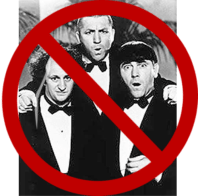
- A caricature of worldly chaos from plurality in our culture – particularly found in three persons would naturally be “The Three Stooges” – Moe, Larry and Curly.
- The Three Stooges were an American vaudeville and comedy team active from 1922 until 1970, Their hallmark was physical farce and slapstick. 3 knuckleheads always fighting with each other, miscommunicating, unable to accomplish anything or get anything straight – always in conflict. A caricature of Plurality in Dissension.
- I grew up on the 3 Stooges. To this day my brother and I will occasionally resurrect a classic Stooges routine – like when Larry and Curly are trying to hammer in a nail. Curly, holding the nail keeps moving his hand and Larry keeps missing and hitting Curly’s hand. Curly finally says, “Ok, when I’m ready, I’ll nod my head and you hit it with the hammer.” So, naturally, when Curly nods his head, Larry hits Curly’s head with the hammer.
- The 3 Stooges are an exaggeration but this is true for most people in this world. I have my own experiences – At one time in my career I had three different bosses
- It was not a good experience. Each boss had their set of objectives and deliverables and spent no time trying to coordinate or prioritize my responsibilities amongst them.
- I was left being constantly jerked around by three persons, each of whom thought that their objectives were of the greatest importance.
- My son is going through the exact same experience today. He is working for 3 bosses and it is leading to confusion, anxiety and disharmony and tremendous inefficiency.
- This is why, when I was on the Board of Elders about 10 years ago, when we had decided to reorganize the staff leadership and a proposal was brought forward for the current structure of 3 co-leaders, I had serious reservations. Because in my experience a plurality leads to disharmony and disunity.
- It usually takes one strong leader to coral differing goals and objectives into one unifying mission.
- Fortunately, what we have found for BRC is what it takes is the right 3 people who, individually and collectively follow Jesus to glorify the Father being led by the Holy Spirit. In other words, they and the organization have the one true leader leading them.
- We see it in our US government. Arguably the best form of government on the planet comprising the 3 branches of Executive, Legislative and Judicial. How well is that working today when there seems nothing but dissention and disunity and disharmony?
- So, once again, most of the evidence in our world points to the fact that where there is plurality there is disharmony.
But, what we find in scripture is the Godhead in perfect unity; all three Persons of the Trinity moving together in complete harmony. Each member of the Trinity being eternal and equal in all things.
Do we have, in this world examples of multiples in harmony as one?
- Certainly, we have many examples in this world of multiples becoming one.
- When Adam and Eve came together they made 1 flesh. Intended for marriage.
- We have organizations, teams, bands that when individuals perform well together as groups we recognize them as 1.
- There are activities comprised of multiple actions known as one thing – Pulling, stroking, kicking, breathing are actions that come together in water to be called 1 thing – swimming.
God emphasizes His unique character in the Universe, His role as the only LORD, the only Creator. This emphasis does not, however, exclude a plurality within that unity.
- The Scriptures are full of implications that the One God is more than one Person, beginning with the very first verse of the Bible.
- The Bible opens with seven words, using 28 letters in the Hebrew: In the beginning, God created the heavens and the earth. Genesis 1:1
- Focusing on the words God created. The word for “god” in Hebrew is el or eloah, and the plural form is Elohim. The noun and verb have to agree in most languages, often more rigorously than in the English. Elohim is plural, and yet, the word bara for created is a singular verb.
- In fact, every place Elohim occurs in reference to the God of Israel we find the grammatical error of a plural noun used with a singular verb. These are the only times that this grammatical “error” occurs in the Bible, much less anywhere else.
God often refers to himself in the plural
- And God said, Let Us make man in Our image, after Our likeness’” Genesis 1:26
- And the LORD God said, Behold, the man is become as one of Us, to know good and evil… Genesis 3:22
- And let Us go down, and there confound their language, that they may not understand one another’s speech. Genesis 11:7
Okay, Plurality but where do we find the 3 Persons Identified?
- each member of the Trinity has His own distinct identity.
- Throughout Scripture, we consistently find all three members of the Trinity mentioned as God, yet acting and speaking as distinct from one another.
- One of the most interesting examples of this plurality is found in the 2nd Psalm, where we find all three Persons of the Trinity speaking.
- I’ve read this psalm and others like it and it can be very confusing. Who’s speaking? It becomes clearer if you consider multiple people are engaged in some form of conversation.
- The 2nd Psalm opens with the Holy Spirit speaking through the Psalmist. Initially He appears to be speaking to the other persons. Then, in conclusion, He acts somewhat like a Narrator speaking to the earthly kings on behalf of the Godhead.
HS – Why do the nations rage, And the people plot a vain thing? The kings of the earth set themselves, And the rulers take counsel together, Against the Lord and against His Anointed, saying, “Let us break Their bonds in pieces And cast away Their cords from us.” He who sits in the heavens shall laugh; The Lord shall hold them in derision.
Then He shall speak to them in His wrath, And distress them in His deep displeasure:
The Father – 6 “Yet I have set My King On My holy hill of Zion.”
The Son – 7 “I will declare the decree: The Lord has said to Me, ‘You are My Son, Today I have begotten You.
The Father – 8 Ask of Me, and I will give You The nations for Your inheritance, And the ends of the earth for Your possession. You shall break them with a rod of iron; You shall dash them to pieces like a potter’s vessel.’”
HS – 10 Now therefore, be wise, O kings; Be instructed, you judges of the earth. Serve the Lord with fear, And rejoice with trembling. Kiss the Son, lest He be angry And you perish in the way, When His wrath is kindled but a little. Blessed are all those who put their trust in Him.
Moving to the New Testament, the best examples of the three persons working in harmony in Jesus’ baptism in Matthew 3:16-17, The Transfiguration in Matthew 17 and in then all 3 of the temptations of Jesus, all of which were promises made for the Messiah in Psalm 2:6,8-9 above.
The Names of God – Unity in Plurality
- The Bible tells us a lot about the Father, the Son and the Holy Spirit, their unity and their plurality, even through God’s names and titles.
- There is a long list of names for God in Scripture-derived from three primary ones:
- Elohim (the creator God),
- YHWH (Yahweh) (The Covenant Keeper), and
- Adonai (The Owner or Master)
These are translated in our English Bibles as God, LORD, and Lord.
Yahweh as an example –
- We know the Father as Yahweh as identified throughout the old testament (The God at burning bush, plagues, splitting red sea, giving the Law)
- but we also see examples of ‘The Spirit of Yahweh’ identified in 1 Sam16:13 where it says “the spirit of the Lord came upon David from that day forward.”
- And then in Isaiah 45 in the great prophetic words about Jesus, Jesus is identified as Yahweh. The words from Isaiah are then repeated by Paul in Philippians 2 concluding with “that every tongue should confess that Jesus Christ is Lord, to the glory of God the Father.”
Holy, Holy, Holy
- Another acknowledgement of the three persons is found in the earliest vision of God’s throne in Isaiah 6 – The Temple itself is known as the “Holy of Holies” but its precise label in the Hebrew is the “Holy Place of the Holy Ones” – plural.
- There the Seraphim cry out and repeat “Holy, holy, holy, is the Lord of hosts: the whole earth is full of His glory.” Isaiah 6:3.
- This is later repeated in Revelation 4 “holy, holy, holy, Lord God almighty.”
- It may be that holy is repeated for emphasis to hammer home the point of God’s holiness but maybe the “holy, holy, holy” is a testimony to each person of the trinity.
The Lord of Hosts
- Isaiah is particularly focused on God as the LORD of Hosts who fights his enemies.
- 1 Sam 17 David says to Goliath, “but I come to thee in the name of the Lord of hosts”
- Then in the new testament John quotes Isaiah 6 in reference to Jesus in John 12 where he is ascribing the Lord of Hosts to Jesus Christ.
- Then in Acts 28 Paul quotes the same passage from Isaiah 6 but this time ascribes it to the Holy Spirit saying, “Well spoke the Holy Ghost by Isaiah the prophet”
- The plurality involved in the “Lord of Hosts” includes the Father, Son and Holy Spirit.
The First and the last – throughout the Bible, appears the term and the prepositional modifier alpha and omega – the beginning and the end in connection with the Father, the Son and the Holy Spirit. Another example of one name referring to all the members of the Godhead.
All three Persons can be found in each of the names of God.
What About The Works of God?:
- Going through the Bible we discover that the members of the Trinity are all declared to have wrought the same works entirely, completely and independently by Himself.
- Every Works of God is expressed in Scripture for each of the three persons.
- Creation and the Incarnation we find all 3 as given credit.
- Tons of scriptural references testify to God the Father is the creator of all things.
- Yet we see the Gospel of John and in Colossians all things were created by Jesus
- And then in many places beginning with Genesis 1 the Holy Spirit is honored as a participant in Creation.
- What about the redeeming Death of Christ? – Who was responsible? Jews/Romans?
- We find in scripture that it was actually the Father, Son and Holy Spirit.
- The Father in Romans 8 – ‘he that spared not His own son but delivered him up.”
- The Son in John 10: – “I lay down my own life, that I may take it again. . . I have power to lay it down, and I have power to take it again.”
- The Holy Spirit in Hebrews 9 – “How much more shall the blood of Christ, who through the eternal Spirit offered himself.”
- The atonement – Like the crucifixion, all three members of the trinity are involved – The Father in Isaiah 53, The Son in Ephesians 5 and The Holy Spirit in Hebrews 9.
- The resurrection of Christ – The father in Acts 2, The Son in Romans 6, and the Holy Spirit in Romans 8.
Scripture highlights the same Unity in Plurality in:
- The resurrection of Humankind
- The Inspiration of Scriptures
- Minister’s authority
- The work of Sanctification
- The Indwelling Presence – I think of Jesus leaving the Holy Spirit as Indwelling in us but scripture reveals that it is all three – Holy Spirit 1Cor 6, the Father in Ephesians 4, the Son in John 14. All indwell in us.
What About The Attributes of God?:
Every Attribute of God is expressed in Scripture for each of the three persons.
- Eternal Existence
- Infinite Power
- Omniscience
- Omnipresence
- Holiness
- Truth
- The believer’s Safekeeping
But, why the 3? Are there distinctions?
The Father – Scripture Identifies that the Plan of Salvation is His Plan. And Jesus indicates that Only the Father knows the day and the hour of the end of our age.
Jesus –
- Jesus Christ has a distinct nature in the Bible as the Word of God in human form, the Messenger and the Message, God-made-flesh to demonstrate in blood and bones the person of God in a way we can see and touch and handle (1 John 1:1).
- It’s through the Son that we see the full measure of the Godhead’s love.
- He bears the Scars – the burden of becoming incarnate and dwelling among us.
- Only Jesus is worthy to open the Book of Life
Holy Spirit –
The Holy Spirit was sent to
- Dwell in us as a comforter (Romans 15:16),
- Move actively in our lives every day
- Teach us the love of God and true righteousness (John 14:26),
- To sanctify us and
- To give us gifts to edify each other (1 Corinthians 12).
- In the Old Testament, the Holy Spirit came upon men and women for specific purposes and seasons. The benefit that we now have as believers in Christ, is that the Holy Spirit indwells us “without repentance” (Romans 11:29, Philippians 1:6)
- The Holy Spirit has a unique position, a unique job on Planet Earth, and Jesus makes it clear that He is a separate individual from the Father and the Son. John 15 & 16
But what about the one scripture I mentioned before?
The only passage in the entire Bible that explicitly delineates the doctrine of the Trinity is found in First John 5:7 – 8 — but only in the King James Version. It says: “For there are three that bear record in heaven, the Father, the Word, and the Holy Ghost: and these three are one.” Is this actually a case of in-authentication? It came from a homily in the eighth century. It was added to a Latin text and wasn’t even translated into Greek until 1520. It’s obviously inauthentic.
So, Christian turned atheist Frank Zindler says that deleting this reference “leaves Christians without biblical proof of the Trinity.”
In response renowned textual critic, Daniel B. Wallace, a professor of New Testament studies at Dallas Theological Seminary and executive director of the Center for the Study of New Testament Manuscripts says, “I’m going to be uncharitable here: that’s just such a stupid comment, I can hardly believe it,” he said. “The Council of Constantinople in AD 381 and Chalcedon in AD 451 emerged with explicit statements affirming the Trinity — obviously, they didn’t need this later, inauthentic passage to see it. “The Bible clearly contains these four truths: the Father is God, Jesus is God, the Holy Spirit is God, and there’s only one God,” Wallace said. “And that’s the Trinity.”
OK, so there are 3 persons clearly identified in scripture, working in complete unity but having distinct role/purpose. How do I relate to each?
- What probably has confused me most early in my Christian walk is the question of how am I to be in relationship with each person of the Trinity?
- When I interact with God, who do I interact with? They are supposed to all be equal. I hear most people pray to the Father, but I hear people pray to Jesus. I don’t hear people pray to the HS but he is an equal member of the Trinity, isn’t He? Though I do hear people cry out to the HS.
- Well, we know that when asked by his disciples, Jesus taught to pray to the Father and to pray in His name. But then Jesus encourages us to call on Him. Then Jesus told His disciples that he would be going but He would leave the Holy Spirit for them.
- So, how and when do I engage with each of person of the Trinity?
- Well, as I have wrestled with this, considered it and meditated on scripture on this, this is what I have concluded:
We again must consider FUNCTION:
- The Father is the Great I Am sitting on the throne
- We pray to the Father in Jesus name as no one comes to the Father except thru Jesus.
- The Father responds through the Holy Spirit
- The Holy Spirit carries a transmitter to speak with us, a battery pack to energize us and a Flashlight that shines the light on Jesus
- The light reveals Jesus’s life and character and sacrificial love.
- It also reveals Jesus doing something. What is He doing? He is pointing back up. to where? Back up to the Father.
- It is a picture of the ongoing dance of the Trinity.
- Our relationship is with each person of the Trinity. We are taught by Jesus to pray to the Father in Jesus’s name. Where’s the Holy Spirit in that? We engage with the Holy Spirit who provides the response – speaking to us, revealing truth and empowering us to be imitators of Jesus.
- We have been guided as to how and to who we should pray to but that does not preclude us from praising and worshiping equally each person of the Godhead. As they are in perfect unity, I am quite certain that there is no competition for our attention and for our affection.
- Acts 13:2 – While they were worshiping the Lord and fasting, the Holy Spirit said, “Set apart for me Barnabas and Saul for the work to which I have called them.”
In Conclusion:
- An appropriate way to conclude is to highlight another area of scripture that reveals the truth and purpose of our God consisting of Father, Son and Holy Spirit.
- In Genesis 48:15-16 Jacob gives a rather elaborate preamble to his blessing of Joseph and his two sons. He speaks of God as the object of divine worship and the source of blessing, but he describes Him in three specific ways:
- God, before whom my fathers, Abraham and Isaac, did walk.
- The God which fed me all my life long, unto this day.
- The angel (messenger) which redeemed me from all evil.
- Here we see God the Father as Leader and Teacher; God the Spirit, who feeds us, as the source of illumination, sanctification and comfort; and God the Son as the Redeemer. This list of God’s leadership, provision and rescue would suggest the Trinity even here in Jacob’s blessing.
- We find a very familiar similar blessing and benediction in Numbers 6:24-26 –
- “The Lord bless thee and keep thee…” In other words, may the benevolent love of God, the Father of mercies, the fountain of all good, bless you.
- “The Lord make his face shine upon thee and be gracious unto thee.” This reflects the redeeming and reconciling grace of our Lord Jesus Christ.
- “The Lord lift up his countenance upon thee and give thee peace.” This blessing is filled with the purity, the consolation, the joy received by communion with the Holy Spirit.
- And finally, we find the New Testament equivalent of the Old testament blessings in 2 Corinthians 13:14 where Paul closes his epistle with another, blessing / benediction:
- The grace of the Lord Jesus Christ,
- and the love of God, and
- the communion of the Holy Spirit, be with you all. Amen.
- The “New Testament benediction” is perfectly aligned with that in Numbers 6
So, we find all 3 members of the trinity specifically and uniquely operating throughout the Old and New Testament. We find each one named by the same names for God, each one active in every major work of God, each one possessing the same attributes of God. Each having a unique purpose /function but working in perfect unity and harmony.
********************************************************
>Becoming ‘Oblivious Man’ – BRC Easton CT – 2/4/2018

Philippians 3:12-14 – Not that I have already attained, or am already perfected; but I press on, that I may lay hold of that for which Christ Jesus has also laid hold of me. Brethren, I do not count myself to have apprehended; but one thing I do, forgetting those things which are behind and reaching forward to those things which are ahead, I press toward the goal for the prize of the upward call of God in Christ Jesus.
- As I get older I’m getting pretty good at practicing something that the Apostle Paul apparently excelled at. Now what was that? Oh, yes – Forgetting.
- In Philippians 3 Paul says, “one thing I do is forgetting”
- More and more often I’m forgetting my keys, my glasses, my iPhone, where I left things, or, I may go to the grocery store and come home with bags of groceries but forgotten the one thing Eleni has asked me to get. A few months ago, when I arrived in Easton to speak, I realized I had forgotten my sermon notes!
- Unfortunately, when Paul talks of forgetting those things which are behind, he is not talking about that kind of forgetting.
- Now, I don’t know about any of you, but there have been plenty of experiences/episodes in my life I wish I could forget. Embarrassing moments, bad behavior, words I wish I could take back. Sometimes when I’m doing something, some completely random memory will pop into my head and I’ll just shudder with embarrassment at the thought.
- I’m pretty sure we all have at least one “Most Embarrassing Moment” in our lives.
One Embarrassing moment I’d like to forget. (I’ve got your attention!)
It was the late 1980’s and I had just taken a job as the Chief Financial Officer for a small start-up company affiliated with a major hospital system. It was a for-profit business developed to support the System’s not-for-profit mission. It was a move from the Corporate finance world to a more of a not-for-profit environment and many people questioned the career move. However, one of the reasons I took the job was because of the opportunity to engage with the major corporate senior executives who sat on the Hospital System Boards. This provided exposure that could lead to further career opportunities.
The president and I would provide monthly updates to our BOD and periodically provide update reports to the larger System BOD. For me, this was my time to shine!
On one occasion, I had diligently prepared for my 15-20 minute financial presentation, however just minutes before I was to present, my boss informed me that there was a change to the agenda and that I needed to do my presentation in less than 5 minutes.
I quickly shuffled through my presentation to determine what I could eliminate but everything seemed to be of equal importance. So, I made the terrible decision to just speak very fast. If you don’t know this already about me, my mouth/tongue just do not move at a faster speed without causing some problems.
The tension mounted as I waited to be called forward. My boss nodded to me and I stood and clicked to bring up the first slide and then began ripping through the material. I was doing okay, only stumbling over a few words here and there but then “it” happened. I don’t believe there is a name for this particular phenomenon but it is where you take 2 words, cram them together and form another existing word that you did not intend to say.
The closest thing I could find is something called a portmanteau word (sometimes referred to as a Frankenword) – a linguistic blend of words in which parts of multiple words are combined into a new word, as in smog, coined by blending smoke and fog, or motel, from motor and hotel.
A Frankenword is intentional while the result of my misspeaking was unintentional. As I look back I believe the 2 words were “Farther Out” which resulted in me very distinctly saying the shortened slang word for flatulence. When I said the word, I was looking at my boss whose eyes immediately bulged as his jaw dropped. The other Board members who were not paying all that much attention, snapped their heads around to look at me with quizzical looks saying “Did you just say what I think you said?”
Somehow, I pressed on and finished up but took my seat completely embarrassed and certain that my hopes for career advancement through this group was now over.
- Now, I can look back and laugh at that memory but there are other, more painful memories, that just won’t easily be forgotten
- As I went through this study I found that The Bible is full of Scripture crying out to “Remember” – God calling out to us to remember Him and all he is and all he has done and all he is capable of doing. Or, his people crying out to God to remember them in times of trouble and despair. Only in one instance are we challenged to forget.
- One of my favorite set of verses in the Bible is Philippians 3:12-14 – Not that I have already attained, or am already perfected; but I press on, that I may lay hold of that for which Christ Jesus has also laid hold of me. 13 Brethren, I do not count myself to have apprehended; but one thing I do, forgetting those things which are behind and reaching forward to those things which are ahead, 14 I press toward the goal for the prize of the upward call of God in Christ Jesus.
- I have loved it because Paul is urging us to forget the past. Whatever foolish, hurtful things we have done – whatever ways we have been hurt or damaged, just leave it behind and forget it. I love that, but it just doesn’t seem to come that easy.
- Why? Because there are often consequences and repercussions and other people involved that cause these memories to be resurrected. It can seem inescapable.
- And, it seems a bit like cheap wise-guy wisdom of the world – “Just Forget about it!”
- The Greek word for Forgetting – Epilanthanomai – includes in the definition “given over to oblivion”. (the state of being unaware or unconscious of what is happening)
- Depending on the context, the Greek word could be consciously or unconsciously forgetting. In this particular context, it is not a spiritual thing where a memory is magically wiped away. Paul says, this is what he does – He chooses to forget those things in the past.
- We all know this to be true in our lives. Memory of failures and mistakes, what we have been told we can or cannot do haunt us as a reminder “I’m not going there again.” I won’t risk embarrassment and failure because of my bad experiences in the past. But what if we could just wipe away these unwanted memories from our past?
Like a Spiritual Super Power
- In the movie comedy, Mystery Men – there are seven quirky amateur crime-fighters with strange powers including one who gets intensely angry, one who hurls silverware, a bowler, a shoveler, one who knocks people out by passing gas, and an invisible boy who can only become invisible when nobody is looking at him.
- My own super hero with unique super power – Forget-it Man or Oblivious Man – A comic book super hero whose unique super power is the ability to forget. The Super hero can “Forge-on” through any difficulty not being burdened with the memory of any weakness or failure or embarrassment. Every moment being new and fresh with the belief that he can do anything regardless of past experience to the contrary, to ultimately outlast any adversary or challenge to go on to ultimate victory.
Forge is the major part of Forget (A linguistic Connection?)
- I see Paul as the original Forget-it Man.
- Think of the baggage Paul had to carry around when becoming a Christian. He was a well-known enemy of the Christians. The disciples knew of Paul’s past and were seriously challenged to accept him. Think of what he had to overcome to be accepted into the Christian community and allowed to minister so powerfully.
- So, how did Paul say he was able to put his past behind him? Of all the things Paul could say to do – to pray, to meditate, to strive, to study, to exert faith, to do good works, to fast, to worship or to do any of the Spiritual disciplines – In Philippians 3:13 Paul says: but one thing I do, forgetting those things which are behind.
Let’s take a closer look at this one thing that Paul considered so valuable in order to put the past behind him
- Backing up to verse Philippians 3:12 Not that I have already attained, or am already perfected; but I press on, that I may lay hold of that for which Christ Jesus has also laid hold of
- Paul first acknowledges, as we all should, that he is not already perfected but that he presses on to lay hold of something. The Greek word for Lay Hold Of is Katalambano and it means to grasp (Physically or intellectually), to take possession of, to learn or understand. What is it that Paul seeks to grasp/understand?
- “That for which Christ Jesus has also laid hold/grasped (Katalambano) of ”
- The sentence structure is such that I have found myself over the years wanting to read this as what Jesus has laid hold of for Right? Jesus has grasped hold of a treasure for me and I want to lay hold of, or grasp that treasure.
- But, that is not what I believe it is saying. How much difference can one small word make? The word OF vs the word FOR.
- Greek for the word OF is Hupo – definition is by or under but half the time is translated as What does that mean?
- John – Nathaniel UNDER the fig tree, People convicted BY their own conscience
- Hupo references something from underneath or from within
- Numerous interpretations. I believe he is saying that what Jesus grasps/understands about me – what we were created to be, all of who we were intended to be, what he loves about us. Paul wants to grasp all of that. It goes back to the age-old believers question of, “How could a perfect God love a cruddy old sinner like me?”
- Paul desires to grab hold of and understand fully that which caused Jesus to grab hold of him. I want to see what God sees in me.
- God does love us and there are reasons for it and Paul wants to grasp and understand it. Why? Because a few verses earlier 4-6 Paul makes the case of how cruddy he has been in his life. How could God love this self-righteous, unloving, self-serving, power hungry, hateful accomplice to murderer who steered others to a path of legalism and darkness be loved by God?
- Paul goes on to say that in his search for what God understands about me, he says in verse 13 “Brethren, I do not count myself to have apprehended – it’s actually the same word for laid hold of (Katalambano). In other words, Paul is continuing the theme from verse 12. – I haven’t grasped it yet but one thing I do… Do with what? Do with the bad stuff from the past – all that he was and had become, he forgets it or as he declared in an earlier verse he “counts it all as lost”. And it also may indicate that it’s not just bad stuff and bad memories, but all of who he had become that might prevent him from becoming all he can be in Christ.
- So, then Paul declares his “one thing” – forgetting those things which are behind”
- Do we just forget? And that’s it? It’s that easy? How is he able to do that?
- No, he goes on to say “and reaching forward to those things which are ahead”.
- Paul may be a super hero but math may not be his best subject. Aren’t we talking about 2 things?
- forgetting those things which are behind, and
- reaching forward to those things which are ahead
- Let’s take a look at the conjunction used in the sentence that is translated here as “and”. The Greek word is De – a conjunction mostly translated as but or and but also translated as moreover, now, then, also, nevertheless, so, even.
- So, it could read as “the one thing I do, as I am forgetting those things which are behind, I’m (also/nevertheless) reaching forward to those things which are ahead.
- So perhaps the “one thing” is a move that accomplishes several things?
- The Greek for Reaching forward is Epekteinomai which means to stretch (one’s self) forward. While this is the only time it is used in the Bible, it is most often used in the context of sport or physical exertion.
- The Greek word is comprised of 2 primary words – Epi meaning UPON and Ekteino meaning PUT FORTH.
- Epi – Matthew 16:18-19 – And I say also unto thee, That thou art Peter, and upon this rock I will build my church;
- Ekteino – Mark 1:41 And Jesus, moved with compassion, put forth his hand, and touched him,
- The imagery that comes to mind is a climber going up a rock face – resting his hand upon the next handhold and pulling themselves up and forward, putting his hand forth for the next handhold leaving that rock behind. Moving forward and upward.
- Or a powerful swimmer doing the breast stroke who cups the water in front of them, shoving it behind and propelling them forward. Putting that water behind is the only way to move forward.
- So, it seems to me that Paul is indicating that to effectively forget that which is behind us we must be moving forward with all of our interest and attention on pressing on to what is ahead
- What are we reaching forward for? Paul goes on to say in verse 14 “I press toward the goal for the prize of the upward call of God in Christ Jesus.
What’s the prize of the upward call of God in Christ Jesus?
- A prize is something you win and is earned so it certainly is not salvation which we know cannot be earned.
- I think we have to go back to previous verses where Paul talks about what He desires to attain:
- Phil 3:7- 11 if, by any means, I may attain to the resurrection from the dead.
- But in the original Greek it uniquely says, “resurrection “out from” the dead?
- He’s using it in a different context. We strive to resurrect ourselves from what we had become to then become that perfect creation God intended us to be – each of us unique but still a perfect reflection of Jesus. That’s the “Prize!”
- I believe Pastor Josh focused on what the prize is in his sermon last week found in Ephesians 2:10 “For we are His workmanship, created in Christ Jesus for good works, which God prepared beforehand that we should walk in them” where Paul declares that we are His works of art created in Christ Jesus.
- NLT – For we are God’s masterpiece.
- Do we really see ourselves that way? Giving over to oblivion the old man/who we were – all the wounds and hurts and failures and messaging telling lies about who we can never be? All of that may have to be jettisoned in order to fully discover our true identity in Christ.
- Colossians 3: 9-10 – you have put off the old man with his deeds, 10 and have put on the new man who is renewed in knowledge according to the image of Him who created him.
- Forge is the major part of Forget – Are we called to forget everything? No, only those things which inhibit us from moving forward to become all we were created to be in Christ Jesus
Not that God is forgetful, yet even He chooses to forget –
- Psalm 103:12 As far as the east is from the west, So far has He removed our transgressions from us.
- Micah 7:19 He will again have compassion on us, And will subdue our iniquities. You will cast all our sins Into the depths of the sea.
- Isaiah 38:17 Indeed it was for my own peace That I had great bitterness; But You have lovingly delivered my soul from the pit of corruption, For You have cast all my sins behind Your back.
- Sounds a bit like Paul in Philippians 3
********************************************************
>Engaging the Engaging God – BRC Stamford, Feb 2017
DRAW NEAR – The Spiritual Two-Step
James 4:7-10 – Therefore submit to God. Resist the devil and he will flee from you. 8 Draw near to God and He will draw near to you. Cleanse your hands, you sinners; and purify your hearts, you double-minded. 9 Lament and mourn and weep! Let your laughter be turned to mourning and your joy to gloom. 10 Humble yourselves in the sight of the Lord, and He will lift you up.
“Accept the risen Jesus into your life. Even if you have been far away, take a small step towards Him: He awaits you with open arms.” – Pope Francis
“Draw Near” in the Bible
Draw Near – To move closer towards something – To come closer in place, time or personal relationship.
Old Testament: Hebrew: Nagash – naw-gash’ – Psalm 73:28 – But it is good for me to draw near to God; I have put my trust in the Lord GOD, That I may declare all Your works.
New Testament: Greek: Eggizo – eng-id’-zo – Hebrews 10:22 – let us draw near with a true heart in full assurance of faith,
Other than being directed to draw near to God the phrase is used for:
- People drawing near to hear or to speak
- Time drawing near to an event
- Redemption drawing near
- Counsel of God drawing near
- Mothers drawing near to the time of delivery
- Armies drawing near to the enemy or a battle
- Jesus drawing near locations – mountains, lakes, cities
- And then you have the people and crowds clamoring to Draw Near to Jesus
But before we dive into the study of Drawing Near let’s talk about what causes us to want to Draw Near – the Desire that causes us to Draw Near to an object of our Desire – that which motivates us to make the effort to Draw Near.
In my opinion our spiritual life starts with DESIRE. Desire drives DETERMINATION to “Draw Near” to what is on our heart.
A Story of Desire and Determination – They go hand in hand as determination is the clearest evidence of our desire:
The year was 1916 and an 8-year-old boy trudged through the Kansas snow with his older brother early one morning. Their job was to warm the schoolhouse before the teacher and their classmates arrived. The older brother went to pour the kerosene onto the coals. However, someone had mistakenly replaced the kerosene with gasoline. When the gasoline hit still smoldering coals it exploded and the boys were engulfed in flame.
The older brother did not survive his burns while the younger suffered from major burns over the lower half of his body. From his bed the young boy heard the doctor say he would also surely die – but even if he did survive, he’d be a cripple.
But the boy’s DESIRE was to live and though he lay on the brink of death, he did survive. Then he heard the doctor talking of amputating his legs but, the boy’s DESIRE was to not be a cripple and he determined that he would walk again. He pleaded for his legs and the Doctor relented.
With his thin legs dangling, lifeless every day his family would clean and massage his legs, but there was no feeling, no control, nothing. Yet, his DESIRE to walk grew and one day while sitting in his wheelchair in the back yard he threw himself from the chair, pulled himself across the grass, dragging his legs behind him.
He worked his way to the white picket fence and pulled himself up. Then, stake-by-stake, he began dragging himself along the fence, resolved that he would walk. He started to do this every day until he wore a smooth path all around the yard. His sole DESIRE was to develop life back into those legs.
Twenty-two months later he stood up and took his first step, then began to stumble a few steps, then to walk by himself. Soon he was able to painfully walk all the way to school. But, then he discovered that it was less painful when he ran so he ran – and he ran everywhere. I imagine he was the original Forrest Gump. He joined the track team and was soon beating boys much older than himself, eventually earning a track scholarship.
And on June 16, 1934 in Madison Square Garden this young man who was not expected to survive, who would surely never walk, who could never hope to run – ran the world’s fastest mile. Glenn Cunningham ran the mile in 4 minutes, 6.8 seconds breaking the world’s record.
Glen had accepted Christ as a young boy, but as he went through life’s ups (including Olympic medals and earning a doctorate’s degree) and downs (including divorce and other physical challenges) he realized that even with God miraculously meeting Glen’s desire to have full use of his legs, there was an even greater DESIRE for God’s calling in his life. In 1946 he opened the first Glenn Cunningham Youth Ranch where during his lifetime he was able to help raise well over 10,000 underprivileged kids in a LOVING, Christ-centered environment.
So, the question is, “What is our true desire?”
Psalm 27:4 – One thing I have desired of the Lord, That will I seek: That I may dwell in the house of the Lord All the days of my life, To behold the beauty of the Lord, And to inquire in His temple.
Desire – Ta’avah – desire, wish, longings of one’s heart, lust, appetite
Even before our desire is God’s desire
- It all starts with DESIRE but even before our desire is God’s desire – James 4:5 – Or do you think that the Scripture says in vain, “The Spirit who dwells in us yearns jealously”?
- Both Greek words for Yearn (Epipotheo) and for Jealously (Phthonos) have as part of their definition “Desire”. So James is expressing a double desire on the part of God’s Spirit.
- Basically James is saying that God desperately desires after the desire he holds for that which his people desire elsewhere – He’s jealous of whatever the thing is we passionately desire. He desires that same desire for himself.
- Why? Because it means our desires have drawn us away from him. And He desires us to draw near to him.
Generally, what is the Purpose of Drawing Near?
When we draw near it is about the effort to come closer, to become more intimate so that we can actually engage more effectively.
- Imagine two boxers in a ring and neither will draw near enough to land a punch. You just have two guys flailing away at the air and nothing being accomplished.
- Picture being alongside a busy freeway and there is someone on the other side you are trying to have a meaningful conversation with. Trucks and cars are whizzing by and each person is only catching a few words here and there. You have to make your way across the highway to more effectively communicate.
- My second short term trip to Panama was a medical mission out in a very isolated area. We set up in an abandoned building and Villagers came from miles, mostly walking to get the medical care they needed. Some showed up at the end of the day after walking all day.
Now, remember also, that Drawing Near is critical to engaging but it is not Engagement. When an army draws near to the enemy, the “Drawing Near” is not engaging the enemy in battle; they are making the effort to come close enough to effectively fight the enemy. When we draw near it is about the effort to come close enough to fully engage another.
So James 4:8 says – Draw near to God and He will draw near to you.
Now, while I am not into spiritual formulas. Just when I think I’ve figured out how God works He does something new. Jesus, himself, acted in ways that were unique to each situation.
But I believe that this is a legitimate spiritual dynamic – to draw near to God and he responds by drawing near to me found in James 4:8 which I call:
The Spiritual Two-Step – is something like a dance. This dynamic has demonstrated to be true over and over in my Christian experience. Even from the moment I first heard the Gospel. God has made himself known. He has made his love for us known. His desire for us is made evident. (Romans 1:20 – For the invisible things of him from the creation of the world are clearly seen, being understood by the things that are made, [even] his eternal power and Godhead; so that they are without excuse)
He stands with open arms (The Eternal Gentleman) waiting for us to take the step towards him and then He responds. He does not impose himself.
The Greek word for Prayer (pros-yoo-khom-ahee) root word – pros – is a preposition of direction – forward – toward – along side of – drawing close to. yoo-khom-ahee – make your wishes known.
Even the second Greek word sounds like A Wise Guy calling you to come closer. “Eh, you want a piece a me? Yoo-khom-ahee”
So what is required of us to Draw Near to God?
I believe the answer is found in the scriptures around Verse 8 – Draw near to God and He will draw near to you.
James 4:7-10
- Therefore submit to God. Resist the devil and he will flee from you.
- Cleanse your hands, you sinners; and purify your hearts, you double-minded.
- 9 Lament and mourn and weep!
- Let your laughter be turned to mourning and your joy to gloom.
- 10 Humble yourselves in the sight of the Lord, and He will lift you up.
Before James encourages us to Draw near to God in verse 7 he says “Therefore” What’s the There For? Because the previous scriptures talk of the entanglements of the world and now James is talking about how to escape that.
Submit to God and resist the devil
Submit – Hupotasso – hoop-ot-as’-so – A Greek military term meaning “to arrange troops in a military fashion under the command of a leader.
Resist – Anthistemi – anth-is’-tay-mee – to set one’s self against, to withstand, resist, oppose.
In the 1980 move “My Bodyguard” a young weakling kid is being bullied by kids bigger than him. The weakling agrees to assist an even bigger/older kid rebuild his motorcycle. In exchange the older boy agrees to be his bodyguard. So the next time the bullies bother the boy, they are surprised when he stands up and resists. Then the bullies run off in fear. Why? – because the bullies see the weakling resisting as he now has someone even more powerful and threatening standing behind him.
So this takes the devil’s influence out of the equation.
Part of Submitting is faithfully carrying out God’s call even if we don’t fully understand the purpose – Baptism (putting ourselves under God’s authority)
Now we’re talking about Drawing near in relationship to God. What does God say is required? What’s the recipe? I believe it is found in the 2nd half of verse 8 through verse 10.
- Cleanse your hands, you sinners. What does that mean? The Greek word for hands actually refers to that which we do with our hands. We need to as they say “Clean up our act!” But wait. I thought our sins were forgiven? True. But this is not about our salvation but about drawing near in relationship with God. It’s about dealing with those things we make a greater priority than our relationship with God.
- Purify your hearts, you double-minded. The Greek word for Heart is referring to that which is central to us. When we purify water it is about cleaning out the harmful things that don’t belong there. Be single minded and pure about what is important to you.
God wants us to deal with what we actually do and also what is on our heart.
Now, as someone who is fully convinced of God’s goodness and that that fruit of the spirit displays the beautiful character of God and that Jesus’ declaration in Matthew 10:10 is true that he came so that we would have an abundant life, verse 9 has been a troublesome verse for me. I mean, really James? What a downer!
Lament and mourn and weep! Let your laughter be turned to mourning and your joy to gloom.
This is how we draw close to God by being a sad, pathetic creature?
Taking a closer look, I believe that this is referring to those things that James is saying we need to cleanse and to purify. Letting go of those things that draw us away from God. They, however, are things that have grown in importance and what we rely on to get ourselves through life and the letting go of those things will not likely be easy.
As an extreme example let’s consider a heroin addiction. Verse 9 is actually an amazing description of what someone goes through on withdrawal while breaking a habit.
- Lament and mourn and weep! It’s like a smorgasbord of anguish!
- Lament – Talaiporeoto – to endure labors and hardships. To feel afflicted and miserable.
- Mourn – Pentheo – Experiencing loss
- Weep – Klaio – weeping as the sign of pain and grief
Philippians 3:8 – Yet indeed I also count all things loss for the excellence of the knowledge of Christ Jesus my Lord, for whom I have suffered the loss of all things, and count them as rubbish, that I may gain Christ
Suffer Loss – Zemioo – dzay-mee-o’-o – to affect with damage, do damage to. to sustain damage, to receive injury, suffer loss.
- Let your laughter be turned to mourning and your joy to gloom
- The Greek for Let your is Humon meaning of yours
- The laughter of yours is turned to mourning and your joy to gloom
What gave you euphoria and laughter and joy before is now a source of mourning and gloom. The excessive alcohol and drug party inevitably leads to a painful hangover and being left face to face with an even more dismal reality of this life. The Medication is short lived
The word Turn in the Greek is Metastrepho and it actually means to pervert
Finally, he echoes Jesus’s words in verse 10 saying,
- Humble yourselves in the sight of the Lord, and He will lift you up.
If we will make ourselves of low position, God will what? Draw near to lift you up. But the Greek for Lift up is Hupsoo – which is not just to pick us up but to lift up on high, to exalt – to raise to the very summit of opulence and prosperity – to raise to dignity, honor and happiness.
Matthew 23:12 And whosoever shall exalt himself shall be abased; and he that shall humble himself shall be exalted.
James is saying that this is what needs to happen is a process of cleansing, purifying, lamenting, mourning, weeping and humbling! Okay, but what exactly can we do to draw near and for God to respond? How do we draw near? What does that look like?
- So that is what is required but what exactly can we do? What does this look like to Draw Near to God?
What did it look like in the Gospels? The people then had the advantage of having the  physical person of Jesus Christ that they could seek out and draw near to. Envision the many scenes in the Gospels where individuals like the centurion, the blind men who follow Jesus into the house, the Samaritan woman, Zacchaeus climbing the tree, the paralytic who was passed down through the roof, the rich young ruler that came running and knelt before Jesus, and all the crowds that followed Jesus, coming from great distances, through towns and cities, up hills and mountains and to the shores and out into the sea. In almost every case of healing there is an effort on the part of the people to Draw Near to Jesus. Unfortunately, we do not have a physical object to draw near to and to demonstrate our desire and determination towards.
So, if you ask most people what it means to Draw Near to God they would say that it means Praying and reading Your Bible.
Those activities, while vital Disciplines in Engaging God are not Disciplines about Drawing Near to God. If we feel that our prayer life and Bible study is not fruitful and we still feel distant from God it may be because we are trying to engage without first drawing near.
I believe that the tangible effort to Draw Near to God today can be found through exercising certain Spiritual Disciplines.
In Dallas Willard’s book The Spirit of The Disciplines he breaks the 15 disciplines into two groups – the 7 Spiritual Disciplines of Abstinence and the 8 Spiritual Disciplines of Engagement. What he calls the Disciplines of Abstinence I would say are all about Drawing Near so that you can then more Fully and more intimately Engage with God.
I will not go through each of these disciplines in detail today but just to summarize; each is an effort to remove the things of this world that bombard our senses and all that demands our attention and draws all our physical, emotional and spiritual energy leaving little left for God.
I would call them the Disciplines of Drawing Near. Each is an effort to abstain from the desires of this world to shift to the desire to engage with God.
Summary of the 7 Spiritual Disciplines of Abstinence (Drawing Near Disciplines):
We draw near spiritually when we seek to grow closer to God by:
- Solitude – entering into a place to be alone with God,
- Silence – entering into silence to be able to hear his voice,
- Fasting – dedicating time where His relationship is our sole sustenance,
- Frugality – dedicating a time where our pleasure is found only in Him and not in the luxuries of this world.
- Chastity – dedicating time where we do not dwell on the sexual dimension of our relationships.
- Secrecy – practicing letting God be our defender and Public Relations Department and,
- Sacrifice – practicing forsaking the security of meeting our needs with what is in our hands. With sacrifice we practice a different dimension of faith – putting ourselves in a position to enjoy our provision directly from the King. Psalm 51:16 – For You do not desire sacrifice, or else I would give it; You do not delight in burnt offering.
Wait a minute. Who has the time for any of that?
That is a very good question. And if you ask that then you have likely answered your own question. You likely never have any time to dedicate to God as you do all the other things in your life. Even good ministry work is too important to take the time to Sup with Jesus and enjoy a deeper relationship with Him that brings the full fruit of the Spirit into our lives.
However, while these practices can be sustainably practiced even in our busy lives, yet even periodically practiced will bear tremendous fruit.
Even in our daily or regular devotions with God when we practice the prayer acronym of ACTS we first Draw Near and then Engage:
- Adoration – Pushing all the cares of the world – food, luxury, disengaging our physical senses to adore God and to worship him.
- Confession – Clearing away the things that stand in the way of our relationship between you and God, which not only are offensive to God but also are barriers to our communication with Him.
- Thanksgiving. We can recall the wonderful things that God has done for us, and the gifts that we have been given. And so, we need to be constantly thanking God for his blessings because he is deserving, but also for how it increases our faith and expectation of the reality of God.
- Supplication or Intercession. I call it simply Sup – to Sup with God. Having drawn Near to God through ACT we Engage with God as if sitting down to break bread, making our wishes known (for ourselves and for others), asking for counsel and giving time to listen for God to respond. Sharing what is on our hearts and understanding what’s on His heart for us. Enjoying relationship with the Living God.
I’m not going to say that at any moment you can’t drop to your knees and call out to God and expect Him to respond – however, demonstration of tangible efforts to relationally engage with God will cause God to step forward to reveal himself in ever deepening ways.
In conclusion:
I present a challenge to each one of us this week to demonstrate to yourself this Spiritual Two-Step. Consciously make a decision to practice one of these disciplines to shove something aside in your life to make room for God, fully expecting that when you draw near in this way that God will respond to draw closer to you.
Ecclesiastes 5:1 – Walk prudently (Watch where you place your foot) when you go to the house of God; and draw near to hear rather than to give the sacrifice of fools
Romans 12:1-2 I beseech you therefore, brethren, by the mercies of God, that you present your bodies a living sacrifice, holy, acceptable to God, which is your reasonable service. 2 And do not be conformed to this world, but be transformed by the renewing of your mind, that you may prove what is that good and acceptable and perfect will of God.
Malachi 3:10 – Bring all the tithes into the storehouse, That there may be food in My house, And try Me now in this,” Says the Lord of hosts, “If I will not open for you the windows of heaven And pour out for you such blessing That there will not be room enough to receive it.
********************************************************
>Does God Get Disappointed With Us? – BRC Easton, 5/2017
Genesis 6:6 – The Lord regretted that he had made human beings on the earth, and his heart was deeply troubled.
Story of Disappointment:

It’s a big day. A young boy stands in the fading afternoon sun of the outfield anxiouslylooking at the growing crowd of adults. They are gathering to watch their kids play little league baseball. He’s looking for his dad.
The boy understands that his dad is busy. Theirs is a family of 9 kids. Dad has a long commute to work and gets home late so it’s hard for him to spread his attention to all of his kids. But this time his dad has promised to come see him play.
The boy’s heart jumps when he sees dad arrive. They wave to each other. He’s proud to have dad there and nervous, wanting desperately to impress his father with his play. The game starts. The boy presses as he weakly grounds out the first few times at bat. In the outfield he badly misplays a fly ball.
But, the big opportunity to impress comes in the last inning. It is the classic – bottom of the 9th, his team is down by 2 runs with the bases loaded and two outs. The boy peeks over to his dad who is cheering him on as he steps to the plate. He works the count to full. Here it is – the payoff pitch.
The boy steps out of the batter’s box. He is certain that the ball will be right down the middle. He is determined to swing with all his might to win the game, yes, to impress his dad but, more importantly, not to disappoint his dad.
The boy steps back into the box. The pitcher winds up and throws. It’s a fastball and the boy swings hard. The crowd does not cheer but gasps. The pitch was wildly off the plate and the boy still swung, flailing and missing badly. It was ball four but the boy – like mighty Casey – had struck out and ended the game.
The embarrassment and humiliation and shame of the disappointment rushes to his face in crimson red. He drags himself back to the bench and looks up to see his father standing there with a look of sad, painful disappointment in his face. The boy bursts into a shower of tears.
Have you ever disappointed others – disappointed yourself? The fear of disappointing others can paralyze some people. It’s one of the greatest fears of those serving in the ministry – to disappoint the flock.
Disappointment – is defined as the feeling of sadness or displeasure caused by the non-fulfillment of one’s hopes or expectations. The disappointment can create am myriad of emotions – sadness, regret, dismay, sorrow; dispiritedness, despondency, distress, chagrin; disenchantment, disillusionment; displeasure, dissatisfaction, disgruntlement, even anger and violence
But, what about God? Many of us carry a lot of fear and guilt that we disappoint God with our failures, our sin and our impure thoughts and actions. Does God get disappointed with us?
What does the Bible say about God and Disappointment?
Most of what I have read on this topic by Christian authors seems to run from the notion that God could not possibly be disappointed. How can an omnipotent, omniscient, omnipresent God, who is all powerful, always present and knows everything be surprised or disappointed?
I have comforted myself and others with the idea that God could not possibly be disappointed with us because of who he is.
However, after digging in for myself, the scriptures I looked at seems to indicate that God does get disappointed.
As I studied this I find the word itself “Disappointed” rarely shows up in any of the major translations.
KJV -Genesis 6:6 – And it repented the Lord that he had made man on the earth, and it grieved him at his heart. NIV – The Lord regretted (sorry, ashamed) that he had made human beings on the earth, and his heart was deeply troubled.
Later on in Exodus after engaging with Moses God decided not to destroy the grumbling Israelites saying in Exodus 32:14 – And the Lord repented of the evil which he thought to do unto his people.
- Hebrew – Chapher (khaw-fare’) Verb – Definition: to be ashamed, be confounded, be abashed or embarrassed, repentant
- My model Tank came out so bad that I blew it up with a firecracker
In the New Testament we find the Greek word:
- Kataischuno (kat-ahee-skhoo’-no) to dishonor, disgrace, to put to shame, make ashamed, to be ashamed, blush with shame, some hope has deceived
Romans 10:11 For the scripture saith, Whosoever believeth on him shall not be ashamed.
However, nowhere in the New Testament do we find indication that God is ashamed or disappointed with us
Yet, on a number of occasions we do find that Jesus seems taken by surprise and disappointed with his disciples
In Matthew 17 we have the epileptic boy that the Disciples could not heal. 17 Then Jesus answered and said, “O faithless and perverse generation, how long shall I be with you? How long shall I bear with you? (Sounds like disappointment to me)
In Revelations chapter 2-3 Jesus repeatedly with each church identifies what he has something “against them” indicating disappointment
Revelation 2:4 – To the angel of the church of Ephesus write – 4 Nevertheless I have this against you, that you have left your first love.
Against – Kata (kat-ah’) Preposition – it has this notion of “down from” or in this case “my thinking of you has been lowered” disappointment.
- So, how does that work? How can an omnipotent, omniscient, omnipresent God, who knows everything, be surprised or disappointed?
Now, I’m going to ask you to extend to me a little grace – a little latitude as I share my “theory” on this. Like Darwin’s “Theory of Evolution” it is only my opinion based of the evidence I have looked at.
“David’s Theory of Omni Suppression” – Using a sports analogy. There have been occasions when there was a major sporting event occurring at a time where I could not watch it live. Before I would set my VCR and now my DVR to record the event and then do everything in my power not to learn the result in order that I could later watch the game as though it were live – turning on the VCR and hitting play I could watch the game and even though the action was already played and the result concluded, I could sit and cheer or go into contortions, rooting (as if my rooting still could affect the result) for an outcome that had already been decided.
Okay, so, is it possible that our God could do something of the same thing with our lives? Could God actually hit a pause button on his Omniscient Attribute – to enjoy the thrill of rooting for His creation and experience the Joy of our victories and have the compassion to experience alongside of his creation the pain of our defeats?
- The Omnipotence Paradox
I know that it is a bit crazy and likely heretical to many Christian scholars. When I have brought this up with other Christians, invariably they will invoke what is known as The Omnipotence Paradox. The most well known version of this is the paradox of the stone: “Could God create a stone so heavy that even He could not lift it?”
My simple-minded answer to the question is – “YES!” God can do anything and if He chooses to create something that even he can’t or won’t lift, then He can do it because it is under His power and authority and it fits with His Goodness, Righteousness and Truth.
If you have a Theory, you must have some proof. What is my proof? My proof is that God – who he is – the very essence of God cannot be changed and the promises he makes cannot be changed – therefore God certainly can create something that will not be moved even by himself.
James 1:17 – Every good gift and every perfect gift is from above, and comes down from the Father of lights, with whom there is no variation or shadow of turning. Always consistent in His character.
Numbers 23:19 – God is not human, that he should lie, not a human being, that he should change his mind. Does he speak and then not act? Does he promise and not fulfill?
Hebrews 13:8 Jesus Christ is the same yesterday and today and forever.
But what I am suggesting here is not really the same thing – Can God turn off, not His character, but His power or attributes for His own pleasure and for the benefit of His creation?
- Okay, so if this is my Theory then what is my proof? My proof is that, I believe, God already did this. When? We find it in
Philippians 2:5 Christ Jesus: Who, being in very nature God, did not consider equality with God something to be used to his own advantage; rather, he made himself nothing by taking the very nature of a servant, being made in human likeness. And being found in appearance as a man, he humbled himself by becoming obedient to death—even death on a cross!
Jesus, the son of God, equal part in the triune God willingly gave up his power and Omni attributes when he came down to walk the earth as a man. He for the time could only be in one place at one time. He did not know all things and did not act with all power. So, I believe that God could do this.
So, is it possible that God could chose not to know every outcome, to enjoy being surprised, to enjoy the sensation of victory and to understand failure?
We know the definition of disappointment. Yet, I believe that there is a spectrum of disappointment moving from One end being
- Upset to the point of anger and seeking revenge and retribution for the failure and shame
- To the other end of the spectrum where there is shared sorrow and regret bringing understanding, compassion and comfort.
So, let me go back to the story I shared at the opening. Anybody guess who that little boy was?
As a little leaguer I can certainly remember teammates who failed badly only to be met by parents that were angry over the shame and embarrassment of their child’s disappointment.
However, my father’s look of disappointment was truly for the pain he felt for me and my own disappointment. My father expressed the loving compassion to throw his arms around me and to encourage me that “I’d get ’em next time!” He shared my disappointment but chose to love and console me.
I have always felt as though God is rooting for me/us – “Come on Dave, I have given you instruction and guidance and now there is this test in front of you – two paths to take. The answer is clearer than you think. Ask me and I will guide you. Come on Dave. I know your heart. You can do this!”
He delights in following our progress and providing guidance and direction – enjoying our victories and feeling our pain and shame in our defeats – knowing full well that ultimately, He, God is victorious.
Now, whether you believe in my theory or not, I believe in whatever way is hard for us to understand, our god is able to delight in our victories and console and encourage us through our failures.
What does God promise – The best? No, he desires for us an abundant life. He imagines for us a good and peaceful life with a future that offers great hope. In this world we will have tribulation but He has overcome the world
Jeremiah 29:11 – For I know the thoughts that I think toward you, says the Lord, thoughts of peace and not of evil, to give you a future and a hope.
NLV – For I know the plans I have for you,’ says the Lord, ‘plans for well-being and not for trouble, to give you a future and a hope.
Hope – Tiqvah (tik-vaw’) – cord. hope, expectation
Rahab and the Spies – Joshua 2:18 (NIV) unless, when we enter the land, you have tied this scarlet cord in the window through which you let us down,
As God cheers us on He is always encouraging us to put our hope in Him and the goodness, righteousness and truth only He can offer.
So, in conclusion, to answer the question, “Does God Get Disappointed With Us?” the answer is YES but it is all in the inflection of the word “WITH“. He is not disappointed in us but is disappointed along with us. Our God is a God who experiences life and relationship with as – He is the only God who can be called by the very name – Immanuel – God With us!
Matthew 1:23 “Behold, the virgin shall be with child, and bear a Son, and they shall call His name Immanuel,” which is translated, “God with us.”
You may think, “Nobody knows what I’m going through, nobody feels the pain I’m experiencing.”
But God knows!
He knows your feelings and frustrations. He’s seen the crisis in your soul. There’s no hurt that goes unnoticed by God. Psalm 56:6 says, “You know how troubled I am; you have kept a record of my tears.” (Good News)
Often when we’re hurting, we feel very isolated and lonely. Maybe there’s been a death in the family, a divorce, maybe we’ve gotten fired, and we start to think, “Nobody understands the way I feel; nobody can tell the way I feel; nobody feels the pain.”
But God knows, and “The LORD is like a father to his children, tender and compassionate to those who fear him.” (Psalms 103:13, NLT)
God not only sees, He cares!
He knows the causes, the reasons, the things that brought you to this point. He understands because he made you, and he sees the hurt in your heart like nobody else can.
Because God knows our frustrations and despair, we can give those feelings to God: “Give all your worries and cares to God, for he cares about what happens to you.” (1 Peter 5:7, NLT) Cast them all permanently on God, once and for all, and then, don’t take them back.
********************************************************
>Walking Wise Guys – Please Pass the Salt – BRC Easton 11/2016
Colossians 4:5-6 – Walk in wisdom toward those who are outside, redeeming the time. Let your speech always be with grace, seasoned with salt, that you may know how you ought to answer each one.
 When I last shared with you about the meaning of “Joy in Trials” the issue of Wisdom was brought up in James 1:5 which stirred me to take a closer look at What God says about Wisdom. The focus on what we will consider from God’s Word in Colossians 4:5-6 today is with “Wisdom” and in particular what it is and what it means to “Walk IN” wisdom.
- Scripture itself identifies Wisdom as a primary spiritual consideration for our lives:
- Proverbs 4:7 says that “Wisdom is the principal thing” “Principal” means first in time, place, order, and rank. (Among Knowledge, understanding,
- Proverbs 4:5 – Get wisdom! Get understanding! Do not forget, nor turn away from the words of my mouth.
- Proverbs 4:11 – I have taught you in the way of wisdom; I have led you in right paths.
- Proverbs 5:1 – My son, pay attention to my wisdom; Lend your ear to my understanding,
- The word for Wisdom in the Greek is – Sophia – wisdom, broad and full of intelligence; used of the knowledge of very diverse matters, the wisdom which belongs to men or supreme intelligence. (Interesting to note that it is used as a woman’s name)
- Specifically, the varied knowledge of things human and divine, acquired by acuteness and experience, and summed up in maxims and proverbs, the act of interpreting dreams and always giving the sagest advice, the intelligence evinced in discovering the meaning of some mystery.
- Even from this definition there is an indication of 2 major categories of Wisdom – The first is human wisdom or– Wise Guy Wisdom and secondly Godly Wisdom. So, what is the major difference between a “Wise Man” and a “Wise Guy”?
- When I hear the term “Wise Guy”, immediately what jumps into my mind comes from hours of TV watching when I was a kid. James Cagney or the 3 Stooges calling out somebody, “Oh, wise guy, eh?” They were calling out someone who was trying to be clever perhaps in a humorous way or trying to show them up or outsmart them. Mobsters began to call themselves Wise Guys as they thought they could always outsmart the Coppers – the rule of law.
- Wise Guys rely on their street smarts and clever instincts to fake out others in order to succeed. This is the epitome of Human Wisdom.
- Scripture does not speak very highly of Wise Guy wisdom –
- In 1 Corinthians there is a litany of condemnation toward worldly wisdom – it speaks of the failed wisdom of words, God will destroy the wisdom of the wise, God made foolish the wisdom of this world, we should not be speaking the wisdom of this age, If anyone among you seems to be wise in this age, let him become a fool that he may become wise. For the wisdom of this world is foolishness with God. my speech and my preaching were not with persuasive words of human wisdom, but in demonstration of the Spirit and of power, These things we also speak, not in words which man’s wisdom teaches but which the Holy[a] Spirit teaches, comparing spiritual things with spiritual.
- 2 Corinthians 1:12 – For our boasting is this: the testimony of our conscience that we conducted ourselves in the world in simplicity and godly sincerity, not with fleshly wisdom but by the grace of God, and more abundantly toward you.
- Colossians 2:23 – These things indeed have an appearance of wisdom in self-imposed religion, false humility, and neglect of the body, but are of no value against the indulgence of the flesh.
- James 3:15– This wisdom of the world does not descend from above, but is earthly, sensual, demonic.
- Godly Wisdom
- So, even in the commentary on human wisdom we get an idea of what Godly wisdom is:
- Simplicity, sincerity, grace, being circumspect. Wisdom that Teaches us spiritual things through the Holy Spirit and that can only be Spiritually discerned and are demonstrations of the Spirit and of Power.
- Scriptures referencing Godly Wisdom:
- In addition, other scriptures indicate that wisdom is – works done in meekness, something God is willing to give liberally, leads to redemption, where the word of God dwells, where the knowledge of His will dwells, truth that adversaries will not be able to contradict or resist, something our spirituality is built upon, it starts with the fear of the Lord, through wisdom mighty works are performed by His hands!
- Romans 11:33– Oh, the depth of the riches both of the wisdom and knowledge of God! How unsearchable are His judgments and His ways past finding out!
So, what does Godly Wisdom look and sound and feel like?
- The best and most complete description of how to identify Godly Wisdom comes from James 3:17– But the wisdom that is from above is first pure, then peaceable, gentle, willing to yield, full of mercy and good fruits, without partiality and without hypocrisy.
- Does this describe someone? – Sounds like a description of someone we might know – Jesus!? So, true wisdom is a reflection of the person of Jesus Christ.
- This is confirmed in Scripture:
- 1 Corinthians 1:24 – but to those who are called, both Jews and Greeks, Christ the power of God and the wisdom of God.
- 1 Corinthians 1:30 – But of Him you are in Christ Jesus, who became for us wisdom from God—and righteousness and sanctification and redemption—
- Colossians 1:28 – Him we preach, warning every man and teaching every man in all wisdom, that we may present every man perfect in Christ Jesus.
- Colossians 2:3 – in whom are hidden all the treasures of wisdom and knowledge.
- Let me digress for a moment – Because I have at times been confused about the difference between Knowledge and Wisdom.
- Knowledge is the accumulation of facts. Wisdom is the proper use of the facts. For instance – Knowledge will tell you that little black animal with a white stripe going down its back is a skunk. Knowledge will tell you that that skunk can excrete a pungent/burning spray. Wisdom will tell you do not go up and try to pet that little animal and to get out of there before you get sprayed.
- Now, when I was a youngster walking home from my friend’s house late one night, I did not exercise wisdom. I got skunked
Question: Are there different categories or purposes of Godly Wisdom? As I have spent time on this topic I have come up with three broad categories
- There is the Wisdom that:
- Individually guides us, directs us and blesses us – it answers the Who, What, Where, When and Why questions of life (though I don’t think we spend much time on the Why question though I believe based upon James 1 that James is referring to God’s eager desire to give us answers to the Why Questions in life.)
- God provides us Wisdom and guidance for others in the family of God. Often manifested as the Gift of Wisdom exercised for the building up of the church.
- Provided for redeeming those who are outside. We’ll talk about that shortly.
- For now, what do you think it means to “Walk” in Wisdom?
- The phraseology to “Walk in” something is very common throughout the Old and New Testaments.
- The scriptures repeatedly declare to – Walk in His ways, Walk in Truth, Walk in His Light, Walk in the Newness of Life, Walk in the Spirit, Walk in Godly Works, Walk in Love, And here in Col 4 Paul urges to walk in Wisdom.
- So what did I conclude before – that true Godly Wisdom is embodied in Jesus Christ. Col 2:6 says, “As you therefore have received Christ Jesus the Lord, so walk in Him”
- Peripateo – to walk – to make one’s way, progress; to make due use of opportunities – Hebrew for, to live – to regulate one’s life – how you conduct yourself as you pass through life.
But what does this phrase mean? I believe the most succinct way to say it is using the common phrase – “if you’re going to talk the talk, you’ve got to walk the walk”, or “walk it like you talk it”. There are various sayings that epitomize the notion that ‘talk is cheap’, for example ‘actions speak louder than words’ and ‘practice what you preach’. The context for the use of any of these expressions is in response to what is seen as empty boasting. People who are accused of such are said (in the USA) to ‘talk a good game’ or (in the UK) to be ‘all mouth and no trousers’. Exposed – The king has no clothes.
- In other words, It’s not enough to just know Jesus as head knowledge but we must experience Christ and live out this embodiment of Wisdom in our own lives – a living, breathing image of Christ.
- What this reinforces is our need to be studied in the Life of Christ – as our example of how to rely on Wisdom and the leading of the Holy Spirit in our lives. Dallas Willard (one of my favorite modern day theologians) in The Spirit of the Disciplines acknowledges that this is an area sorely lacking for most churches – studying the life of Christ – who he was and how he lived as our example to follow. Paul says in 1Cor 1:11 – Imitate me as I imitate Christ.
- But what is Paul saying to the Colossians? Why is it important to walk in Wisdom? Paul directs in this verse that the wisdom being walked in is to be displayed towards those “who are outside”. Who is that? The word in the greek is Exo and is often used to reference those who are outside the family of faith – non-believers. However, on occasion is translated as those who are “away” or as “strange.” So, it can refer to those within the faith who are not behaving correctly. But I believe in this case it’s most likely saying that we are to walk the talk in terms of our wisdom as a demonstration to non-believers. Why?
- Looking back to verses 2&3 Paul indicates what’s on his heart – “Continue earnestly in prayer, being vigilant in it with thanksgiving; 3 meanwhile praying also for us, that God would open to us a door for the word, to speak the mystery of Christ.”
- So, Walking in wisdom is not just about where we go but what we do as well as what we say. Clearly, it is important that we benefit from God’s wisdom, that the church benefits from God’s wisdom through us but that those on the “outside” should be impacted by Godly wisdom.
Colossians 4:5 – Walk in wisdom toward those who are outside, redeeming the time.
- (kind of scary to think of us as the church and we have the lost looking in at us. What do they see?) John 15
- The result being that we are “Redeeming the Time.” What does that mean?
- I Love the phrase “Redeeming the time” More than likely your version says, “Making the most of every opportunity”. It actually says in the original Greek “Redeeming Time”. Redeeming is the same word used for God’s redeeming us from what Paul says in Gal 3:13 – Christ has redeemed us from the curse of the law.
- Redeeming – Exagorazo – to redeem by payment of a price to recover from the power of another, to ransom, buy off.
- Ask: Does anybody know the significance of last Wednesday, October 21st 2015? That was the day that Marty McFly was jettisoned into the future in the movie – Back to the Future II. The premise of the original movie was that Marty was able to go back in time to make changes that would save his family and change his life for the better back into the future time. In essence he was “Redeeming The Time”. Don’t we all wish we could do that for some episode or issue in our lives? Well, I believe, what Paul is instructing, that by following God’s wisdom and listening to his voice on behalf of others that we can redeem the time even for those relationships where past events or conversations seem to have left no opportunity for God’s redemptive work. But relying on the power of Godly wisdom (walking in His Wisdom) we can be a part of redeeming that, which is lost and overcome the past failures.
Finally, I’ll conclude with verse 6 – “Let your speech always be with grace, seasoned with salt, that you may know how you ought to answer each one.”
- Here, Paul provides further guidance relative to the wisdom that prompts us to speak out to those on the outside and how it should sound (Or perhaps Taste):
- The image I get is one of serving up a meal – your speech is the meal that has been cooked up by God, it should always be served with a side portion of Grace. And the meal itself should be seasoned with salt.
- Your speech – The main meal. This should be God’s wisdom. We listen as He directs us with the menu and all the ingredients and the directions as to how it is cooked. Then we serve it up.
- With Grace – The side portion. Always served up with the meal. These are words that are generous and by worldly standards are not deserved and generally might be considered foolish to include with the meal. (Schnitzel always served with red cabbage and spatzel)
- I find that this is often frustrating to Christians. Does this mean we can only say nice, gracious things when we know there are serious issues that need to be confronted? Often when there is a serious issue with another that we feel we need to confront, feelings of anger and disappointment and judgment well up within us to cloud our ability to hear God’s voice. The issue is obvious and we attack it headlong. We often feel a sense of self-righteousness to judge and to administer God’s condemnation and correction – we then pften fail to walk in God’s Wisdom.
- But if there are some tough words to be said it better be guided by God’s wisdom and served up with a portion of Grace. For without the hope of God’s grace then we just have condemnation with no redemption.
- “Love without truth is sentimentality; it supports and affirms us but keeps us in denial about our flaws. Truth without love is harshness; it gives us information but in such a way that we cannot really hear it.” Tim Keller
- Seasoned with salt. I always thought that the salt part had something to do with having a little sting to it (salt on a wound) or being something that is a preservative. But the indication here is that the salt has to do with seasoning or taste.
- Seasoned – Artuo – to prepare, arrange, with respect to food. to season, to make savory
- the equivalent of 1 Cor 10:13 test for prophetic words – edification, exhortation and comfort. Words that are savory – make your mouth water.
- Luke 14:34 Salt is good: but if the salt have lost his savour , wherewith shall it be seasoned ? 35 It is neither fit for the land, nor yet for the dunghill; but men cast it He that hath ears to hear, let him hear.
- If someone is describing a meal that they thoroughly enjoyed the word savory is often used to describe how good it was. Savory – juicy, mouth watering sensation that not only makes your taste buds pop but makes your eyes pop! That is the word that is being used here and translated into seasoned. If you salt a piece of meat before putting it on the grill it becomes mouth-watering savory.
- How do we make it seasoned with salt and savory? The question is, are our words more about correction or about redemprion? Do we share God’s wisdom in a way that says, “Ohhhh, this is so good – you have to have this!”
- These are words that should make the hearer’s mouth water and cause them to want more.
- So, what would Colossians 4:5-6 look like?
- Walk in wisdom toward those who are outside, redeeming the time. 6 Let your speech always be with grace, seasoned with salt, that you may know how you ought to answer each one. (Not should or want to)
- I can think of several examples of people I had felt compelled to confront over issues and it really didn’t go well. But, when I decided to approach God asking for his wisdom and insight I was guided in a very different way and we saw breakthrough.
- The most current example is one I recently shared concerning my Brother Jay passing away last May. Years of feeling dismissed being the younger brother to my older brother with his lack of interest in my faith. Never having any opening to sharing the gospel him. But when I decided to walk in God’s wisdom and was led to just love on him, and trust in God’s insight and leading, the walls came down, the lost time was redeemed and now I live confident that my brother is no longer one on the outside but inside the faith, now spending eternity with the living God.
- So, we all likely have those who we know and love who are “Living outside.” Who may or may not be Christians but are living outside God’s will for their lives – Walk in Wisdom. Walk as Christ walked – Only doing what he saw His heavenly Father do and only saying what the Father told Him to say. Letting God prepare the meal so that we may serve up a savory meal that provides just the right answer to those we know living on the outside.
 Tucked In and Lamps Burning