Wasn’t it Doubting Thomas?
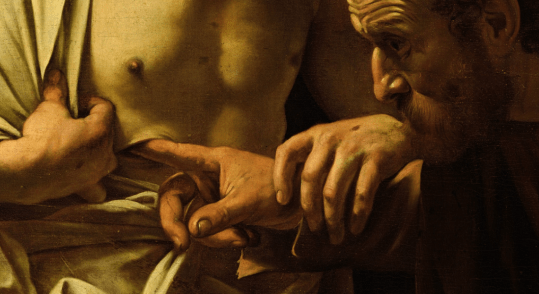 We certainly have examples in the gospels where the disciples failed to exercise the same power and authority as Jesus, to his apparent frustration. Jesus attributes their failure to their lack of faith – doubt. But, there is one story in the gospels that I find particularly astounding.
Most of the Christian world agrees that Jesus is the Savior of the world—THE Son of God. He always was, is, and will be. Yet, we find in Mark 6:4-6 an interesting phraseology found only here and in one other location. It reads,
“But Jesus said to them, ‘A prophet is not without honor except in his own country, among his own relatives, and in his own house.’ Now He could do no (dunamai—ability, poieo—to do, oudeis—nothing) mighty work there, except that He laid His hands on a few sick people and healed them. And He marveled because of their unbelief.”
It is saying that, Jesus on earth, at that moment as Son of Man/Son of God, had the ability to do nothing or was unable or powerless to do the mighty works he was normally able to do. Why? Because the people in his home town were offended that Jesus was acting in ways that were beyond who they believed he was—at worst an illegitimate child or at best merely a carpenter’s son. They knew his background and understood that he had no real religious pedigree.
- D. Pentecost writes of Jesus’s family’s unbelief, “The unbelief that characterized Nazareth where Jesus grew up had permeated the home in which Jesus grew up; thus John noted, ‘His own brothers did not believe in him’ (John 7: 5).”
Jesus’s own brothers did not believe in him and lacked faith in him. This seemed to limit Jesus in his exercise of the Father’s powers. Is it possible that this lack of faith in him, for this moment caused a limiting doubt in himself? Ouch! Is that possible?
Now, I’m certain that many Christians will have an immediate negative reaction to the idea that Jesus had doubts. After all, doubt is a sin, isn’t it? God certainly does not doubt himself. So, Jesus as God would not doubt himself. But, what of Jesus, the man? If we have honest doubts and questions that cause us to cry out to God for honest answers, does that mean we have transgressed into sin?
Whether it was self doubt that limited Jesus’ ability to heal on that particular occasion or not, there are other occasions where Jesus seems to be experiencing something like doubt. Did Jesus as a man have doubts?
If Jesus, the Son of God in full human form, experienced all we experienced but was victorious in every way, couldn’t He have experienced doubt and then turned to His Heavenly Father to satisfy that doubt?
John the Baptist had doubts in Jesus but Jesus did not condemn him for his honest questions. We call out to God in our confusion and doubt seeking answers. Even in our own doubt we can be confident in God. It’s a reflection of our lack of faith and trust not on God’s lack of character and ability.
Jesus’ half-brother, James wrote about doubt saying in James 1:6-8 “But let him ask in faith, with no doubting, for he who doubts is like a wave of the sea driven and tossed by the wind. For let not that man suppose that he will receive anything from the Lord; he is a double-minded man, unstable in all his ways.”
OK, that’s clear – no room for doubting. But, just preceding these verses, James writes of asking for wisdom about the trials we endure. James is saying here to not doubt that God is big enough to give you wisdom about the trials you are enduring. Don’t expect wisdom from God if you are doubting God can provide the answers. Ain’t going to happen!
But, I do believe there is likely a spectrum of doubt that moves from an extreme category of sin, to a doubt that falls into the category of temptation, to doubt that is a healthy part of exploring our faith. James is saying, don’t let doubt drive your life. That may be on the sin end of the spectrum. But, I don’t think doubt and trust are mutually exclusive. We can have doubts but still trust in God. Can’t we?
John Ortberg in his book, Faith and Doubt, makes a great case for the critical role doubt plays in our growing faith and relationship with Jesus.
Even the infamous ‘doubter’ Thomas, loved Jesus but insisted on proof before he would believe Jesus was alive. Jesus revealed himself to Thomas and responded to Thomas’s honest doubts by saying in John 20:29 “Thomas, because you have seen Me, you have believed (or stopped doubting). Blessed are those who have not seen and yet have believed.”
For Christ-Followers that is what we cheat ourselves of when we live in a mindset of doubt – blessings of a deeper relationship with Jesus. But even our honest doubts and questions can lead us to a deeper knowledge of Him. In Mathew chapters 14 and 21 Jesus comments on doubt and lack of faith with the result that followers would not see the fullness of God if they harbored doubt.
In Matthew, there are four occasions where Jesus chastises, or perhaps critiques, the disciples about things that did not happen because of their “little faith”. The word in the Greek for little faith is Oligopistos and it is also defined as “trusting too little.” A synonym for doubt is distrust. Jesus did not condemn them for their distrust in God but taught them by highlighting what they missed by doubting in God’s power, provision and protection.
But, Did Jesus Ever Doubt?
Back to the question of whether Jesus had the capacity to doubt. I have previously argued that Jesus, while on earth in human form had chosen to empty himself of his God powers; to not be all knowing. This would require walking by faith.
What is Faith? We learn in Hebrews 11:1 “Now faith is the substance of things hoped for, the evidence of things not seen.” We also know that just a few scriptures later it says in verse 6 “But without faith it is impossible to please Him”.
If so, would that faith walk allow for the temptation of occasional doubt? When Jesus was “tempted” in the wilderness, wouldn’t Satan have to have sown some seeds of doubt in order for Jesus to have been ‘tempted’ by what Satan was offering him? As we know in Hebrews 4 it states that we do not have a High Priest who cannot sympathize with our weaknesses, but was in all points tempted as we are, yet without sin. Isn’t it a temptation that we all experience on occasion to doubt God’s provision and protection?
Why does it please God when we live by faith? Because, we are trusting in what we can’t see which involves some element of risk and uncertainty and doubt. Faith and trust, by definition involves moving forward into the unknown. Many Christians I know, including myself, when faced with significant life choices, exert faith in God but experience anxiousness and doubt about choosing the “right” path. I doubt that’s sin?
We know that Jesus experienced some level of stress as documented in Luke 12:50 – “But I have a baptism to be baptized with, and how distressed I am till it is accomplished!” In a previous Blog Post I highlighted the Greek word for distressed being Sunecho and it means feeling a constraining pressure. When we are under great pressure, doubts can work their way in. Jesus, as a man, was understandably distressed and anxious about facing the baptism of a torturous death and separation.
In Hebrews 5:7 the author also writes of Jesus’ anxious prayers saying, “who, in the days of His flesh, when He had offered up prayers and supplications, with vehement cries and tears to Him who was able to save Him from death, and was heard because of His godly fear.”
Then in Gethsemane Jesus poses a very reasonable and a very human question (I’ve asked the same question in far less high-stakes and anxiety-riddled situations) when he asks, “Father, isn’t there another way?” It obviously wasn’t a sin for Jesus to ask. I can’t help but sense the doubt in the midst of Jesus faithfully following through with His Father’s plan.
Theologian Lesslie Newbigin highlights the doubt of Jesus when he writes “Doubt is useful for a while…. If Christ spent an anguished night in prayer, if he burst out from the cross, ‘My God, my God, why have you forsaken me?’ then surely we are permitted doubt.” Lesslie Newbigin, Proper Confidence (Grand Rapids: Eerdmans, 1995), 23–24.
What I do seriously doubt is that Jesus lived his life riddled or consumed with doubt. I know with certainty, when I read the Gospels, the old testament prophesies concerning Jesus and the New Testament writings about Jesus, that his life is the embodiment of the Fruit of the Spirit. That is the core of His character.
In James 1:14-15 James makes the distinction between temptation and sin, “But each one is tempted when he is drawn away by his own desires and enticed. Then, when desire has conceived, it gives birth to sin; and sin, when it is full-grown, brings forth death.” It seems to me that doubt is one of those things that can itself be a temptation but then can “draw us away” into sin.
My wife and I recently experienced a very painful loss. It rocked our world. The temptation had a name and it was doubt – doubt in God’s goodness and to be angry at God for letting it happen. I was so blessed to watch, through my own anger, as my wife chose to draw near to God, rejecting the desire to pull away and abandon Him. Her doubt never rose to the level of sin.
Doubt can raise itself to the level of a character flaw or even sin in some people, but that is certainly not what we see in Jesus. If Jesus did experience the temptation of doubt, then he was perfectly victorious over it and now sits in perfection at the right hand of the Father.
This is what I see – the life of Jesus, a man empowered by the Holy Spirit, led by the Father, walking by faith, fighting through any doubt to perfectly accomplish the Father’s will. What an amazing example for His followers!
Because Jesus knows all too well the temptations we face, Harvard Chaplain Jeremy M. Mullen writes, “In Matthew 11:27-30 Jesus offers an invitation to those who doubt – who doubt in good faith – Jesus simply gives himself. If we’re weary, we may rest in him. If we’re burdened by the weight of our failings, he may trust in him. Everyone has doubts and questions. Jesus doesn’t begin by offering answers, instead he offers himself. Some answers will come, some questions might linger for some time; but what is always available to anyone who would come is the love of Christ!”
His amazing love is always there, even when we struggle through doubt!
 Tucked In and Lamps Burning
well done Dave, and just deep and wide enough to keep praying when circumstances stay the same and we wonder why God us not working at our pace, but His pace. Alan
>
LikeLike
Thanks Alan. Agreed. God is blessed when we trust that His timing and ways are perfect.
LikeLike
Very nicely done! The thing that makes me consider that Jesus was tempted by doubt is the fact that during his time of testing at the onset of his ministry, Satan said to him, “If you are the Son of God.,,.” Satan himself KNEW that Jesus was God’s son! Obviously, this was an attempt to make Jesus question Himself.
LikeLike