Happy New Year 2019 – For God’s Sake!
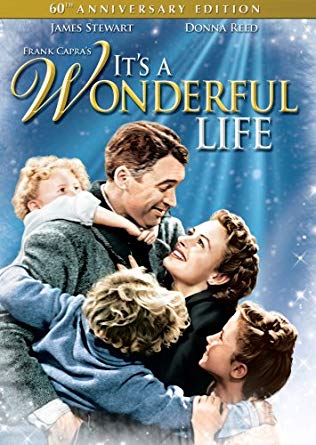 If I haven’t sung Auld Lang Syne every year, just about every year I’ve heard it as the ending to the movie, It’s A Wonderful Life.
I’ll assume that I’m not the only one in the world who has not understood the song’s meaning. Not being a real Scotsman, I had been ignorant about the song we’ve sung at the passing from the old into the new year. I had always assumed that it was an ode to some memorable Scottish figure that represented good friendship.
What I found is that it was the writer, Robert Burns who is recognized as the first to write down the ancient song ‘Auld Lang Syne’ in the year 1788.
The phrase ‘auld lang syne’ roughly translates as ‘for old times’ sake’. It is all about preserving old friendships and looking back over the events of the year.
The old Scottish tradition is to sing the song just before midnight. Everyone stands in a circle holding hands, then at the beginning of the final verse (‘And there’s a hand my trusty friend’) they cross their arms across their bodies so that their left hand is holding the hand of the person on their right, and their right hand holds that of the person on their left. When the song ends, everyone rushes to the middle for a big group hug.
This is the Original (shortened) Version (Mimicking Scottish Brogue)
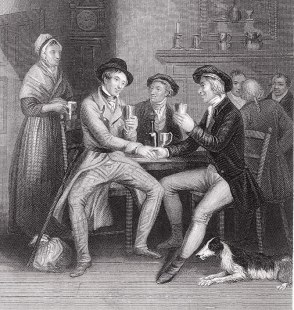 Shid ald akwentans bee firgot,
- an nivir brocht ti mynd?
- Shid ald akwentans bee firgot,
- an ald lang syn?
- CHORUS:
- Fir ald lang syn, ma jo,
- fir ald lang syn,
- wil tak a cup o kyndnes yet,
- fir ald lang syn.
- An sheerly yil bee yur pynt-staup!
- an sheerly al bee myn!
- An will tak a cup o kyndnes yet,
- fir ald lang syn.
- CHORUS
- We twa hay rin aboot the braes,
- an pood the gowans fyn;
- Bit weev wandert monae a weery fet,
- sin ald lang syn.
- CHORUS
- We twa hay pedilt in the burn,
- fray mornin sun til dyn;
- But seas between us bred hay roard
- sin ald lang syn.
- CHORUS
- An thers a han, my trustee feer!
- an gees a han o thyn!
- And we’ll tak a richt gude-willie-waucht,
- fir ald lang syn.
- CHORUS
In Modern English
- Should old acquaintance be forgot,
- and never brought to mind?
- Should old acquaintance be forgot,
- and old lang syne?
- CHORUS:
- For auld lang syne, my dear,
- for auld lang syne,
- we’ll take a cup of kindness yet,
- for auld lang syne.
- And surely you’ll buy your pint cup!
- and surely I’ll buy mine!
- And we’ll take a cup o’ kindness yet,
- for auld lang syne.
- CHORUS
- We two have run about the slopes,
- and picked the daisies fine;
- But we’ve wandered many a weary foot,
- since auld lang syne.
- CHORUS
- We two have paddled in the stream,
- from morning sun till dine;
- But seas between us broad have roared
- since auld lang syne.
- CHORUS
- And there’s a hand my trusty friend!
- And give me a hand o’ thine!
- And we’ll take a right good-will draught,
- for auld lang syne.
- CHORUS
I love his song and what it represents. The song is intended to evoke a sense of belonging and fellowship, tinged with nostalgia. It certainly does that for me. It strikes me as a good celebration for a church body – fellowshipping to celebrate the past year together.
The question is “for who’s sake?” In the song, it’s for “old time’s sake” – the things we’ve shared together in the past we celebrate.
Should it be ‘for old times’ sake?’ It’s great to celebrate the past together but not at the expense of the promise for the future. For me, the imagery is much like from my last blog post, suggesting we hoist a ‘pint’ to celebrate the past because the future can never be as good as the past.
Yet, what I glean from the Bible is to not get stuck in the past, even for the great things God has done through us and for us. He promises even greater things in the future. In Isaiah 42:9 God declares, “Behold, the former things have come to pass, And new things I declare; Before they spring forth I tell you of them.” (Even promising to tell us about it before He does it. Are we listening?)
God isn’t dwelling on the past. He goes on to say in verse 19, “Behold, I will do a new thing, Now it shall spring forth; Shall you not know it? I will even make a road in the wilderness And rivers in the desert.”
Again in Isaiah 48:6 he promises to give us a vision of what He has in store, “You have heard; See all this. And will you not declare it? I have made you hear new things from this time, Even hidden things, and you did not know them.”
Back to the question of, “For whose sake” do we celebrate?
The Greek word most often translated as “Sake” is Heneka. At its core, it is about doing something for a “cause”, for a “purpose”.
From a Christian’s standpoint, it is still a celebration of the closest of friends – Jesus’s “cause” is about restoring a right relationship with God for all people – for our sake. And now we extend that relationship to the world for every individual’s sake and, most importantly, for His sake.
This circular cause/purpose is reflected throughout scripture but highlighted in Psalm 23:3 – “He restores my soul; He leads me in the paths of righteousness for His name’s sake.” His restoration of our lives is not only for our sake but primarily for His sake – so that we and He may enjoy relationship together.
Why, primarily for God’s sake? because, He is our creator and while we have rebelled and walked away from him, it’s all His work to draw us back into the relationship God intended. It’s all on His effort and His strength and His loving persuit. He therefore deserves for it to be for His sake.
So, at the stroke of midnight we ‘hoist a pint’ together – to celebrate what we’ve shared (the good, bad and ugly of life) this past year. For His blessings and sustenance. But, even more so, to celebrate His vision of what He promises to be even better for us in the next year – for as much as we draw closer to Him.
Hebrews 12:22 says to those who trust Christ, “You have come to Mount Zion and to the city of the living God, the heavenly Jerusalem, and to innumerable angels in festal gathering and to the assembly of the first born, who are enrolled in heaven.”
Given that our God has been referred to as “The God of Zion” I will beg our dear Scotsmen friends for their indulgence, as I try not to butcher the old classic with a not-so-slight revision to the end of Auld Lang Syne:
- And there’s a hand my trusty friend!
- And give me a hand o’ thine!
- And we’ll take a right good-will draught,
- for our good God of Zion
- Chorus:
- For our ‘good God of Zion’, my dear,
- for our ‘good God of Zion’,
- we’ll take a cup of kindness yet,
- from our ‘good God of Zion’.
A very Happy New Year to you all and more so I pray for your sake what the Psalmist wrote in Psalm 122:8
“For the sake of my brethren and companions, I will now say, “Peace be within you.”
for all of 2019 and beyond!
 Tucked In and Lamps Burning
Well done, and a happy new year to you and family.
>
LikeLike
Thanks Alan. Really appreciate your encouragement. Happy New Year to the Dodds.
God bless you guys for all you allow God to do through you.
LikeLike