But He said to them, “Where is your faith?” – Luke 8:25
I’m a Believer! A Christ-follower. I know in the core of my being that Jesus was true to all he said he was and to all he said he would do. The evidence is overwhelming that he lived, died, rose from the dead and ascended back into heaven. He is alive. I continue to grow in the knowledge of Jesus by going deeper into his word and responding to his voice.
So, Why So Much Unbelief?
As a follower of Jesus, my relationship compels me to, by faith, follow His leading – listen for his voice and act on his directives. Yet, I often don’t trust enough to act on my faith. I have more than enough experience to believe he is trustworthy and true, but I fail to act. Why?
James addresses this issue in James 2:26 saying, “For as the body without the spirit is dead, so faith without works is dead also.”
I sometimes think that if I could only experience relationship with Jesus in the flesh as the original Apostles did, that I would never fail. Yet, we find on a number of occasions in the Gospels where Jesus directly addressed the disciple’s unbelief. Let’s take a look at 2 episodes.
In Matthew 17 a man brings his epileptic son to the disciples for healing. They fail but Jesus steps in and declares in verse 17, “O faithless and perverse generation, how long shall I be with you? How long shall I bear with you? Bring him here to Me.”
Ouch! Jesus seems to be declaring his disciples as complete and utter failures. I think I hear his frustration and disappointment, Really? How long must I put up with your faithless incompetence? He must be questioning whether he picked the right dudes to follow him.
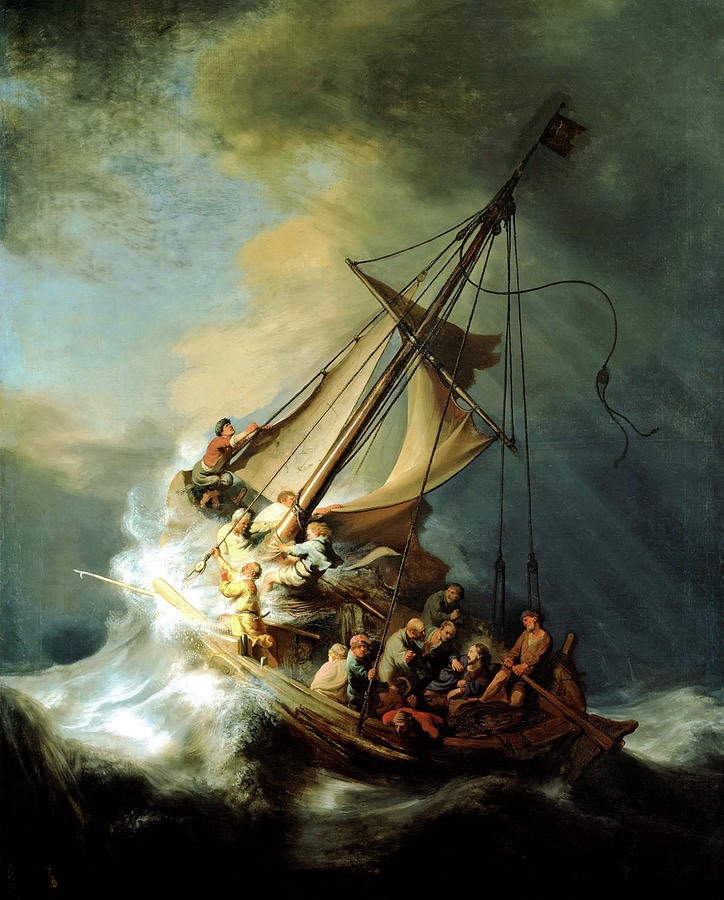
Then in Luke 8 we have another example of the disciples spiritual ineptitude. The disciples are directed to cross the sea while Jesus naps in the back of the boat. A great storm arises and the disciples do all they can to rescue themselves. Finally, they cry out to Jesus and say they are Apollumi – drowning or perishing. Jesus gets up bleary-eyed, shaking his head. He waves his hand at the storm and basically says, “Stop already.” And the storm immediately stops. Jesus then turns to his disciples with what sounds like a tinge of disgust saying, “Where is your faith?” before laying back down.
Ouch! Once again you can hear the irritation and disappointment. How many times have I heard this echo in my head when my faith has proven to be so weak? I declare myself to be a follower of Jesus. I am a believer who has been provided mountains of evidence of God demonstrating His reality – His goodness, righteousness and truth. When I fail to move out and act in faith on his direction He must be so disgusted with me. What a useless fraud!
That’s certainly how I might be tempted to respond to the disciple’s failure. But, if we test all of Jesus’ words against Galatians 5:22-23’s Fruit of the Spirit (love, joy, peace, patience, kindness, goodness, faithfulness, gentleness, self-control), and believe that Jesus words and actions were always a perfect expression of that Fruit then I get a different take on Jesus’ actions.
Let’s take a closer look at what I believe Jesus is saying in each of these two episodes.
Matthew 17 – The Disciples Fail to Heal
If it is true that Jesus only spoke words consistent with the Fruit of the Spirit, then these statements were not words of condemnation but words of truth and instruction. My take on Jesus addressing His disciples for failing to heal the boy, is that he is speaking not to their failure but to a “generation” of spiritual legalism that had distorted who God is resulting in a dependance on man’s abilities and a passivity with regards to trusting in God’s supernatural power. This is the spiritual culture the disciples had been enveloped in for their entire lives and were struggling to break free from.
Then Jesus reminded the disciples that he, as their Rabbi, would not always be there to model a man relying on the guidance of the Father and the power of the Holy Spirit. He was there not to do it all for them but to model what they themselves could do. Jesus stepped up, once again, to show them how to do it. What did Jesus do? He somehow knew it was not the illness of Epilepsy or being “Moon-struck” but there was a demon torturing this boy. He rebuked the demon and the boy was immediately healed.
To the disciple’s credit, they came to Jesus privately and asked him, “Why could we not cast it out?” In verse 20 Jesus replies, “Because of your unbelief; for assuredly, I say to you, if you have faith as a mustard seed, you will say to this mountain, ‘Move from here to there,’ and it will move; and nothing will be impossible for you.” Jesus as their Rabbi, compassionately tells them that their faith is still very small but it if they persist it will grow rapidly into something very big as they continue to step out in faith.
Then Jesus leaned in and added to his teaching saying in verse 21, “However, this kind does not go out except by prayer and fasting.”
Whoa! What!?
If I were one of the disciples, I’d be a little annoyed, Well thanks a lot Jesus for that little tidbit. It would have been nice if you had shared that before we prayed for healing! But then I’d be a bit confused, Wait? I didn’t see you stopping to pray and fast before you immediately healed the boy. When did all that happen?
My take on verse 21 is this: Jesus had a habit of meeting daily with the Father in the early morning hours. In that time of engaging with the Father, He would prepare Jesus for the day ahead – giving Jesus the words to say and showing him what to do. But, what was the fasting? I’m guessing it was Jesus willingness to give up (fast) his sleep time to be with the Father – Prayer and Fasting. This was Jesus teaching that to operate more fully in the Spirit you must consider prioritizing spending more time with the Father.
Luke 8 – The Disciples Come to Jesus to Calm the Storm
In this episode, we find Jesus reclined in the back of the boat while a wild storm arises and the disciples struggle mightily to save themselves. Finally, they come to Jesus for help. Jesus seems annoyed. But why? Isn’t the what we are supposed to do? When we realize we are at the end of our own strength, we turn to Jesus?
Firstly, the Greek word translated as “awaken”, may not actually mean that the disciples woke Jesus up but caused him to rise up. While Jesus was surely asleep at one point, it’s reasonable to presume that he was awakened by such a great storm. In the depiction of this episode in Mark 4, the disciples actually challenge Jesus asking, “don’t you care if we drown?” indicating Jesus was already awake but stayed reclined. So, I envision Jesus merely lying there watching the disciples as they struggled, wondering, When will they cry out to God the Father?
Jesus, as their Rabbi, was holding off intervening, giving them independence to do what Jesus had taught them to do. They did not need to come to him but could cry out to the Father directly for His power to stop the wind and waves.

Where is Your Faith?
Was Jesus being demeaning when he asked the disciples, “Where is your faith?” in Verse 25?
I don’t believe Jesus was chastising the disciples. I believe he was still instructing and challenging the disciples. He simply asked, “Where about is your faith?” The Greek adverb translated as ‘Where’ is Pou – and the original meaning has to do with estimating something – ‘somewhere about’. (When asked to guess the number of Jellybeans in the jar, you respond with, “Hmmm? Somewhere about 250”)
Jesus seems to be asking the disciples to consider “Along the continuum of faith, where about is your faith?” or “Where would you estimate your faith to be?” (from “no” faith to “my” faith) Where is your faith? He is not deriding them for their lack of faith but asking them to consider where they are with their faith.
So Why Such Little Faith or Unbelief?
Firstly, the original disciples grew in their faith. We see Jesus teaching and sending them out but it wasn’t until Jesus rose from the dead and ascended that we see them filled with the Holy Spirit and move with the power and authority of Jesus’ ministry.
So, what is our tipping point for us to move out in greater faith and belief? I believe it comes from moving out on God’s word – knowing His voice, listening and acting on His word. As Christians, we often draw a line in the sand and say this is as far as I want to go in my faith. Yet, God stands on the other side lovingly beckoning us to step over the line. He loves us right where we are but is a rewarder of those who step out further in faith. The greater steps of faith we are willing to take being motivated by His love, the more God will show up and respond to our faith. (Hebrews 11:6)
Just as James declared that faith without works is dead, the prophet Ezekiel warned of the people hearing God but not doing. Ezekiel 33:31 says, “So they come to you as people do, they sit before you as My people, and they hear your words, but they do not do them; for with their mouth they show much love, but their hearts pursue their own gain.”
Going back to James 2, James gives several examples of hearing God and the resulting action/works as evidence of our faith:
- The first is James describing how we respond to a person who is destitute. We don’t just send them off with warm wishes, we meet their need. How do we know that? We act on God’s Logos. His written word that is embraced in our heart. We don’t need to hear the voice of God commanding us. It is a truth we know of God’s character and desire for our behavior.
- The second, example was Abraham offering Isaac his son on the altar. Here is an example of God’s Rhema, His word spoken to our spirit that directed Abraham in a specific way. Based upon Abraham’s knowing God – His voice and trustworty, loving character, he stepped out in faith to do the unthinkable. By this James says faith was working together with works, and by works faith was made perfect.
As I see it, it all starts with a desire to draw deeper into relationship with God to know his word, hear his voice and see Him work more powerfully through us. (James 4:8)
One last thought: One of the things that restricts our stepping out more courageously in faith, is being connected with a fellowship and culture that does not encourage bold action and expectancy for God to move more supernaturally. That doesn’t mean God is not at work in churches that don’t. But, it may just be today’s version of the faithless (passive) and perverse (distorting) generation that Jesus cried out against for inhibiting people’s faith in the true power of God.
So, let us encourage one another in greater faith-led action and expectancy of who God is and what God can do through us! For God’s glory, for others to be impacted by the power of God and for all of our mutual joy.
 Tucked In and Lamps Burning
Great as usual, Dave. I fully agree with your take. In Luke 8, my take has been that Jesus was in the boat. If his disciples believed that he was the Son of God, would they think that God would allow the boat to sink with his son in it? Come on Guys, where is your faith?
Pete
LikeLike
Love your insight Dave! We incorrectly read Jesus’ question “Where is your faith?” with the condescension and critical spirit a question like this often has — but is in no way consistent with Jesus’ heart of grace and compassion. Just another case of how we read into how we would respond in this situation! I continue to pray that I would be willing to take more risks to demonstrate the love and power of God…moving from asking myself the question “But what if God doesn’t show up?” to expectantly wondering “What if He does?”
“Jesus, I believe…help my unbelief!”
Dan
LikeLike
Thanks Dan. Totally agree. Miss you guys. Hope all is well and that we can catch up sometime. Continued blessings!
LikeLike